The photos on this site, except for the
obviously historical photos and where indicated, are my exclusive property and were
photographed by me, except where otherwise noted. This site is
not-for-profit and is for educational purposes. I am happy to
share my photos and have no objection to your personal use.
However, if you wish to use my photos for advertising and/or
profit-making purposes, I do ask that you contact me for permission.
I've never rejected such requests, nor have I ever insisted on
remuneration for such use, and rarely have ever even requested a photo
credit, but I do not take kindly to unauthorized use of my photos for
advertising or profit without my permission. Thank you.
--Owner & webmaster of this site.
Tampapix.com
is proud to team up with the
Tampa Natives
group site on Facebook to
bring you a list of photos & discussion topics located
on that site. See over 1000 photos and over
340 discussion topics posted by members, listed on this
searchable index! The index provides easy and direct
link access to each photo and discussion topic, as well
as the photo caption and comments posted by group
members. To view the photos and topic discussions,
you must be logged in to Facebook, but you do not need
to be a member of the group to view the photos. Tampa Natives Photo and
Discussion Index at Tampapix
NEW!
Two photos have been added to Maas Brothers History at
Tampapix. A family portrait of Henrietta Maas Waterman,
sister of Abe & Isaac Maas, which shows her husband and
children, including son Jerome Waterman. Also a photo of
Jerome in 1965.
Solomon
and Jacob Maas came to the US from Germany in 1870 and opened
a general store in Cochran, Georgia. They were soon
joined by brothers Abraham, Isaac and Julius in the business. In the 1880s, the brothers
went their own ways. Abe came to Tampa and opened his
dry goods Palace on Franklin St. in 1886. He was soon
joined by Isaac, and together they became "Maas Brothers".
See Maas
Brothers History
The
final battle for Fort Brooke lasted over 20 years, but it was not fought
with cannon, gun or sword. It was fought with mightier weapons--the
pen, the word, capital and the law. When Tampa found out that the
military was about to abandon Fort Brooke, in late 1882 many
Tampans desired that this land should not be developed for
commerce or industry, but instead set aside as a public park
for its great natural beauty. Read about the plan that
Tampa citizens came up with to gain title to the land, and the
legal battles that ensued. Learn about the players, the
plan, the fort and the land, and see many photos related to
the fort, including two cannons from the fort placed in Plant
Park, here at Tampapix.
DID YOU KNOW?
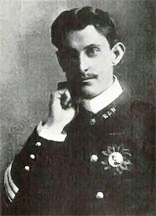
Francis J. Bellamy, author of the Pledge of Allegiance to the Flag
in 1892, lived in Tampa from 1922 until his death in 1931.
The 1930 census of Tampa shows Francis and 2nd wife Marie Bellamy
living at 2926 Wallcraft Ave. His occupation was "Advertising
Manager, Public Utilities."
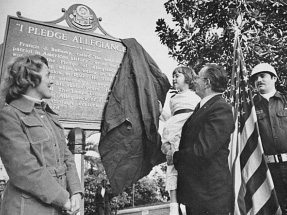
Unveiling the marker from the Tampa Historical
Society that honors Francis Bellamy. Six year old Colleen Griffin
unveils the plaque at Curtis Hixon Convention Center on Nov. 21,
1974. She’s held up by Hampton Dunn, past president of the Tampa
Historical Society, as County Commissioner Betty Castor, who gave
dedicatory address, and MacDill Air Force Base color guard look on.
Francis Julius Bellamy (May 18,
1855 – August 28, 1931) was an author, editor, and publicity
director born in Mount Morris, New York in 1855. He attended Rome
Free Academy in Rome, NY, the University of Rochester (1872–1876)
and the Rochester Theological Seminary (1876–1880). He was an
American Baptist minister who wrote the original Pledge of
Allegiance in 1892. It was published in the Youth's Companion, which
was a nationally circulated magazine for adolescents, and by 1892
was the largest publication of any type in the United States, with a
circulation around 500,000.
Including his years at previous
journalism jobs, Bellamy had spent nineteen years in advertising in
New York City. He had played a part in the development of the
advertising industry from its infancy to a fabulous world of
signboards, neon lights, double page color ads, and the beginnings
of radio commercials. The "Madison Avenue" advertising world had
arrived in New York City with his blessing and help.
Bellamy believed in high pressure advertising but believed it still
could be truthful advertising. He believed that advertising should
create the demand for the increasing output of American industry. He
saw selling as very important to business and saw advertising copy
as his specialty.
In 1922 he decided to leave New
York City for the remainder of his life in Tampa, with his second
wife, Marie. His first wife, Harriet Bellamy, had died in 1918. In
1920 he had married Mrs. Marie Morin, who had been a successful
business woman in the women's hat business in New York City.
In 1926 Francis Bellamy began working part time as the advertising
manager for the Tampa Electric Company after he convinced the
management that the company needed systematic publicity and
advertising that he could develop. On July 15,1931, he was fired
from this part time job at the Tampa Electric Company and on the
same day he applied for and received a similar job with the Tampa
Gas Company. He died on August 28, 1931, in Tampa, Florida, at the
age of seventy-six.
The Pledge of Allegiance, which is inscribed on his tombstone in
Rome Cemetery, Rome, NY, was originally "I pledge allegiance to my
Flag and the Republic for which it stands, one nation indivisible,
with liberty and justice for all." It has been modified four
times.
WHAT'S
IN A NAME?
Read about the individuals whose lives influenced the naming of
Tampa's thoroughfares, and learn the reason why some places are
named as they are.
NEW!
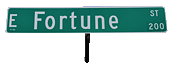
- The name
of Fortune Street downtown conjures up images of boom-time
prosperity, with business owners making a fortune in profits, but
this isn't why this street and the bridge, now named the Laurel
Street bridge, were named. See the newly updated feature
about Fortune Street and the bridge, with new photos, scenes from
the 2004 film "The Punisher" shot on this bridge, and more,
here at Tampapix.
Also, "The
Gandy Bridge, First to Span Tampa Bay" has been updated
with newspaper clippings and narrative concerning Gandy's Island,
information about the tolls including actual toll receipts from
1942, and the story behind the streetcar tracks that ran down the
center of the bridge from it's opening in 1924 to 1947.
Don't miss the incredible 2-page newspaper promotion by the Old
Tampa Bay Navigation & Construction Company, describing the entire
construction site, along with promoter Eugene Elliott's
archaeological extravaganza, Weedon Island, as the ultimate
tourist attraction.
Read about Tampa in 1886 from "Webb's
1886 Tampa City Directory" and see the street listings
DID YOU KNOW?
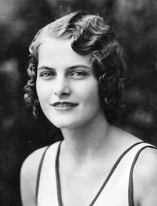
Miss Tampa of 1930 became Miss Florida and went on to become
"Miss America". Margaret "Mickey" Ekdahl was more than a
pretty face; she came to America from Sweden as an infant and
eventually went on to compete in the Miss Universe pageant in
Rio de Janeiro. But her Miss America title in the midst
of the Great Depression was not achieved without controversy.
Read about Mickey Ekdahl
--Tampa's Miss America--her rise to fame, and her shocking
decision in the midst of her success. See photos of
Mickey, her 1930 Census in Tampa, and newspaper clippings
detailing her life and tragic death.
DID YOU KNOW?
Before the
Florida State Fair was located at its present location at
US-301 and I-4, but after it had moved from the old
fairgrounds at North Blvd. and Cass St., it was held at an
interim location until the present grounds were ready.
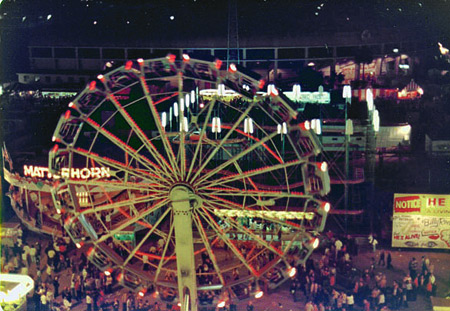
That location was the parking area of Tampa Stadium, 1976.
Area for the midway increased from 3 acres to over 10 acres,
but space for the exhibits was severely curtailed and limited
to the area under the east stands. The interim location
also resulted in no sprint car races that year.
Above left:
The full moon over the midway of the Florida State Fair, Feb.
1976, viewed from across Himes Ave. at Ivy Street.
Above right: Al Lopez Field stadium in the background.
Opened
in August of 1976, the Tampa Bay Center mall was Tampa's
unique shopping experience. With its interior bathed in
sunlight, a glass elevator and teeming with live trees, it was
Tampa's first 2-level mall. Read about the rise and fall
of Tampa Bay Center, see photos and video, NEW at Tampapix!
Tampa
Bay Center Mall
NEW
at Tampapix--Three video excerpts from Pete and Paul
Guzzo's documentary on Tampa crime figure Charlie Wall have
been added to the sights and
sounds of Tampa in the 1940s!
See these videos at the
bottom of
this page.
Read about Tampa from the
onset of the Great Depression in 1929, through the 1930s,
Tampa's recovery and involvement in World War II through the
1940s, Tampa's Hollywood actress Mary Hatcher, Warner
Bros. filming of their movie "Air Force" at Drew Field,
and a page you just can't refuse...the darker side of
Tampa--from the Prohibition years to organized crime of the
1940s.
Turn on your speakers and get ready to swing!
All at Tampa
in the 1940s
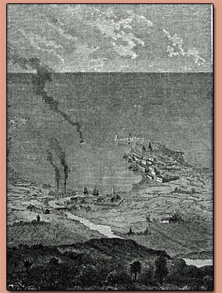
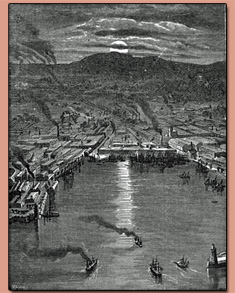
Verne's
illustration on p.66 shows Tampa town "previous to the
undertaking."
Verne's illustration from page 83 shows "Tampa town
after the undertaking." A veritable boom-town.
Except for the mountains, he pretty much nailed it.
DID YOU KNOW?
Tampa
is mentioned in science-fiction writer Jules Verne's book,
"From the Earth to the Moon." Published in 1865, a
portion reads:
Previous to the
undertaking: "After coasting along a series of creeks
abounding in lobsters and oysters, the "Tampico" entered the
bay of Espiritu Santo where she finally anchored at a small,
natural harbour, formed by the embouchure of the river
Hillsborough..." "Barbicane has scarcely set foot on
shore when three thousand of the inhabitants of Tampa town
came forth to meet him..." "Declining ovation, he
ensconced himself in a room of the Franklin Hotel."
Read more
"The Frenchman and two Americans entered the enclosure
reserved in the center of the multitude...Ten o’clock
struck. The moment had arrived for taking their places in
the projectile...thirty-eight, thirty-nine, forty!!!
Instantly, Murchison pressed the key...An appalling,
unearthly report followed...An immense spout of fire shot up
from the bowels of the earth…The earth heaved
up...spectators obtained a momentary glimpse of the
projectile cleaving the air in the midst of fiery
vapors...The glare of the flames lit up the whole of
Florida..."
After the
undertaking: "After the 23rd
of September, the enclosure of Stones Hill was thrown open
to the public, and it will be easily imagined what was the
concourse of visitors to this spot. There was an
incessant flow of people to and from Tampa Town, and the
place, which resembled a procession, or rather, in fact, a
pilgrimmage."
Read more
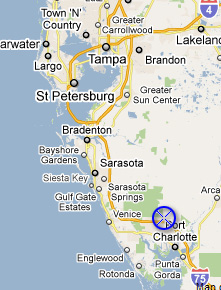
Verne describes
the exact launch location as "Stones Hill", at latitude 27
deg, 7 min north, longitude 5 deg, 7 west of the Washington
(DC) meridian, which would make it longitude 82 deg, 9 min W.
"Barbicane
wrote down the result of his observations.." "On that
plain will be raised our magazines, workshops...and here, from
this very spot, hence shall our projectile take its flight
into the regions of the Solar World!"
This location is
not too near Tampa, see blue circle on map. He also
describes it at 1800 feet above sea level, an elevation not
found in Florida. But keep in mind, this was written in
1865, and it was fiction.
A hundred years after the
prophetic author who never left France wrote those lines, U.S.
space projects were being launched regularly from Florida, not
too far away from what Verne called "Tampa Town." There
were many curious parallels between his story and the actual
moon shots of today.
Jules Verne is not a prophet
without honor in Tampa Town. An official marker at the
approach of the Ballast Point Pier tells of the park at this
scenic point being named Jules Verne Park in honor of the
French writer who did so much to publicize Tampa.
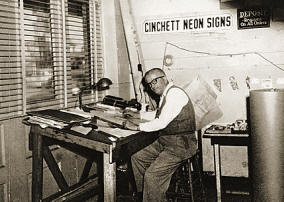
The
Cinchett Neon Sign company operated in Tampa for 50
years. New at Tampapix--Read about Frank & John F. Cinchett's legacy in Tampa and see 2
newly discovered photos of John F. Cinchett's last neon sign which is still around today.
NEW:
See an
amazing video showing color footage shot by Frank Cinchett,
showing dozens of their signs in action at night!
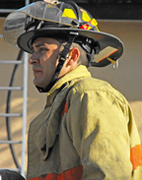
TAMPA'S
BRAVEST
tampasbravest.com is dedicated to the men and
women who place their lives on the line everyday for the City
of Tampa and its citizens. This unofficial website is intended
to provide information about the history of the City of Tampa
Fire Department including pictures and information of
apparatus and stations, past and present.
Tampa
in the 1950s, in LIVING COLOR
with the sounds of the 50s!
See some beautiful color
photos of Tampa scenes in the mid to late 1950s, scanned
from color slides. Scenes include Franklin Street ablaze
in neon, two night views of Ayres
Diner in Seminole Heights, the US Navy submarine SS Spikefish
on display at the Port of Tampa, the SS Ybor sailing down Ybor
Channel, the Gandy Bridge, and Fairyland at Lowry Park.
All photos courtesy of Tampa native Yvonne Colado.
What
does U.S. Army Brigadier General William H. Bisbee have to do
with legendary pirate José Gaspar? They both had a
three-masted schooner named after them, in fact, the same
ship.
The schooner William
Bisbee was built in 1902 in Maine, and after over 30 years of
service as a cargo ship in the Atlantic, she was sold in 1936
to a Tampa freight broker in the interest of the Gasparilla
Festival.
Read about the José Gaspar's previous
life as the William
Bisbee, and see images of the Bisbee, and a beautiful photo of
her as she sailed up the Hillsborough River in 1938.
Attention
Tampapix visitors:
Your assistance is
requested in identifying the students in a photo of the Helen
Hill School kindergarten class, taken May 31, 1951.
See the full size photo
here
or click on the photo at right.
Did you know?
Fernando Figueredo was a
hero of Cuba's Ten Years' War, a Florida State
Representative and leader of the Cuban Revolutionary
Party BEFORE becoming the first mayor of West Tampa in
1895.
Figueredo was married
THREE times, each time to the same woman, and is
honored on 3 postage stamps.
The order to start the
revolution in Cuba against Spain in 1895 was hidden in
a cigar made in West Tampa, carried on the H.B. Plant
steamer "Mascotte" to Key West, and from there
smuggled in to Cuba and the leaders of the revolution
by the hands and mouth of no less than 3 different
men.
The O'Halloran Bros.
cigar factory sat in a square right in the middle of
present-day Howard Avenue between Main St. and Union
St. in 1895.
In the 1940s,
Ybor City's Cuscaden Park was THE place to go on a
Sunday afternoon or Thursday evening to catch a baseball
game between teams of the Inter-Social league. The
result of one of Roosevelt's WPA projects in Tampa,
Cuscaden was home field for many baseball players from
Tampa who went on to the major leagues. For many
West Tampa and Ybor City youths, the public pool at
Cuscaden was where they first learned to swim.
Boxing on Florida's west coast had its revival at the
Cuscaden boxing arena in the 40s. The park was the
focus of athletic social interaction during the war
years, and served as a respite from the solemn news that
WW2 brought to the forefront in those days.
TAMPA CHANGING!
Tampa has come a long way in 100 years, and Tampa Native
Bryan Weinstein has a creative
and interesting method of sharing this fact. Bryan has
created a website using "Re-photography."
On his site, he has
exhibited various sights of Tampa. Each location has two
photographs, a historical photograph, taken up to one hundred
years ago, and the re-photograph, taken within the last couple
of years. Bryan uses a slideshow blend effect so that the old
photo morphs into the recent photo. He has so exactly
captured the scenes from the same vantage point, it's like
instant time travel. Bryan brings to mind how much Tampa
has changed and how much has stayed the same. Visit
Bryan's site at
TampaChanging.
Bryan seeks assistance by way of support and re-photography of
your own to display on his site!
Did
You Know? Tampa's international airport had its
beginnings at Drew Field. In the 1920s, a dreary
damp marshy land with stretches of sand covered over
with a sparse growth of palmetto scrub was purchased
from John H. Drew by the city as an air field.The Federal government turned it into a military base
in 1941.
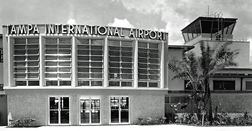
In
1946 it became the site of Tampa's municipal airport and
in 1950, Tampa International Airport. Then in
1952, a brand new terminal was built on the south side
of the east-west runway.
Read about the history
of Drew Field and Tampa's first airport, along with
wartime images of Drew Field's weekly newspaper, "Drew
Field Echoes". See the very first issue, the 1-year
anniversary issue, and rarely seen photos from the
Christmas 1942 issue featuring photo montages of war-era
Tampa, life at Drew and MacDill Fields, including
commanding officers, and the top brass of the 3rd Air
Force Headquarters. Also photos of Tampa's
gleaming new international airport terminal in 1952.
JOSEPH ROBLES - The Robles are an old and important family in
the history of Tampa beginning with Joseph Robles, an
immigrant from Madrid, Spain who came to the United States in
the nineteenth century. Robles was born in 1817 and migrated
as a stowaway at the age of 15 from his native Spain. He is
said to have jumped ship in 1832 in Georgia and headed to
Florida after marrying in Georgia. Read about the Robles and see original land
surveys of Tampa that show where the Robles properties were
located. If you work in downtown Tampa, chances are you
drive through it every day.
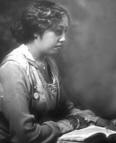
Blanche
Armwood was a Tampa native and the first African-American woman from
Florida to graduate from an accredited law school--Howard University.
Armwood High School in
Seffner, which opened in 1984, was named after her.
An early
20th-century Renaissance woman, Ms. Armwood steadfastly held the values of
hard work, religious morality, and judicial equality before the American
consciousness. She used diplomacy to present these ideals to the American
public. Called a "Female Booker T. Washington," Armwood served as liaison
between the black and white races. She was administrator, educator, innovator,
writer, and poet.
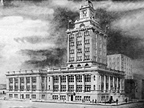
95-YEAR-OLD STILL WORKS AT TAMPA'S CITY HALL!
See interior photos added Oct. 6, 2010
Hortense
recently turned 95-years-young and yet SHE sets the pace for
City Hall's employees and downtown visitors. She
performs her job with pride, on the 10th floor where she's
worked ever since she started there in the early 1900s.
She's always punctual and doesn't plan on slowing down or
retiring any time soon!
READ
about
and see photos of "Hortense the beautiful" as she's known to
many. Also learn about the city hall building, its
history and design.
See
T-38 Talon, F-5A, C-5
Galaxy, P-40 Warhawk, P-47 Thunderbolt, B-24 Liberator, P-51
Mustang, A-7 Corsair, F-4 Phantom & F-111 Aardvark
Also,read
about the history of MacDill AFB, from before site selection
at Catfish Point through World War 2. See photos of life at MacDill Field
from WW2 era,
published in Drew Field's weekly news,
"Drew Field Echoes"
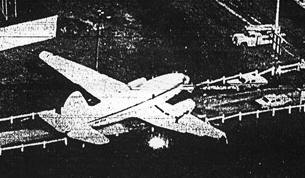
SNAKES ON A
PLANE! - Dec. 9, 1969
A NEW Photo has been
added on 9-27-2010 from "The Reading Eagle", a Pennsylvania
newspaper. On the above date,
a C-46 cargo plane made a forced landing in the parking area
of Al Lopez field. It came to rest against a utility pole,
just 500 feet from a house which was across Himes Ave.
Stories circulated amongst the locals that it carried reptiles
and that snakes escaped to roam the neighborhood until they
were rounded up. Part of this is true;read on!
B-17
"Fortress" Bomber Makes Crash Landing in West Tampa - May 19,
1944
Shortly before 7 a.m. on May 19, 1944, a four-engine
B-17 bomber crashed on Abdella Street in West Tampa just
east of Drew Field, the giant wartime base where
today's Tampa International Airport is located.
Read about the heroic efforts
of neighborhood residents to rescue the 9-man crew from the
flaming wreckage.
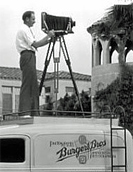
The Burgerts were a family of photographers who came to Florida late in the
nineteenth century and established a quite remarkable record in various phases
of the photography business, primarily in Florida. The Burgert brothers were
six sons and one daughter-in-law of the original photographic
progenitor of the family, Samuel Burgert. Three generations of
Burgert photographers worked productively from around the 1870s until the
1960s. The brothers
at various times took, sold or marketed supplies for hundreds of thousands of
photographic images usually requested by commercial clients, and in the
process coincidentally documented the Tampa Bay area’s development from the
little more than a scrubby port village to a major urban center of
international importance.
The Burgert Brothers at Tampapix
DID YOU KNOW?
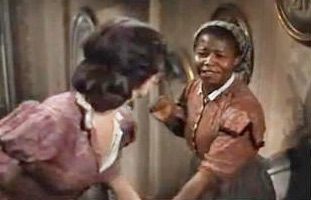
Thelma McQueen was a Tampa Native.
Better
known as Butterfly McQueen, she was an actress best known
for her role as Miss Scarlett's squeaky-voiced maid, "Prissy"
in "Gone With the Wind." Her delivery of her most memorable
line, "...We got to have a doctor, I don't
know nothin' 'bout birthin' babies," took Hollywood by storm.
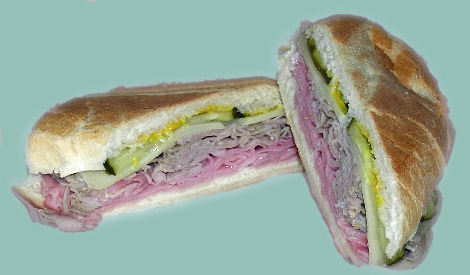
Nothing says "Tampa" like a
mouth-watering Cuban sandwich
Ask 10 people what goes
into making an exceptional Cuban Sandwich and you'll likely
get ten different responses that vary in ingredients,
preparation and appearance. The debate can get as hot as the
bread just out of the oven--not just over the ingredients, but
even on the order they're stacked, the cut and pressing.
It may depend on your interpretation of "Cuban"
--traditional as it was in Cuba, or how Tampa/Ybor City's rich
ethnic mix caused it to evolve early on. Either way,
there's not much variation in the recipe and preparation.
But it is the bread that makes or breaks a Cuban sandwich; as
with any building, the foundation is important.
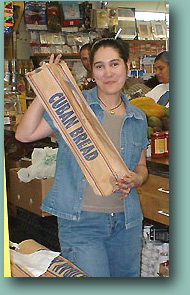
See Cuban Bread
- first baked in Ybor City's "La Joven Francesca" bakery,
1896.
Like
Cuban cigars, it can be mighty difficult to find a fine Cuban
sandwich. Unlike Cuban Cigars, one could argue that the
so-called Cuban sandwich is more Tampa than Havana.
People in Miami often talk as if they invented the Cuban
sandwich, but they are pretenders to the throne. In the early
1900s, workers in Cuba brought simple "mixto" sandwiches to
work or bought them at cafes. These cold-cut concoctions took
on a new character in Tampa, influenced by Ybor City's vibrant
mix of immigrant cultures. By the 1920s, the old "mixtos"
coalesced into something more distinct – the Cuban sandwiches
we know and love – an original Tampa creation.
More on the "Mixto"
Beginning in 1886,
immigrants from Spain, Italy, and Cuba fled poverty and
warfare to seek new lives in Tampa. An erratic cycle of
feast and famine continued in Ybor City for fifty years. The
Cuban sandwich rose in popularity during the 1920s, when
electric sandwich presses and toasters became more common.
During tough times, Ybor City had the example of Cuban bread
to follow. When Cuba struggled for independence from Spain in
the late 1800s, citizens there faced hunger and hardship.
Cuban bakers responded by stretching their bread into long,
thin loaves to provide small slices for rationing. The
practice never changed in Tampa; but today, bread in Cuba
(when it can be obtained at all) is short and more round.
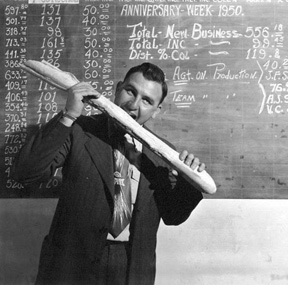
A. J. Schleman biting into loaf of Cuban bread at
Independent Life and Accident Insurance Co., 1950
Tampa's most famous
sandwich would not be possible without the stretched Cuban
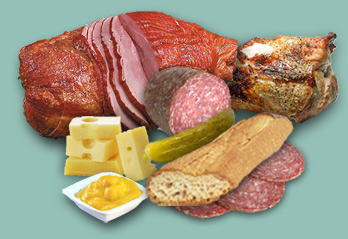
loaf. Ybor City split the loaf and filled it with mojo roast
pork, sugar-cured ham, salami, Swiss cheese, pickles and
mustard. Each of the main ingredients came from Ybor City's
dominant ethnic groups: the Spaniards supplied fine glazed
ham; bread and mojo pork came from the Cubans; and the
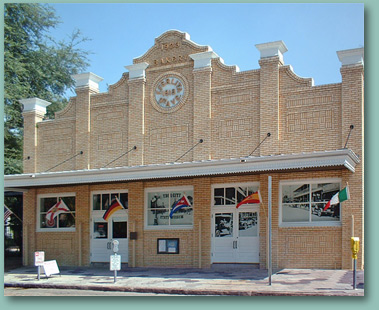
Italians supplied salami. Below: "La Joven
Francesca" Bakery where the first Cuban bread was baked, 1896.
It is now the Ybor State Museum.
When one examines the
labor that went in to making an old-fashioned Cuban, it is
more under-standable that today's sandwiches fall short so
often. Like so many simple things in early Ybor City, the
Cuban sandwich was elevated to an art and craft. Restaurateurs
prepared every ingredient in painstaking fashion. If modern
sandwich slingers take some short cuts, it is hard to blame
them. Their profits may not suffer, but the cult of the Cuban
does.
Tampa's Cuban
sandwich is a dying culinary breed. By the time it became a
recognized and revered tradition in the 1940s, the real thing
was already fading fast. The true Cuban sandwich – conceived
in Cuba and perfected in Tampa – lived and died with Ybor
City. And for the uninitiated, Ybor City died some time
between the Great Depression and urban renewal's bulldozers in
1965. Wet, cheap boiled ham and processed pork loaves give us
little indication of what a real Cuban sandwich should taste
like. It doesn't help that most places pile on lettuce, mayo,
and tomato, which is like adding a glass of water – it dilutes
the flavor. When done right, the sandwich showcases the
contrast between the dry crust of Cuban bread with the rich
mingling of melted fats within. The bold combination of salty
ham and salami, the garlic and vinegar overtones of the roast
pork, the sharp taste of pickle and mustard – are all married
by the bread and subtle charm of Swiss cheese.
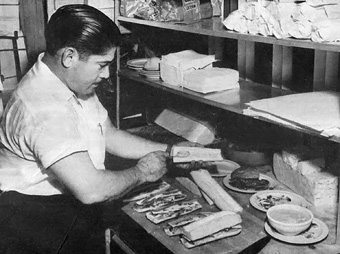
Manuel Torres making Cuban Sandwiches the old fashioned
way, 1957
A long-time Ybor restaurant worker,
Manuel Torres, made Cuban sandwiches in 1957 in what even then was known as the "old
fashioned way". Torres soaked a select pork
roast overnight in a mojo marinade of lemon juice, salt, fresh
garlic, oregano and vinegar. He then parboiled the pork with
onions, celery and garlic and then roasted it. A whole smoked
ham was then parboiled in the same mixture. Torres trimmed
excess fat from the ham and coated it in sugar. He then melted
the sugar onto the ham with a hot iron. The resulting
caramelized sugar gives the ham a distinctive taste. Drawn by
the irresistible aroma, salivating onlookers gathered around
the storefront as the sugar transformed into a thin amber
glaze. Torres then carved the meat into thin slices: pork, ham
and peppered Genoa salami. Imported Swiss cheese, sour dill
pickles, mustard and Cuban bread rounded out the sandwich. He
layered the ingredients onto the bread in traditional order:
first the ham, then pork, salami, cheese, pickle, and mustard
spread only on the top slice of the sandwich. "It is always
done that way," Torres said.
Richard
Gonzmart, president of the world-famous Columbia Restaurant,
gets a fresh burst of energy as he describes the way his
grandfather, a second-generation owner of the restaurant, used
to make it. This sandwich isn't just a sandwich. It's his
history, his legacy, a signature of his family's labor for
four generations. Richard has recently decided to recreate the
Cuban Sandwich of his grandfather's day. "It started
with fresh-baked Cuban bread from La Segunda Central Bakery.
Then a layer of ham, sweet on the edges, from a sugary rub
that caramelized as it baked. Then thin-sliced pork, which
bathed overnight in mojo marinade before it was roasted to
savory tenderness. Then salami, oh, the salami, studded with
peppercorns and sitting high so its fat could infuse the other
meats. Then a slice of aged Swiss cheese that supported rounds
of sour pickle. And under the lid, a single layer of yellow
mustard. Press this into an inch or two of crusty, buttered
warmth, and cut on the diagonal. Bite." This quote and
photo from a St. Pete Times article by Becky Bowers. See
the whole article here.
Six videos
have been added to the Columbia Restaurant at
Tampapix! See behind the scenes with Richard Gonzmart.
Read
how it took an act of Congress
to
keep Chef Pijuan's great Spanish food at the Columbia and see photos
of Chef Francisco Pijuan and his successor, Vincenzo "Sarapico"
Perez.
The father of a Tampa Mayor and Florida
Governor worked as a waiter at the Columbia for almost 40
years...See a 1966 photo of him and the
Columbia waiters staff
Before playing videos, stop the Tampapix theme music by first
clicking your browser "stop load" button; the "x" next to the
refresh button
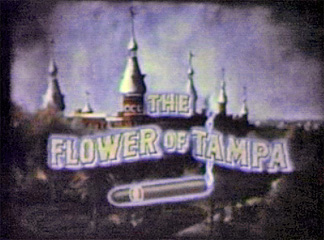
The Flower of Tampa
is a 1950s color film
that uses the story of a young man visiting his uncle, a cigar
manufacturer, in Tampa to showcase the city’s cigar industry. Along
the way the young man meets an attractive young woman who takes him
on a tour of Ybor City and the cigar plant where all aspects of
cigar making are discussed, and hand and machine cigar rolling
techniques are highlighted. The film also includes scenes of Tampa’s
airport, downtown, and harbor during the annual Gasparilla Pirate
Festival. This is a LINK to
view the video at the Florida
Memory Project website, it is 27 minutes.
George
Sheppard "Dad" Gandy was one of those fellows who laughed at the
word “impossible.” He has a long list of achievements to his credit
and many of those achievements represent the completion of ideas
which once were branded as absurd. The original Gandy Bridge was the
work of a dreamer--unquestionably. Only a dreamer of the most
pronounced type could have conceived such a project and only a
dreamer could have believed that it would some day be completed.
But there was nothing dream-like about the struggle which Gandy had
to make his dream materialize.
Read about the
amazing perseverance of George "Dad" Gandy and his 22 year quest to
be the first to bridge Old Tampa Bay. Learn about "colorful"
promoter Eugene Elliott who raised $2 million for the project, in
just 110 days...in 1922!
The Gandy Bridge - First to Span Tampa Bay
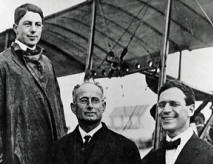
The
First Scheduled Airline Passenger Service, Jan 1, 1914
In November of 1913, Percival E. Fansler arrived in the bay area to
sell an airline - either to Tampa or St. Petersburg. He first made a
spirited presentation to City of Tampa officials with his business
proposition--to be the headquarters and financers of his proposed
airboat passenger service between Tampa and St. Pete. He was
turned down. Fansler took
his proposition to St. Pete officials and businessmen in December of
1913 and in less than a month, history was made when the St.
Petersburg-Tampa Airboat Line made its inaugural flight across the
bay from St. Pete to Tampa in 23 minutes.
Read all about Tony Jannus
(he was no rookie when he made his flight), his brother Roger, P.E.
Fansler, the driving force behind the airline, Abram Pheil, the
first passenger and the cost of his ticket, Tom Benoist, owner of
the company who built the airboat, and many others involved.
Three
Franklin St businesses in 1924 bit the dust to make way for the
South's most beautiful theatre. See photos of these
businesses, the clearing of the property and construction of the
Tampa Theatre from 1924 to 1926 at
Tampa Theatre.
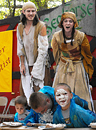
New
video of Bay Area Renaissance Festival
Watch orphan beggars Seymour P.
Freely and his sister Penelope host an action-packed pie eating
contest.
Snow Park -
Who was Maj. Henry E. Snow? Why this park is in the Guinness
Book of World Records and Ripley's..Believe it or Not? Learn
about the numerous names of Kennedy Blvd: Lafayette, Grand Central
Ave & Memorial Hwy. Where did they start and end?
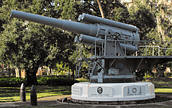
Spanish-American War memorialat Plant Park, Univ. of Tampa--Read about
the REAL history of this cannon--was it really from Ft. Dade, Egmont
Key?
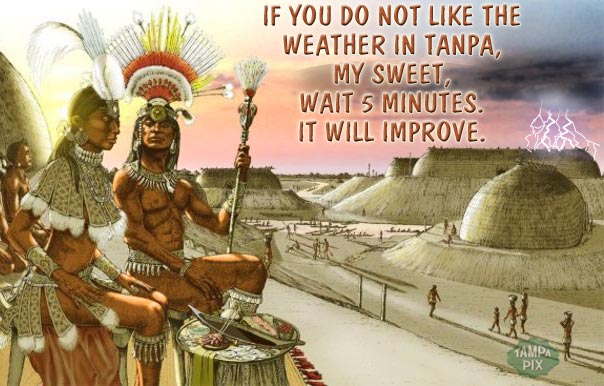
Did you know? The name “Tampa” comes
from the
Calusa Indians
who lived in West Central Florida between
1500 and into the 1800’s. The Calusa (or Caloosa) called this place Tanpa,
with an “N”, which translates to “sticks of fire.” Some have said
that this refers to the abundance of kindling and driftwood along
the Hillsborough river (sticks to make fire), but the more plausible
reference is to the frequent, intense lightning storms in the area.
In
1521 Juan Ponce de Leon was the first European to discover present
day Tampa Bay. De Leon was allegedly slain in this area by the
Calusa Indians “as a response to information they received of
Spanish mistreatment of Indians (Calusa and Caribe) in Cuba”. De
Leon’s body was first taken to Europe and now resides in the
cathedral of St. John the Baptist in San Juan, Puerto Rico.
Panfilio de Narvaez landed in Tampa
Bay on Good Friday, April 1528, with the intention of starting a
colony. He declared it “the best port in the world.” After
being told by the natives of better riches to the north, Narvaez
immediately got into an argument with a local Indian chief who in
turn sliced off Narvaez’s nose and chased him out of the area.
They abandoned their camp after only a week. A dozen years later, a
surviving member of the expedition named Juan Ortiz was rescued by
Hernando de Soto's expedition.
Hernando de Soto
arrived in the area on May 25, 1539, calling Tampa Bay “La Bahia Del
Espiritu Santo” (the Bay of the Holy Spirit) and met with native Indians
under the Charter Oak (or De Soto Oak) near present day Plant Park
at the University of Tampa. A peace treaty was conducted with
the local Tocobaga Indians, and a short-lived Spanish outpost was
established. However, this was abandoned when it became clear that
there was no gold in the area, that the local Indians were not
interested in converting to Catholicism, and that they were too
skilled as warriors to easily conquer. The Tampa area would be
effectively ignored by its colonial owners for the next 200+ years.
The name "Tanpa"
first appears in the "Memoir" of Hernando de Escalante Fontaneda.
Fontaneda was a Spainish shipwreck survivor who lived among the
Native Americans of Florida for 17 years (1575) as a Calusa captive.
He calls it "Tanpa" and describes it as an important Calusa town.
While "Tanpa" is the apparent basis for the modern name "Tampa",
archaeologist Jerald Milanich places the Calusa village of Tanpa at
the mouth of Charlotte Harbor, the original "Bay of Tanpa". A later
Spanish expedition failed to notice Charlotte Harbor while sailing
north along the west coast of Florida and assumed that today's Tampa
Bay was the bay that they had sought. Thus, the name was
accidentally transferred north.
Did
you know?
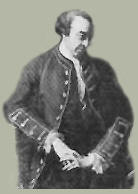
Hillsborough County was named for
Wills Hill(1718 –
1793), the 1st Marquess of Downshire, known as the Viscount
Hillsborough from 1742 to 1751 and as the Earl of Hillsborough from
1751 to 1789. He was a British politician of the Georgian era.
Best known in the United States as the Earl of Hillsborough, he
served as Secretary of State for the Colonies in 1768 to 1772, a
critical period leading toward the American Revolution.
Hillsborough County, New Hampshire, the town of Hillsborough, New
Hampshire within the county, the town of Hillsborough, North
Carolina and Hillsborough County, the River and bay in Florida, as
well as Hillsborough Bay in Prince Edward Island and the village of
Hillsborough, New Brunswick, in Canada, are named in Hill's honor.
The name "Hillsborough River" first appeared on a British map in
1769. At the time, the Earl of Hillsborough was the British
Secretary of State for the Colonies, and thus controlled the
pensions of the surveyors working in the American colonies, which
included East Florida.
Florida's Hillsborough county was
created on January 25, 1834 from Alachua and Monroe counties.
Its boundaries of 1834 included the present-day counties of
Charlotte, DeSoto, Hardee, Manatee, Pasco, Pinellas, Polk and
Sarasota.
Did
you know? Recognize this dashing
young man? After the outbreak of the Cuban
Revolution in 1895, Tampa served as the
crossroads for journalists en route to the
Caribbean to cover the brutality. This
21-year-old requested to cover the war, in his
words, "to seek professional experience at the
seat of a war." His Dec 14, 1895 article
describing the revolution, datelined "Tampa,"
appeared in London's "Daily Graphic." Written by
the young journalist pictured here, a lieutenant
in the Queen's Fourth Hussars, none other than
THE Winston Churchill.
Did you know? The highest point of
elevation in the Tampa city limits is 74.29 feet and is located at
the northeast corner of Fowler Avenue and 50th Street, caddy-corner
to MOSI.
Did you know? What do Buffalo Bill Cody and Babe Ruth have in common? They
were both visitors to Tampa's Plant Field in the 1910s. Read
about it and see old photos at Tampapix, the history of
Plant Field.
Did you know? From
February 23, 1862 to October 24, 1866, Tampa had no mayor and
no municipal form of government. Read what Tampa Mayor Hamlin
Snell did in May of 1861, at List of Tampa Mayorsfrom the first to present, dates of
term and links to view their portrait and biographical sketch.
Mouseover
the sign to turn it on
Frank Cinchett brought his neon sign
business to Tampa from Philadelphia in 1948. His son, John
F. Cinchett, joined the business and raised it to a new level of
creativity.
John V. Cinchett worked at his
grandfather’s sign shop until the late 1980s. A third-generation
Floridian and Tampa native, John is the organist at various
historic Tampa-area churches. He is enamored with the 1950s,
the years when his father was supplying neon signs to a growing,
bustling Tampa.
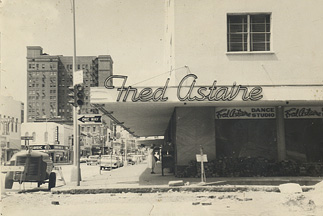
Captured in photographs taken by the Cinchett family for their
neon sign shop in Tampa, these never-before-seen images will take
you back to the day when Tampa was a bustling haven of popular
stores and restaurants.
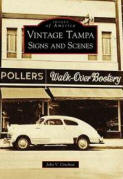
John
V. Cinchett's passion for the
1950s and his love of commercial neon art finally came together.
Compiling and organizing rare old photos of Tampa, he authored
Vintage Tampa Signs & Scenes.The book is about
family history as much as civic history.
Photos here
are copyrighted property of John V. Cinchett and used with his
permission.
Alphabetic
listing of all Tampapix photo feature pages:
IMPORTANT NOTE: Before
playing this video, stop the Tampapix theme music by clicking
on the "X" (stop) at the top of your browser window, usually located
near the refresh button.


 NEW!
Two photos have been added to Maas Brothers History at
Tampapix. A family portrait of Henrietta Maas Waterman,
sister of Abe & Isaac Maas, which shows her husband and
children, including son Jerome Waterman. Also a photo of
Jerome in 1965.
NEW!
Two photos have been added to Maas Brothers History at
Tampapix. A family portrait of Henrietta Maas Waterman,
sister of Abe & Isaac Maas, which shows her husband and
children, including son Jerome Waterman. Also a photo of
Jerome in 1965.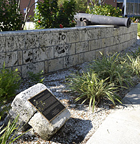
 Francis J. Bellamy, author of the Pledge of Allegiance to the Flag
in 1892, lived in Tampa from 1922 until his death in 1931.
Francis J. Bellamy, author of the Pledge of Allegiance to the Flag
in 1892, lived in Tampa from 1922 until his death in 1931.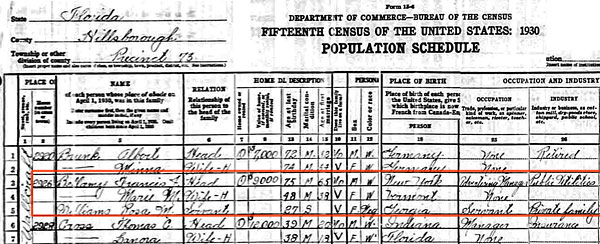
 NEW!
- The name
of Fortune Street downtown conjures up images of boom-time
prosperity, with business owners making a fortune in profits, but
this isn't why this street and the bridge, now named the Laurel
Street bridge, were named. See the newly updated feature
about Fortune Street and the bridge, with new photos, scenes from
the 2004 film "The Punisher" shot on this bridge, and more,
NEW!
- The name
of Fortune Street downtown conjures up images of boom-time
prosperity, with business owners making a fortune in profits, but
this isn't why this street and the bridge, now named the Laurel
Street bridge, were named. See the newly updated feature
about Fortune Street and the bridge, with new photos, scenes from
the 2004 film "The Punisher" shot on this bridge, and more,
 DID YOU KNOW?
Miss Tampa of 1930 became Miss Florida and went on to become
"Miss America". Margaret "Mickey" Ekdahl was more than a
pretty face; she came to America from Sweden as an infant and
eventually went on to compete in the Miss Universe pageant in
Rio de Janeiro. But her Miss America title in the midst
of the Great Depression was not achieved without controversy.
DID YOU KNOW?
Miss Tampa of 1930 became Miss Florida and went on to become
"Miss America". Margaret "Mickey" Ekdahl was more than a
pretty face; she came to America from Sweden as an infant and
eventually went on to compete in the Miss Universe pageant in
Rio de Janeiro. But her Miss America title in the midst
of the Great Depression was not achieved without controversy.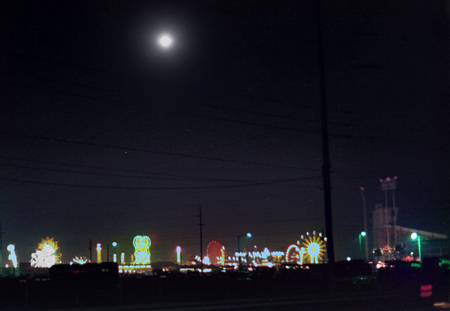
 Opened
in August of 1976, the Tampa Bay Center mall was Tampa's
unique shopping experience. With its interior bathed in
sunlight, a glass elevator and teeming with live trees, it was
Tampa's first 2-level mall. Read about the rise and fall
of Tampa Bay Center, see photos and video, NEW at Tampapix!
Opened
in August of 1976, the Tampa Bay Center mall was Tampa's
unique shopping experience. With its interior bathed in
sunlight, a glass elevator and teeming with live trees, it was
Tampa's first 2-level mall. Read about the rise and fall
of Tampa Bay Center, see photos and video, NEW at Tampapix!

 "The Frenchman and two Americans entered the enclosure
reserved in the center of the multitude...Ten o’clock
struck. The moment had arrived for taking their places in
the projectile...thirty-eight, thirty-nine, forty!!!
Instantly, Murchison pressed the key...An appalling,
unearthly report followed...An immense spout of fire shot up
from the bowels of the earth…The earth heaved
up...spectators obtained a momentary glimpse of the
projectile cleaving the air in the midst of fiery
vapors...The glare of the flames lit up the whole of
Florida..."
"The Frenchman and two Americans entered the enclosure
reserved in the center of the multitude...Ten o’clock
struck. The moment had arrived for taking their places in
the projectile...thirty-eight, thirty-nine, forty!!!
Instantly, Murchison pressed the key...An appalling,
unearthly report followed...An immense spout of fire shot up
from the bowels of the earth…The earth heaved
up...spectators obtained a momentary glimpse of the
projectile cleaving the air in the midst of fiery
vapors...The glare of the flames lit up the whole of
Florida..." 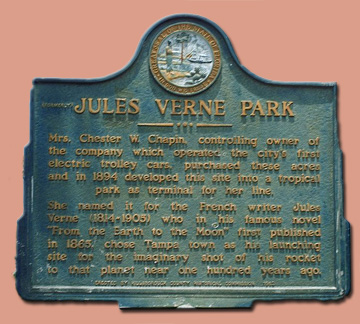
 The
Cinchett Neon Sign company operated in Tampa for 50
years. New at Tampapix--Read about Frank & John F. Cinchett's legacy in Tampa and see 2
newly discovered photos of John F. Cinchett's last neon sign which is still around today.
The
Cinchett Neon Sign company operated in Tampa for 50
years. New at Tampapix--Read about Frank & John F. Cinchett's legacy in Tampa and see 2
newly discovered photos of John F. Cinchett's last neon sign which is still around today. 
 TAMPA'S
BRAVEST
TAMPA'S
BRAVEST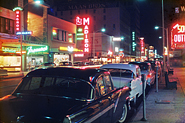 Tampa
in the 1950s, in LIVING COLOR
with the sounds of the 50s!
Tampa
in the 1950s, in LIVING COLOR
with the sounds of the 50s!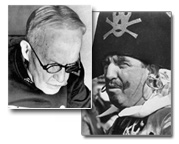 What
does U.S. Army Brigadier General William H. Bisbee have to do
with legendary pirate José Gaspar? They both had a
three-masted schooner named after them, in fact, the same
ship.
What
does U.S. Army Brigadier General William H. Bisbee have to do
with legendary pirate José Gaspar? They both had a
three-masted schooner named after them, in fact, the same
ship.


 In
1946 it became the site of Tampa's municipal airport and
in 1950, Tampa International Airport. Then in
1952, a brand new terminal was built on the south side
of the east-west runway.
In
1946 it became the site of Tampa's municipal airport and
in 1950, Tampa International Airport. Then in
1952, a brand new terminal was built on the south side
of the east-west runway.
 See interior photos added Oct. 6, 2010
 SNAKES ON A
PLANE! - Dec. 9, 1969
A NEW Photo has been
added on 9-27-2010 from "The Reading Eagle", a Pennsylvania
newspaper.
SNAKES ON A
PLANE! - Dec. 9, 1969
A NEW Photo has been
added on 9-27-2010 from "The Reading Eagle", a Pennsylvania
newspaper.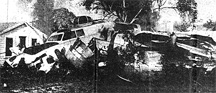 Shortly before 7 a.m. on May 19, 1944, a four-engine
B-17 bomber crashed on Abdella Street in West Tampa just
east of Drew Field, the giant wartime base where
today's Tampa International Airport is located.
Shortly before 7 a.m. on May 19, 1944, a four-engine
B-17 bomber crashed on Abdella Street in West Tampa just
east of Drew Field, the giant wartime base where
today's Tampa International Airport is located.

 DID YOU KNOW?
Thelma McQueen was a Tampa Native.
DID YOU KNOW?
Thelma McQueen was a Tampa Native.
 Either way,
there's not much variation in the recipe and preparation.
Either way,
there's not much variation in the recipe and preparation.
 When one examines the
labor that went in to making an old-fashioned Cuban, it is
more under-standable that today's sandwiches fall short so
often. Like so many simple things in early Ybor City, the
Cuban sandwich was elevated to an art and craft. Restaurateurs
prepared every ingredient in painstaking fashion. If modern
sandwich slingers take some short cuts, it is hard to blame
them. Their profits may not suffer, but the cult of the Cuban
does.
When one examines the
labor that went in to making an old-fashioned Cuban, it is
more under-standable that today's sandwiches fall short so
often. Like so many simple things in early Ybor City, the
Cuban sandwich was elevated to an art and craft. Restaurateurs
prepared every ingredient in painstaking fashion. If modern
sandwich slingers take some short cuts, it is hard to blame
them. Their profits may not suffer, but the cult of the Cuban
does.
 caramelized sugar gives the ham a distinctive taste. Drawn by
the irresistible aroma, salivating onlookers gathered around
the storefront as the sugar transformed into a thin amber
glaze. Torres then carved the meat into thin slices: pork, ham
and peppered Genoa salami. Imported Swiss cheese, sour dill
pickles, mustard and Cuban bread rounded out the sandwich. He
layered the ingredients onto the bread in traditional order:
first the ham, then pork, salami, cheese, pickle, and mustard
spread only on the top slice of the sandwich. "It is always
done that way," Torres said.
caramelized sugar gives the ham a distinctive taste. Drawn by
the irresistible aroma, salivating onlookers gathered around
the storefront as the sugar transformed into a thin amber
glaze. Torres then carved the meat into thin slices: pork, ham
and peppered Genoa salami. Imported Swiss cheese, sour dill
pickles, mustard and Cuban bread rounded out the sandwich. He
layered the ingredients onto the bread in traditional order:
first the ham, then pork, salami, cheese, pickle, and mustard
spread only on the top slice of the sandwich. "It is always
done that way," Torres said. 

 George
Sheppard "Dad" Gandy was one of those fellows who laughed at the
word “impossible.” He has a long list of achievements to his credit
and many of those achievements represent the completion of ideas
which once were branded as absurd. The original Gandy Bridge was the
work of a dreamer--unquestionably. Only a dreamer of the most
pronounced type could have conceived such a project and only a
dreamer could have believed that it would some day be completed.
But there was nothing dream-like about the struggle which Gandy had
to make his dream materialize.
George
Sheppard "Dad" Gandy was one of those fellows who laughed at the
word “impossible.” He has a long list of achievements to his credit
and many of those achievements represent the completion of ideas
which once were branded as absurd. The original Gandy Bridge was the
work of a dreamer--unquestionably. Only a dreamer of the most
pronounced type could have conceived such a project and only a
dreamer could have believed that it would some day be completed.
But there was nothing dream-like about the struggle which Gandy had
to make his dream materialize.
 The
First Scheduled Airline Passenger Service, Jan 1, 1914
The
First Scheduled Airline Passenger Service, Jan 1, 1914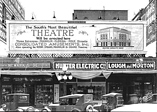 Three
Franklin St businesses in 1924 bit the dust to make way for the
South's most beautiful theatre. See photos of these
businesses, the clearing of the property and construction of the
Tampa Theatre from 1924 to 1926 at
Three
Franklin St businesses in 1924 bit the dust to make way for the
South's most beautiful theatre. See photos of these
businesses, the clearing of the property and construction of the
Tampa Theatre from 1924 to 1926 at
 New
video of Bay Area Renaissance Festival
New
video of Bay Area Renaissance Festival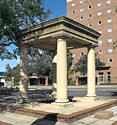
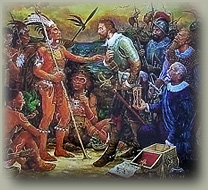 In
1521 Juan Ponce de Leon was the first European to discover present
day Tampa Bay. De Leon was allegedly slain in this area by the
Calusa Indians “as a response to information they received of
Spanish mistreatment of Indians (Calusa and Caribe) in Cuba”. De
Leon’s body was first taken to Europe and now resides in the
cathedral of St. John the Baptist in San Juan, Puerto Rico.
In
1521 Juan Ponce de Leon was the first European to discover present
day Tampa Bay. De Leon was allegedly slain in this area by the
Calusa Indians “as a response to information they received of
Spanish mistreatment of Indians (Calusa and Caribe) in Cuba”. De
Leon’s body was first taken to Europe and now resides in the
cathedral of St. John the Baptist in San Juan, Puerto Rico.
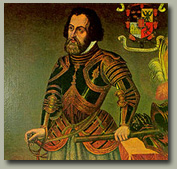 Panfilio de Narvaez landed in Tampa
Bay on Good Friday, April 1528, with the intention of starting a
colony. He declared it “the best port in the world.” After
being told by the natives of better riches to the north, Narvaez
immediately got into an argument with a local Indian chief who in
turn sliced off Narvaez’s nose and chased him out of the area.
They abandoned their camp after only a week. A dozen years later, a
surviving member of the expedition named Juan Ortiz was rescued by
Hernando de Soto's expedition.
Panfilio de Narvaez landed in Tampa
Bay on Good Friday, April 1528, with the intention of starting a
colony. He declared it “the best port in the world.” After
being told by the natives of better riches to the north, Narvaez
immediately got into an argument with a local Indian chief who in
turn sliced off Narvaez’s nose and chased him out of the area.
They abandoned their camp after only a week. A dozen years later, a
surviving member of the expedition named Juan Ortiz was rescued by
Hernando de Soto's expedition.
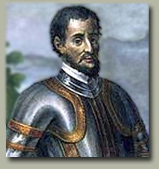 Hernando de Soto
arrived in the area on May 25, 1539, calling Tampa Bay “La Bahia Del
Espiritu Santo” (the Bay of the Holy Spirit) and met with native Indians
under the Charter Oak (or De Soto Oak) near present day Plant Park
at the University of Tampa. A peace treaty was conducted with
the local Tocobaga Indians, and a short-lived Spanish outpost was
established. However, this was abandoned when it became clear that
there was no gold in the area, that the local Indians were not
interested in converting to Catholicism, and that they were too
skilled as warriors to easily conquer. The Tampa area would be
effectively ignored by its colonial owners for the next 200+ years.
Hernando de Soto
arrived in the area on May 25, 1539, calling Tampa Bay “La Bahia Del
Espiritu Santo” (the Bay of the Holy Spirit) and met with native Indians
under the Charter Oak (or De Soto Oak) near present day Plant Park
at the University of Tampa. A peace treaty was conducted with
the local Tocobaga Indians, and a short-lived Spanish outpost was
established. However, this was abandoned when it became clear that
there was no gold in the area, that the local Indians were not
interested in converting to Catholicism, and that they were too
skilled as warriors to easily conquer. The Tampa area would be
effectively ignored by its colonial owners for the next 200+ years.


 Did
you know?
Did
you know?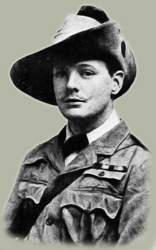 Did
you know?
Did
you know?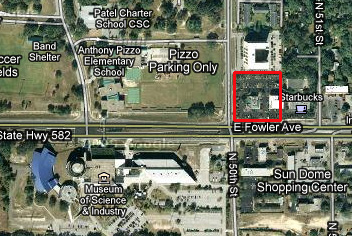 Did you know?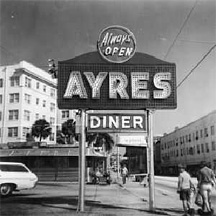

 John
V. Cinchett's passion for the
1950s and his love of commercial neon art finally came together.
Compiling and organizing rare old photos of Tampa, he authored
John
V. Cinchett's passion for the
1950s and his love of commercial neon art finally came together.
Compiling and organizing rare old photos of Tampa, he authored