Sulphur
Springs lies about 6 miles north of downtown Tampa. Its southern
boundary is the Hillsborough River, the northern boundary is
Busch Boulevard. Florida Avenue and the CSX railroad line forms
boundaries on the west and east. Sulphur Springs, like most of
Florida, has a rich and ancient natural history. The man made
history of the area starts with Native Americans, who legend
has it, drank from the Springs and benefited from the medicinal
benefits of the natural mineral water.
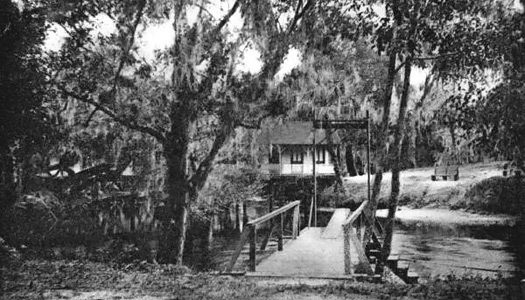
The first mention of Sulphur Springs in
the history of Tampa dates back to 1889 when the Tampa city
commissioners contracted for the building of a bridge to cross the
Hillsborough River at the county road now known as Van Dyke Place.
Completed in 1891, the bridge was used until 1961.
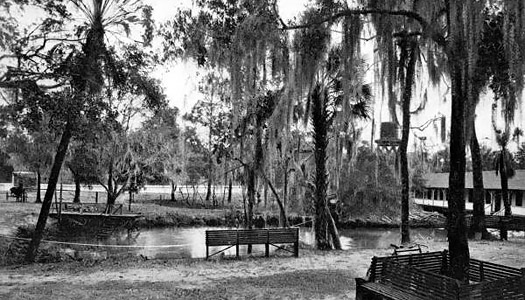
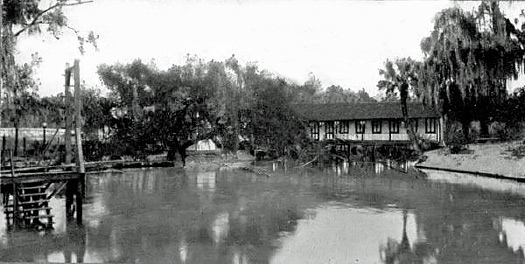
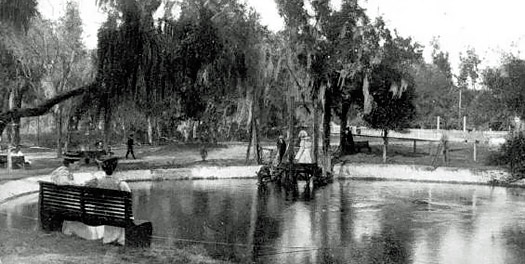
In the late 1890s John Mills purchased what
would later become Sulphur Springs from J.H. Krause, a real estate
developer, and developed a small park around the natural bubbling spring.
Mills developed his park into a small resort community and it opened in 1900
boasting bathhouses, a fishpond, and a pool. Shortly after opening for
business, steam ships traveled along the Hillsborough River filled with
urbanites seeking recreation at the springs.
In 1898, a 25-year-old Kentucky
native named Josiah Richardson arrived in Sulphur Springs and
saw an opportunity. After working for several years as a
painter and paper hanger, Richardson sold his business and in
1906 purchased 100 acres from Mills, between Florida Ave. and
Nebraska Ave. from the Hillsborough River to Waters Avenue, for
$10,000, which he borrowed. The town was a rustic swimming pool with a few
wooden bathhouses when Richardson bought it and he transformed
it into a winter mecca and spa for northerners.
Richardson was said to have a strong
liking for poker,
women and fast horses. He was a dreamer who envisioned a resort for
tourists built around the healing spring waters.
Sulphur Springs in
1906
By 1908 the popularity of the
once small resort community increased so drastically that a
trolley line was built to Sulphur Springs by the Tampa and
Sulphur Springs Traction Company. Visitors flocked to the spring
for its healing waters; a 1911 Tampa tourist brochure touted
Sulphur Springs as possessing “water which is especially
beneficial in cases of chronic constipation, intestinal
auto-intoxication and most kidney diseases where there is need
of a cathartic and diuretic in combinations” (Tampa Board of
Trade, 1911).
In 1920, Josiah Richardson
opened an amusement park called Sulphur Springs Park. The park
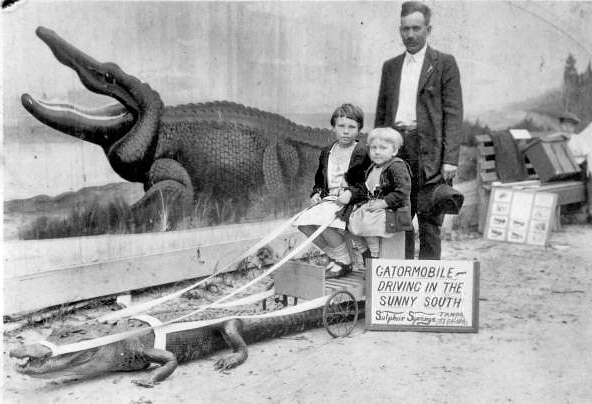
consisted of pools, bathhouses, an alligator farm, a dance
pavilion, shops and a shed for the streetcar that was frequented by
tourists and Tampans alike. He laid walks, erected elaborate
bathhouses, opened 3 restaurants, docks, a high-dive platform,
water slide and toboggan slide.
Richardson also built a beach and tourist cottages which were later
converted to year-round homes as tourists made the community
their permanent residence. A vibrant commercial area grew up
around the “Springs” and development flourished along Nebraska
Avenue. In 1923 Tampa’s city limits were extended to include
Sulphur Springs.
In these days, the rich and
famous often frequented natural springs for their healing
properties and recreation, but Sulphur Springs tended to
attract a more working-class visitor, known as "tin-can
tourists" because they often traveled in campers.
In
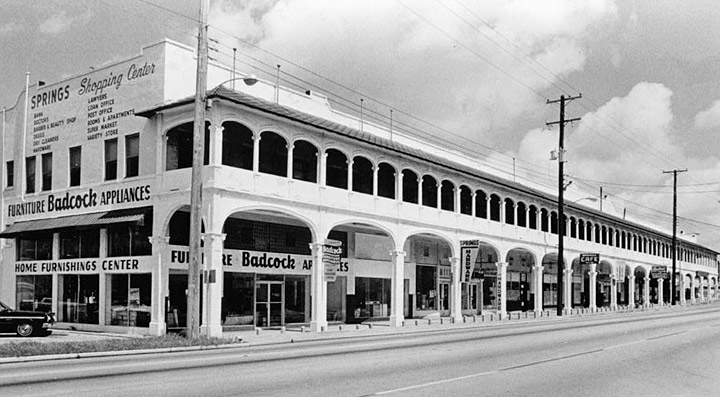
1925 Richardson began construction of the Arcade, a source of
pride and convenience for the community for fifty years.
Richardson saw the springs as a mecca for vacationers of modest
means, but refused to sacrifice quality in the development of its
attractions. He contracted an artist from Europe to decorate the
interior of the Arcade, and for the sidewalk he pioneered
terrazzo, marble chips laid over concrete that were buffed to a
luminous sheen.
(Continued in column at right)
A view from the southwest, taken from the south end
of the bridge (Florida Ave.) that goes over the Hillsborough River.
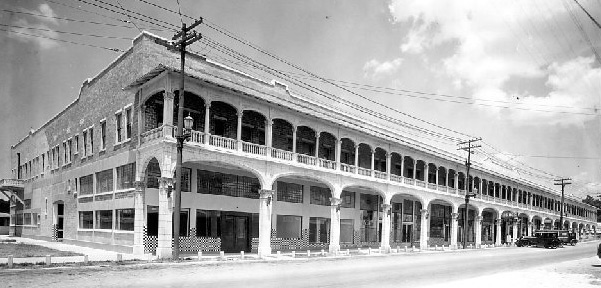
The Arcade in 1929
Completion of the Arcade
created the need for water to service it, so Richardson
mortgaged all of his assets, including the 100 acres of Sulphur
Springs and the Arcade, to build a $180,000 water tower overseen
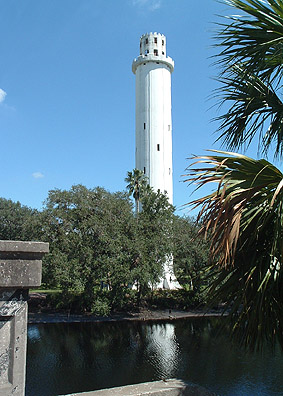
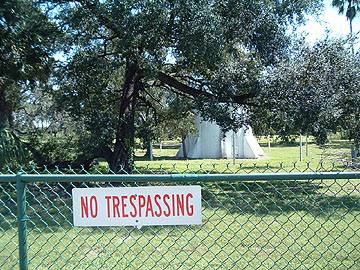
by architect Grover Poole. The Sulphur Springs Water Tower is
located on 13 acres of grassland on the banks of the
Hillsborough River. The expansion of the community into a
bustling tourist destination and real estate market would not
have been possible without the creation of the water tower to
bring the necessary water to its businesses, patrons, and
residents.
The 225-foot-tall Gothic
Revival tower is one of only two such structures remaining in
Florida. Poole designed it to look like a medieval tower,
with slit windows and battlements crowning the holding tank.
The tower combines utilitarian function and
architectural vision with its elaborate detailing, crenellated
parapet walls, lancet windows, and scrolled footings. Constructed
of poured-in-place concrete, the entire structure is on solid rock over a
artesian spring. Plans included an elevator to carry people up the cylinder to the observation
balcony, which provided a panoramic view of this bucolic river
setting. Richardson's original hope of club rooms occupying the floors
between the spring-feed base and the storage tank never materialized.
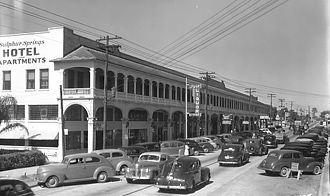
The Arcade in 1947
In 1986, high coliform
bacteria counts forced the city to close the spring to swimmers,
along with the lagoon that carries the spring water to the
river. The city built a 7,400-square-foot concrete pool at
the spring in 2000.
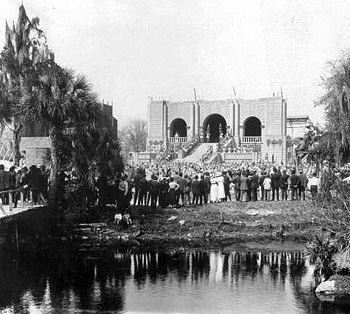
This image is from
1913, from a film called "Birth of a Race" (released in 1919),
the opening "birth of the human race" sequence which was filmed
in Sulphur Springs and around Tampa. Funded in large part by
Booker T. Washington and his Tuskegee Instittute. One of the
earliest African American-made films, it was directed by
Washington's personal secretary, John Noble, and produced by
Emmett Scott. Its title, added probably after 1915, was a
reference (and rebuttal) of D.W. Griffith's controversial "Birth
of a Nation."
Scenes from the movie filmed in
Sulphur Springs
Even with its shortcomings,
from both a technical as well as artistic standpoint, THE BIRTH
OF A RACE at least demonstrated that motion pictures were indeed
a medium to be reckoned with that has an enormous capability to
influence a large number of people.
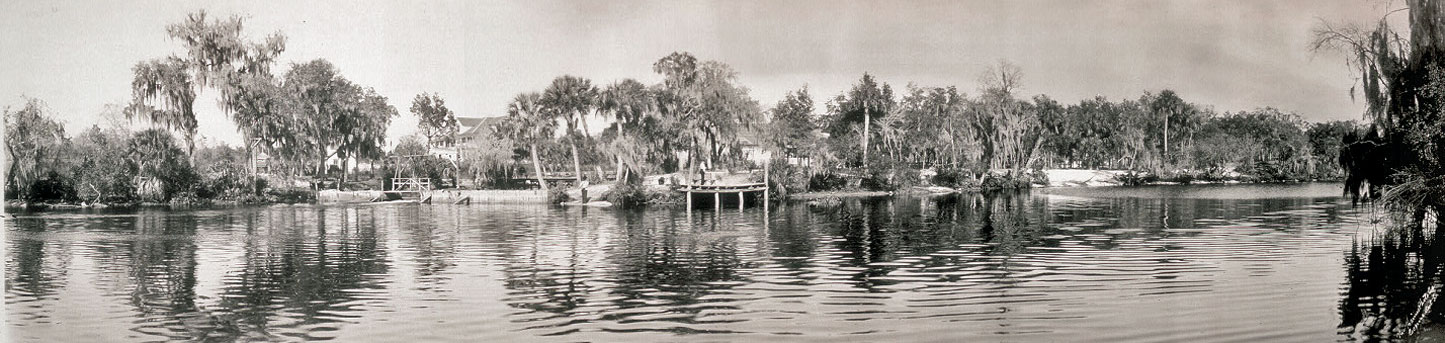
Sulphur Springs, circa
1909 Click photo to view larger then be sure to
use your browser zoom tool to see full size and scroll left/right.
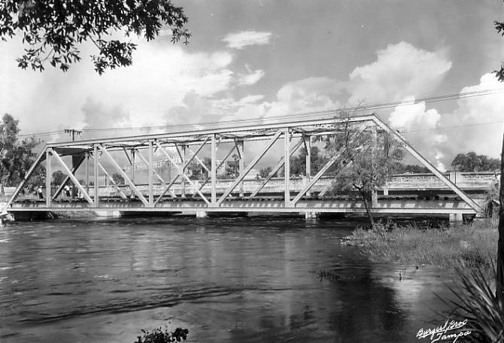
Sulphur Springs steel
streetcar bridge at Nebraska Ave (left) and original wood bridge at
old Nebraska Ave (right) now Van Dyke Place, circa 1909.
Click photo to view larger, then be sure to
use your browser zoom tool to see full size and scroll left/right.
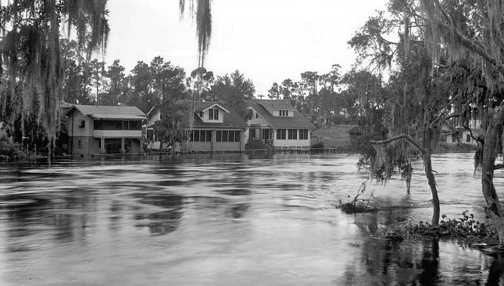
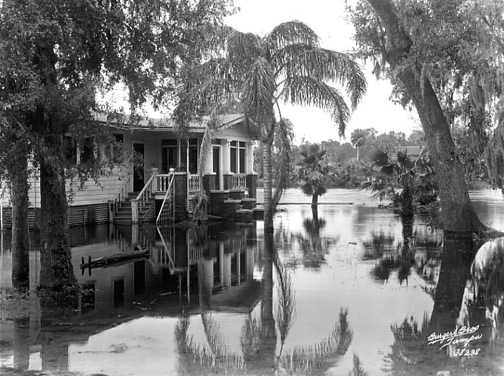
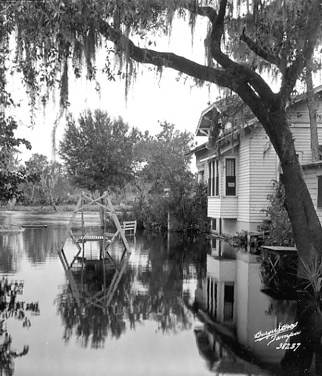
Hillsborough River flooding at
Sulphur Springs
Intense rainfall associated with
the tropical hurricane of September 4, 1933 caused severe damage
in Sulphur Springs and the failure of the Tampa Electric Company
dam on the Hillsborough River. Sudden release of the stored
waters washed out bridges, overflowed banks in the lower river
reaches, and sent water surging through town. Shortly after the
flood the effects of the Great Depression reached Sulphur
Springs causing the Sulphur Springs bank to collapse. Both
events caused the merchants and residents of the Arcade to
default on their rent payments, leaving Richardson without funds
to pay the mortgage on the Arcade. Richardson pulled out before
his vision was fully realized. He never built the elevator.
Richardson was forced to sell his Sulphur Springs holdings to
J.T. Hendrick Estates but remained in Tampa until his death in
1956.
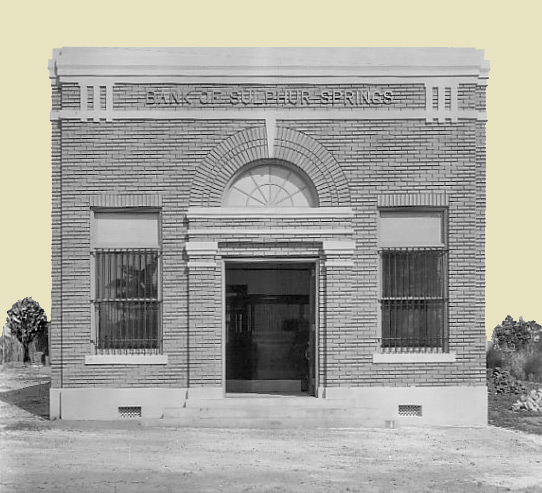
The Bank of
Sulphur Springs, 1921
The steel truss
trolley bridge built in 1907 and the
concrete Nebraska Ave. bridge built in 1923
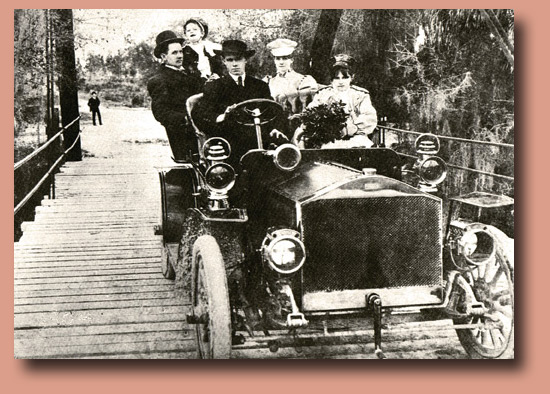
Josiah Richardson and family
riding across the Hillsborough River at Sulphur Springs, circa
1917.
Richardson's
slogan, "Josiah knows where the money grows," gave him instant
recognition around the area. He also reputedly bought new
Cadillacs for his wife and daughter.
Josiah Richardson with his wife
Addie T. Richardson (back seat.) Baby is likely to be
their grandson, Charles G. Roudabush. Girl in front
passenger seat is their daughter, Cecyl Richardson Roudabush,
and driver may be Charles Graham Roudabush, her husband.
Josiah & Addie also had a son, James T. Richardson. Josiah
Richardson died at age 83 on Feb. 24, 1956.
This photo might be printed
backwards, note steering wheel position.
Mouseover
photo for a close up of the family
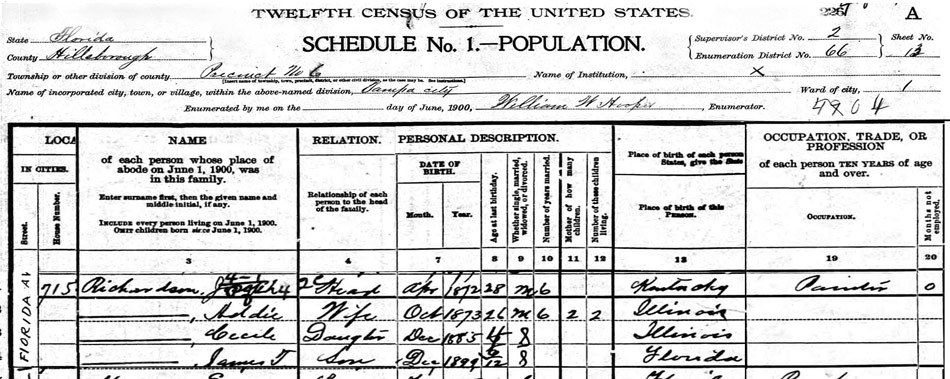
The 1900 census of Tampa shows
Josiah Richardson, wife Addie, daughter Cecyl and son James
living at 715 Florida Ave. Josiah's occupation was "painter."
On the 1910 census, his occupation was real estate agent.
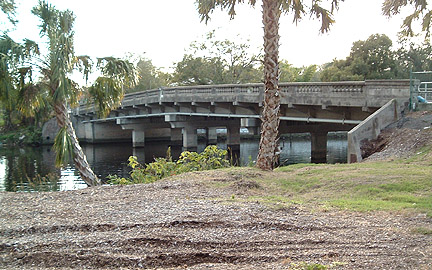
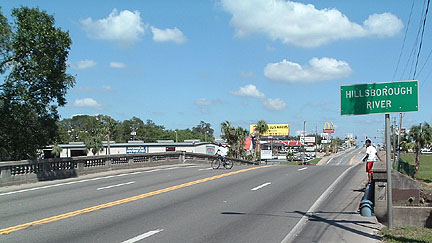
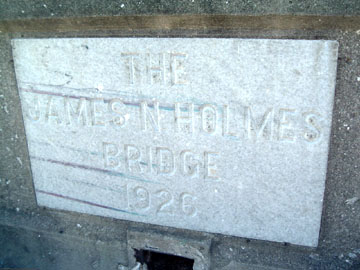
The Florida Avenue bridge was completed
in January, 1927. The "hump" on Florida Avenue as you approach the
river from the south, is actually the James N. Holmes bridge, started
in 1926. Prior to this the only means of traffic across the
river, going north and south, was over the very narrow bridge on
Nebraska Avenue, which was so narrow that traffic going north had to
stop to allow south-bound traffic to pass, and vice versa.
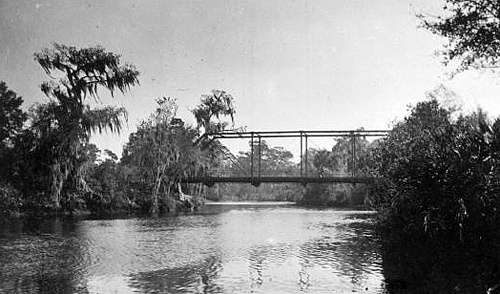
Left: The original wood bridge at
old Nebraska Ave. (now Van Dyke Place) was built in 1891.
Same bridge shown in photo of Josiah Richardson and family.
Click the map below to see more
old photos of the attractions at Sulphur Springs Park on an
interactive map
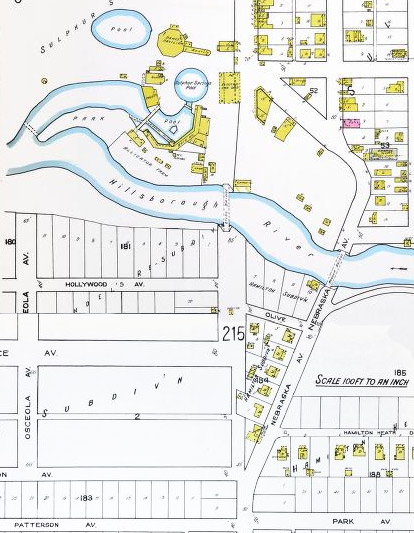
This 1922 fire insurance map of Tampa
shows the Sulphur Springs park area and the original path of Nebraska
Avenue at the river.
Note how it veered to the east of the
present day road. This portion of old Nebraska Ave. is now named
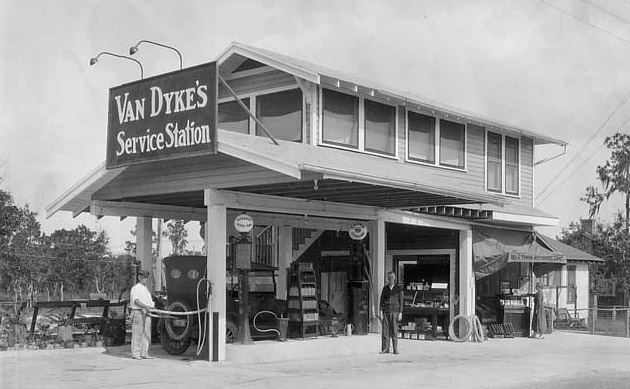
Van Dyke Place, for the man who owned the service station there in the
1920s. The station was located near where Hamilton Heath and
Nebraska intersect on the map at left.
Two bridges are noted here, the east wooden
bridge on the street labeled Nebraska Ave. and a west steel bridge on
an unlabeled street which is now the current path of Nebraska Ave.
The steel bridge was built to bring the Tampa streetcar lines into the
park.
When completed in 1925-26, the 2nd
floor had 39 hotel rooms and 14 apartments and offices.
The arcade was demolished in 1976 to create parking for the
Tampa Greyhound Track.
The Arcade in 1975
Originally owned by Josiah T.
Richardson, the building was sold to South Carolina tobacco
grower J.F. Hendrick when Richardson defaulted in the late
1920s. After Hendrick's death, the property passed to his
5 grandchildren. As estate holders, they exerted control
over leases for the ground floor stores. In order to bring
in new businesses, they refused lease renewals for many of the
original shops. The hotel and shops remained until 1975.
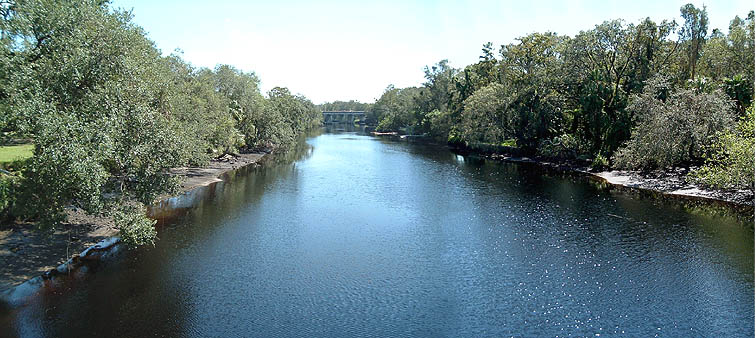
The Hillsborough River as seen looking east from
the bridge.
The tower is on the property to the left and the
bridge in the distance is Interstate 275.
The structure is
constructed from poured cement using railroad rails for "rebar."
The walls are eight inches thick with a buttressed base on solid rock.
"Concrete was poured into forms that were raised by yokes and jacks --
10 feet went up a day. The tower rests on rock, has a cantilever
foundation, and with the buttresses will be rather a difficult job to
ever destroy," wrote Grover Poole. When it was operational it
stored 200,000 gallons of water pumped up from the nearby artesian
springs. The water tank occupies the upper quarter of the cylindrical
tower while seven floors, one room per floor, constitute the lower
three quarters.
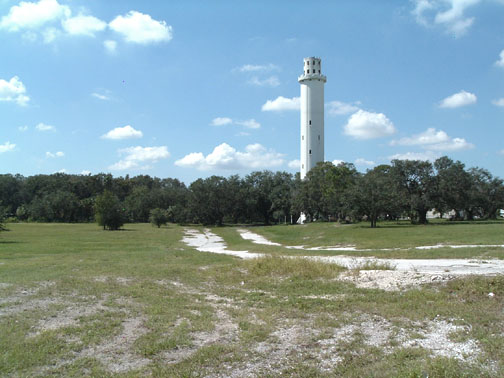
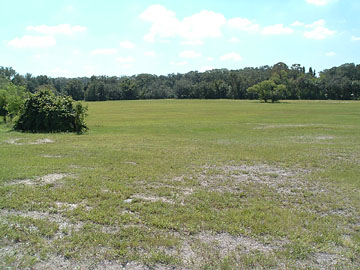
A
view from the northeast along Bird Street midway between Florida
Avenue and I-275.
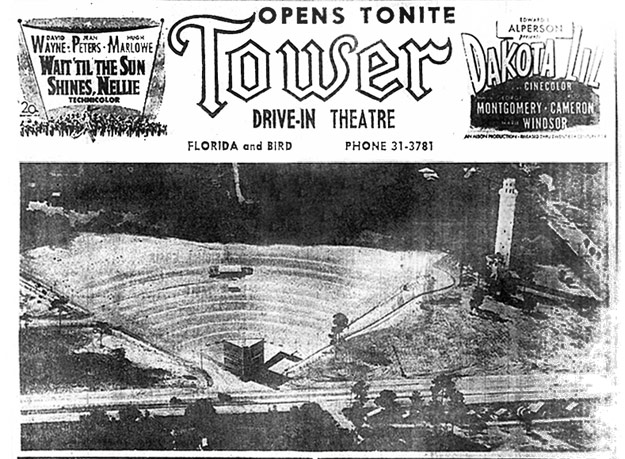
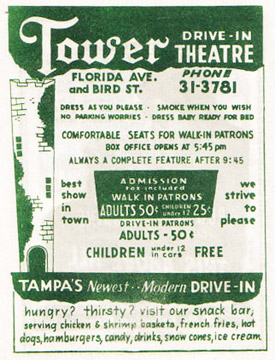
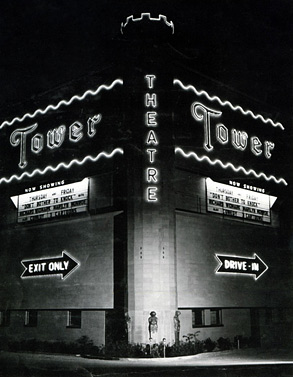
The Tower Drive In
The
Tower Drive In opened on October 22, 1952 with the double feature
“Wait Till The Sun Shines Nellie” and “Dakota Lil.” This is the
grand opening ad with a photo of the lot. The huge full-page ad
contained congratulatory announce-ments from about 20 merchants and
supply companies. The venue had a capacity of 300 cars and
closed down in the 1980s.
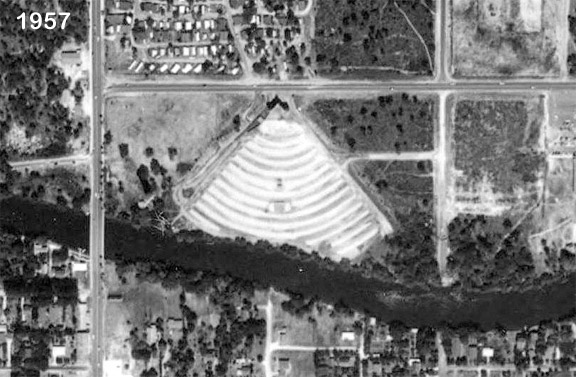
Aerial view of the water tower and the
Tower Drive In, 1957. Place your cursor
on the photo to see same area in 1969, which shows at
top center parking and a portion of J.M.
Fields department store.
The Tower Drive In, 1952 - The
movie feature in this photo was "Don't Bother to Knock" with
Richard Widmark, Marilyn Monroe and Anne Bancroft. The
movie screen was on the back side of this building.
 Sulphur
Springs lies about 6 miles north of downtown Tampa. Its southern
boundary is the Hillsborough River, the northern boundary is
Busch Boulevard. Florida Avenue and the CSX railroad line forms
boundaries on the west and east. Sulphur Springs, like most of
Florida, has a rich and ancient natural history. The man made
history of the area starts with Native Americans, who legend
has it, drank from the Springs and benefited from the medicinal
benefits of the natural mineral water.
Sulphur
Springs lies about 6 miles north of downtown Tampa. Its southern
boundary is the Hillsborough River, the northern boundary is
Busch Boulevard. Florida Avenue and the CSX railroad line forms
boundaries on the west and east. Sulphur Springs, like most of
Florida, has a rich and ancient natural history. The man made
history of the area starts with Native Americans, who legend
has it, drank from the Springs and benefited from the medicinal
benefits of the natural mineral water.