The photos on this site, except for the
obviously historical photos and where indicated, are my exclusive property and were
photographed by me, except where otherwise noted. This site is
not-for-profit and is for educational purposes. I am happy to
share my photos and have no objection to your personal use.
However, if you wish to use my photos for advertising and/or
profit-making purposes, I do ask that you contact me for permission.
I've never rejected such requests, nor have I ever insisted on
remuneration for such use, and rarely have ever even requested a photo
credit, but I do not take kindly to unauthorized use of my photos for
advertising or profit without my permission. Thank you.
--Owner & webmaster of this site.
Tampapix.com
is proud to team up with the
TampaNatives group site on Facebook to
bring you a list of photos AND discussion topics located on that site.
See over 800 photos and over 340 discussion topics posted by group members, listed on
this index which is searchable! The index provides easy
and direct link access to each photo and discussion
topic on on the group
site, as well as the photo caption and any comments
posted by group members. To view the photos and
topic discussions, you
must be a member of Facebook and be logged in, but you
do not need to be a member of the group to view the
photos.
TampaNatives Photo and Discussion Topic Index at Tampapix
Did
You Know? Tampa's international airport had its
beginnings at Drew Field. In the 1920s, a dreary
damp marshy land with stretches of sand covered over
with a sparse growth of palmetto scrub was purchased
from John H. Drew by the city as an air field.The Federal government turned it into a military base
in 1941.
In
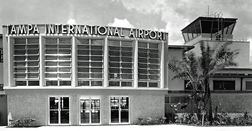
1946 it became the site of Tampa Municipal Airport.
Then in 1952, a brand new terminal was built on the
south side of the east-west runway, and this became
Tampa's first international airport.
Read about the history
of Drew Field and Tampa's first airport, along with
wartime images of Drew Field's weekly newspaper, "Drew
Field Echoes". See the very first issue, the 1-year
anniversary issue, and rarely seen photos from the
Christmas 1942 issue featuring photo montages of war-era
Tampa, life at Drew and MacDill Fields, including
commanding officers, and the top brass of the 3rd Air
Force Headquarters. Also photos of Tampa's
gleaming new international airport terminal in 1952.
JOSEPH ROBLES - The Robles are an old and important family in
the history of Tampa beginning with Joseph Robles, an
immigrant from Madrid, Spain who came to the United States in
the nineteenth century. Robles was born in 1817 and migrated
as a stowaway at the age of 15 from his native Spain. He is
said to have jumped ship in 1832 in Georgia and headed to
Florida after marrying in Georgia. Read about the Robles and see original land
surveys of Tampa that show where the Robles properties were
located. If you work in downtown Tampa, chances are you
drive through it every day.
After exploring the Tampa Bay area, Hernando de Soto's 16th
century expedition was the first to document the discovery of
the Mississippi River and the vast plains of the Midwest.
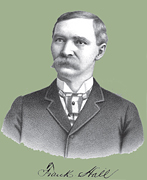
In a multi-volume historical account of the history of
Colorado, historian Frank Hall describes the Native Americans'
reaction to their first encounter with the conquistadores'
horses. "We find in the narrative of Coronado's march
that the natives were astounded at the sight of horses, and
were inclined to worship them as gods. Like incidents
occurred all along the line of de Soto's expeditions from
Tampa [Florida] to Kansas."
In
January of 1860, Congress considered a bill to organize
territories of the Midwest. Due to objections over
naming territories after presidents (because there were not
enough to go around), "Jefferson" was ruled out. An
attempt to enlarge the boundary of the territory of
present-day Kansas, to include the settled portion of present
day Nebraska as far north as the Platte River, failed.
The following list of names was considered to name the new
territory: Tampa, Idaho, Nemara, Colorado, San Juan, Lula,
Arapahoe and Weappollao. IDAHO was chosen.
Before playing the
video, stop the Tampapix theme music by first
clicking your browser "stop load" button; the "x" next to the
refresh button. The Santa Fe Trail, established
in 1822, cut across present-day Marion County, Kansas.
Numerous stops sprang up along the trail, and one of them was
eventually named Tampa, established in April of 1887. Though
Tampa, Kansas seems to precede Tampa , FL by a few months, Tampa, FL was originally
incorporated in 1855, but was abolished in 1869 in part
because residents had no money to pay taxes, and the city had
no money to pay its bills. It was reincorporated in
1887. Tampa, Kansas currently has a population of about 144.
There is also an unincorporated area in Colorado named Tampa.
Read about
de Soto's Tampa Bay area exploration & origin of the name
"Tampa."
Blanche
Armwood was a Tampa native and the first African-American woman from
Florida to graduate from an accredited law school--Howard University.
Armwood High School in
Seffner, which opened in 1984, was named after her.
An early
20th-century Renaissance woman, Ms. Armwood steadfastly held the values of
hard work, religious morality, and judicial equality before the American
consciousness. She used diplomacy to present these ideals to the American
public. Called a "Female Booker T. Washington," Armwood served as liaison
between the black and white races. She was administrator, educator, innovator,
writer, and poet.
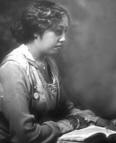
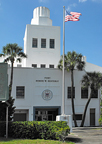
Hortense
recently turned 95-years-young and yet SHE sets the pace for
City Hall's employees and downtown visitors. She
performs her job with pride, on the 10th floor where she's
worked ever since she started there in the early 1900s.
She's always punctual and doesn't plan on slowing down or
retiring any time soon!
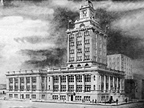
READ about
and see photos of "Hortense the beautiful" as she's known to
many. Also learn about the city hall building, its
history and design.
See
T-38 Talon, F-5A, C-5
Galaxy, P-40 Warhawk, P-47 Thunderbolt, B-24 Liberator, P-51
Mustang, A-7 Corsair, F-4 Phantom & F-111 Aardvark
Also,readabout the history of MacDill AFB, from before site selection
at Catfish Point through World War 2. See photos of life at MacDill Field
from WW2 era, published in Drew Field's weekly news,
"Drew Field Echoes"
B-17
"Fortress" Bomber Makes Crash Landing in West Tampa - May 19,
1944
Shortly before 7 a.m. on May 19, 1944, a four-engine
B-17 bomber crashed on Abdella Street in West Tampa just
east of Drew Field, the giant wartime base where
today's Tampa International Airport is located.
Read about the heroic efforts
of neighborhood residents to rescue the 9-man crew from the
flaming wreckage.
SNAKES ON A
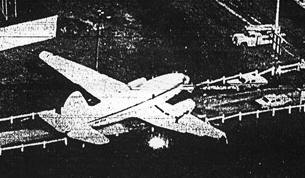
PLANE! - Dec. 9, 1969 On the above date,
a C-46 cargo plane made a forced landing in the parking area
of Al Lopez field. It came to rest against a utility pole,
just 500 feet from a house which was across Himes Ave.
Stories circulated amongst the locals that it carried reptiles
and that snakes escaped to roam the neighborhood until they
were rounded up. Part of this is true;read on!
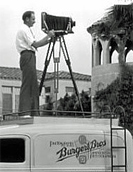
The Burgerts were a family of photographers who came to Florida late in the
nineteenth century and established a quite remarkable record in various phases
of the photography business, primarily in Florida. The Burgert brothers were
six sons and one daughter-in-law of the original photographic
progenitor of the family, Samuel Burgert. Three generations of
Burgert photographers worked productively from around the 1870s until the
1960s. The brothers
at various times took, sold or marketed supplies for hundreds of thousands of
photographic images usually requested by commercial clients, and in the
process coincidentally documented the Tampa Bay area’s development from the
little more than a scrubby port village to a major urban center of
international importance.
The Burgert Brothers at Tampapix
DID YOU KNOW?
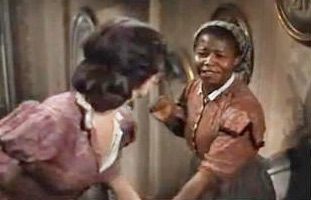
Thelma McQueen was a Tampa Native.
Better
known as "Butterfly" McQueen, she was an actress best known
for her role as Miss Scarlett's squeaky-voiced maid, "Prissy"
in "Gone With the Wind." Her delivery of her most memorable
line, "...We got to have a doctor, I don't
know nothin' 'bout birthin' babies," took Hollywood by storm.
Nothing says "Tampa" like a
mouth-watering Cuban sandwich
Ask 10 people what goes
into making an exceptional Cuban Sandwich and you'll likely
get ten different responses that vary in ingredients,
preparation and appearance. The debate can get as hot as the
bread just out of the oven--not just over the ingredients, but
even on the order they're stacked, the cut and pressing.
It may depend on your interpretation of "Cuban"
--traditional as it was in Cuba, or how Tampa/Ybor City's rich
ethnic mix caused it to evolve early on. Either way,
there's not much variation in the recipe and preparation.
But it is the bread that makes or breaks a Cuban sandwich; as
with any building, the foundation is important.
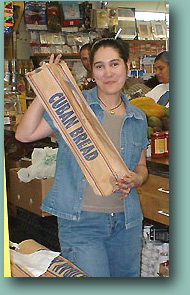
See Cuban Bread
- first baked in Ybor City's "La Joven Francesca" bakery,
1896.
In my opinion, the foremost authority on
restaurant history in Florida is Tampa's own Andy Huse;
Assistant Librarian at USF, Tampa Library Special Collections
Department / Florida Studies Center.
Like
Cuban cigars, it can be mighty difficult to find a fine Cuban
sandwich. Unlike Cuban Cigars, one could argue that the
so-called Cuban sandwich is more Tampa than Havana.
People in Miami often talk as if they invented the Cuban
sandwich, but they are pretenders to the throne. In the early
1900s, workers in Cuba brought simple "mixto" sandwiches to
work or bought them at cafes. These cold-cut concoctions took
on a new character in Tampa, influenced by Ybor City's vibrant
mix of immigrant cultures. By the 1920s, the old "mixtos"
coalesced into something more distinct – the Cuban sandwiches
we know and love – an original Tampa creation.
More on the "Mixto"
Beginning in 1886,
immigrants from Spain, Italy, and Cuba fled poverty and
warfare to seek new lives in Tampa. An erratic cycle of
feast and famine continued in Ybor City for fifty years. The
Cuban sandwich rose in popularity during the 1920s, when
electric sandwich presses and toasters became more common.
During tough times, Ybor City had the example of Cuban bread
to follow. When Cuba struggled for independence from Spain in
the late 1800s, citizens there faced hunger and hardship.
Cuban bakers responded by stretching their bread into long,
thin loaves to provide small slices for rationing. The
practice never changed in Tampa; but today, bread in Cuba
(when it can be obtained at all) is short and more round.
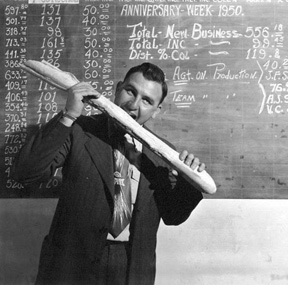
A. J. Schleman biting into loaf of Cuban bread at
Independent Life and Accident Insurance Co., 1950
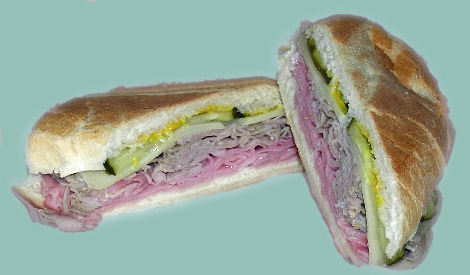
Tampa's most famous
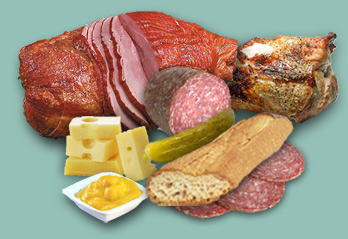
sandwich would not be possible without the stretched Cuban
loaf. Ybor City split the loaf and filled it with mojo roast
pork, sugar-cured ham, salami, Swiss cheese, pickles and
mustard. Each of the main ingredients came from Ybor City's
dominant ethnic groups: the Spaniards supplied fine glazed
ham; bread and mojo pork came from the Cubans; and the
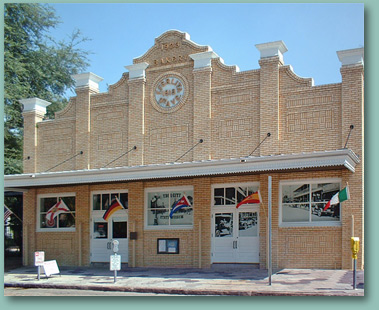
Italians supplied salami. Below: "La Joven
Francesca" Bakery where the first Cuban bread was baked, 1896.
It is now the Ybor State Museum.
When one examines the
labor that went in to making an old-fashioned Cuban, it is
more under-standable that today's sandwiches fall short so
often. Like so many simple things in early Ybor City, the
Cuban sandwich was elevated to an art and craft. Restaurateurs
prepared every ingredient in painstaking fashion. If modern
sandwich slingers take some short cuts, it is hard to blame
them. Their profits may not suffer, but the cult of the Cuban
does.
Tampa's Cuban
sandwich is a dying culinary breed. By the time it became a
recognized and revered tradition in the 1940s, the real thing
was already fading fast. The true Cuban sandwich – conceived
in Cuba and perfected in Tampa – lived and died with Ybor
City. And for the uninitiated, Ybor City died some time
between the Great Depression and urban renewal's bulldozers in
1965. Wet, cheap boiled ham and processed pork loaves give us
little indication of what a real Cuban sandwich should taste
like. It doesn't help that most places pile on lettuce, mayo,
and tomato, which is like adding a glass of water – it dilutes
the flavor. When done right, the sandwich showcases the
contrast between the dry crust of Cuban bread with the rich
mingling of melted fats within. The bold combination of salty
ham and salami, the garlic and vinegar overtones of the roast
pork, the sharp taste of pickle and mustard – are all married
by the bread and subtle charm of Swiss cheese.
In 1957, Manuel
Torres, a long-time Ybor restaurant worker, volunteered to
make Cuban sandwiches in what even then was known as the "old
fashioned way" for a reporter. Torres soaked a select pork
roast overnight in a mojo marinade of lemon juice, salt, fresh
garlic, oregano and vinegar. He then parboiled the pork with
onions, celery and garlic and then roasted it. A whole smoked
ham was then parboiled in the same mixture. Torres trimmed
excess fat from the ham and coated it in sugar. He then melted
the sugar onto the ham with a hot iron. The resulting
caramelized sugar gives the ham a distinctive taste. Drawn by
the irresistible aroma, salivating onlookers gathered around
the storefront as the sugar transformed into a thin amber
glaze. Torres then carved the meat into thin slices: pork, ham
and peppered Genoa salami. Imported Swiss cheese, sour dill
pickles, mustard and Cuban bread rounded out the sandwich. He
layered the ingredients onto the bread in traditional order:
first the ham, then pork, salami, cheese, pickle, and mustard
spread only on the top slice of the sandwich. "It is always
done that way," Torres said.
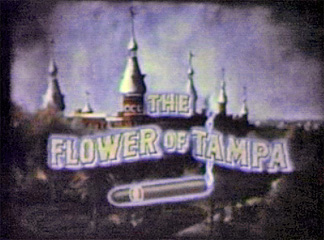
The Flower of Tampa
is a 1950s color film
that uses the story of a young man visiting his uncle, a cigar
manufacturer, in Tampa to showcase the city’s cigar industry. Along
the way the young man meets an attractive young woman who takes him
on a tour of Ybor City and the cigar plant where all aspects of
cigar making are discussed, and hand and machine cigar rolling
techniques are highlighted. The film also includes scenes of Tampa’s
airport, downtown, and harbor during the annual Gasparilla Pirate
Festival. This is a LINK to
view the video at the Florida
Memory Project website, it is 27 minutes.
Six videos
have been added to the Columbia Restaurant at
Tampapix! See behind the scenes with Richard Gonzmart.
Read
how it took an act of Congress
to
keep Chef Pijuan's great Spanish food at the Columbia and see photos
of Chef Francisco Pijuan and his successor, Vincenzo "Sarapico"
Perez.
The father of a Tampa Mayor and Florida
Governor worked as a waiter at the Columbia for almost 40
years...See a 1966 photo of him and the
Columbia waiters staff
What's In A Name?
Read about the individuals whose lives influenced the naming of
Tampa's thoroughfares.
Read about Tampa in 1886 from "Webb's
1886 Tampa City Directory" and see the street listings
DAVID PAUL DAVIS AND
HIS ISLANDS
The development of
Davis Islands by David Paul Davis made him nationally
famous. Read about his visionary quest, his
struggles and mysterious death, here at Tampapix contained
on 4 pages at
D.P. Davis
and his Islands.
George
Sheppard "Dad" Gandy was one of those fellows who laughed at the
word “impossible.” He has a long list of achievements to his credit
and many of those achievements represent the completion of ideas
which once were branded as absurd. The original Gandy Bridge was the
work of a dreamer--unquestionably. Only a dreamer of the most
pronounced type could have conceived such a project and only a
dreamer could have believed that it would some day be completed.
But there was nothing dream-like about the struggle which Gandy had
to make his dream materialize.
Read about the
amazing perseverance of George "Dad" Gandy and his 22 year quest to
be the first to bridge Old Tampa Bay. Learn about "colorful"
promoter Eugene Elliott who raised $2 million for the project, in
just 110 days...in 1922!
The Gandy Bridge - First to Span Tampa Bay
The
First Scheduled Airline Passenger Service, Jan 1, 1914
In November of 1913, Percival E. Fansler arrived in the bay area to
sell an airline - either to Tampa or St. Petersburg. He first made a
spirited presentation to City of Tampa officials with his business
proposition--to be the headquarters and financers of his proposed
airboat passenger service between Tampa and St. Pete. He was
turned down. Fansler took
his proposition to St. Pete officials and businessmen in December of
1913 and in less than a month, history was made when the St.
Petersburg-Tampa Airboat Line made its inaugural flight across the
bay from St. Pete to Tampa in 23 minutes.
Read all about Tony Jannus
(he was no rookie when he made his flight), his brother Roger, P.E.
Fansler, the driving force behind the airline, Abram Pheil, the
first passenger and the cost of his ticket, Tom Benoist, owner of
the company who built the airboat, and many others involved.
Three
Franklin St businesses in 1924 bit the dust to make way for the
South's most beautiful theatre. See photos of these
businesses, the clearing of the property and construction of the
Tampa Theatre from 1924 to 1926 at
Tampa Theatre.
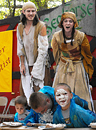
New
video of Bay Area Renaissance Festival
Watch orphan beggars Seymour P.
Freely and his sister Penelope host an action-packed pie eating
contest.
In the 1940s, the Centro Español
Club in West Tampa was home to the
Royal Theatre.
It was THE place in West Tampa
to go to see movies and live shows. Also, read about two
popular entertainers that frequently performed there; Mary Cintra
"the Cuban Bombshell" and "Tongolele."
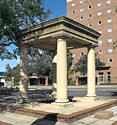
Snow Park -
Who was Maj. Henry E. Snow? Why this park is in the Guinness
Book of World Records and Ripley's..Believe it or Not? Learn
about the numerous names of Kennedy Blvd: Lafayette, Grand Central
Ave & Memorial Hwy. Where did they start and end?
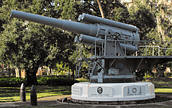
Spanish-American War memorialat Plant Park, Univ. of Tampa--Read about
the REAL history of this cannon--was it really from Ft. Dade, Egmont
Key?
Homer Wynne Hesterly was a
prominent Tampa citizen, recognized for his long and distinguished
military career, business interests and civic involvement. He was
proprietor and President of the Turner Marble and Granite Company
from the 1930s to 1950, and president of the First Federal Savings
and Loan Association.
Visit
the improved Ybor City pages at
Tampapix!
New photos added; existing ones replaced with larger, higher quality
images.
Other improved
pages with newly added photos and larger existing photos: The Tampa Theatre
| Downtown
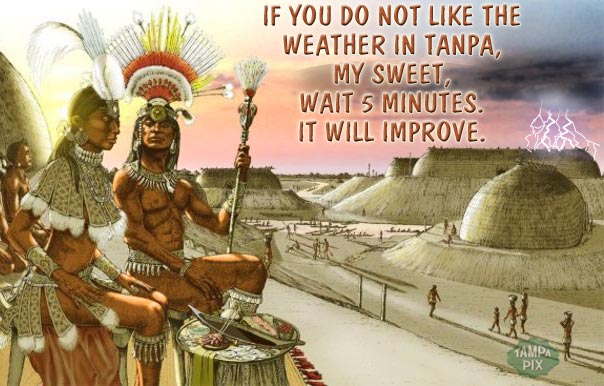
Did you know? The name “Tampa” comes
from the
Calusa Indians
who lived in West Central Florida between
1500 and into the 1800’s. The Calusa (or Caloosa) called this place Tanpa,
with an “N”, which translates to “sticks of fire.” Some have said
that this refers to the abundance of kindling and driftwood along
the Hillsborough river (sticks to make fire), but the more plausible
reference is to the frequent, intense lightning storms in the area.
In
1521 Juan Ponce de Leon was the first European to discover present
day Tampa Bay. De Leon was allegedly slain in this area by the
Calusa Indians “as a response to information they received of
Spanish mistreatment of Indians (Calusa and Caribe) in Cuba”. De
Leon’s body was first taken to Europe and now resides in the
cathedral of St. John the Baptist in San Juan, Puerto Rico.
Panfilio de Narvaez landed in Tampa
Bay on Good Friday, April 1528, with the intention of starting a
colony. He declared it “the best port in the world.” After
being told by the natives of better riches to the north, Narvaez
immediately got into an argument with a local Indian chief who in
turn sliced off Narvaez’s nose and chased him out of the area.
They abandoned their camp after only a week. A dozen years later, a
surviving member of the expedition named Juan Ortiz was rescued by
Hernando de Soto's expedition.
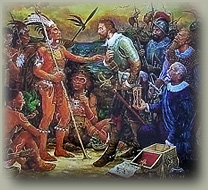
Hernando de Soto
arrived in the area on May 25, 1539, calling Tampa Bay “La Bahia Del
Espiritu Santo” (the Bay of the Holy Spirit) and met with native Indians
under the Charter Oak (or De Soto Oak) near present day Plant Park
at the University of Tampa. A peace treaty was conducted with
the local Tocobaga Indians, and a short-lived Spanish outpost was
established. However, this was abandoned when it became clear that
there was no gold in the area, that the local Indians were not
interested in converting to Catholicism, and that they were too
skilled as warriors to easily conquer. The Tampa area would be
effectively ignored by its colonial owners for the next 200+ years.
The name "Tanpa"
first appears in the "Memoir" of Hernando de Escalante Fontaneda.
Fontaneda was a Spainish shipwreck survivor who lived among the
Native Americans of Florida for 17 years (1575) as a Calusa captive.
He calls it "Tanpa" and describes it as an important Calusa town.
While "Tanpa" is the apparent basis for the modern name "Tampa",
archaeologist Jerald Milanich places the Calusa village of Tanpa at
the mouth of Charlotte Harbor, the original "Bay of Tanpa". A later
Spanish expedition failed to notice Charlotte Harbor while sailing
north along the west coast of Florida and assumed that today's Tampa
Bay was the bay that they had sought. Thus, the name was
accidentally transferred north.
IMPORTANT NOTE:Before
playing this video, stop the Tampapix theme music by clicking
on the "X" at the top of your browser window, usually located
near the refresh button.
Frank Garcia has "magically
recreated my grandparents, my youth and my old home town of
Tampa from a song. But its more than just a song, it is
something that lasts. Walking down Ybor early in the morning
or late at night, dominoes can still be heard falling from a
distant time, Havana tobacco leaves from the cigar factories
can still permeate memories into believing nothing has
changed. The stacks of Cuban sandwiches piled high can
still be seen outside that Silver Ring Cafe if you just wished
it; the swaying of the palms with the rhythm of the people
dancing in the red brick streets is all so very there. In a
sense, I really didn't write Corazon de Tampa... Ybor city and
West Tampa did. All I did was listen, look, feel and live that
enchanting time. My heart did the rest."-- Frank Garcia
Did
you know?
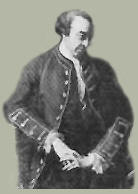
Hillsborough County was named for
Wills Hill(1718 –
1793), the 1st Marquess of Downshire, known as the Viscount
Hillsborough from 1742 to 1751 and as the Earl of Hillsborough from
1751 to 1789. He was a British politician of the Georgian era.
Best known in the United States as the Earl of Hillsborough, he
served as Secretary of State for the Colonies in 1768 to 1772, a
critical period leading toward the American Revolution.
Hillsborough County, New Hampshire, the town of Hillsborough, New
Hampshire within the county, the town of Hillsborough, North
Carolina and Hillsborough County, the River and bay in Florida, as
well as Hillsborough Bay in Prince Edward Island and the village of
Hillsborough, New Brunswick, in Canada, are named in Hill's honor.
The name "Hillsborough River" first appeared on a British map in
1769. At the time, the Earl of Hillsborough was the British
Secretary of State for the Colonies, and thus controlled the
pensions of the surveyors working in the American colonies, which
included East Florida.
Florida's Hillsborough county was
created on January 25, 1834 from Alachua and Monroe counties.
Its boundaries of 1834 included the present-day counties of
Charlotte, DeSoto, Hardee, Manatee, Pasco, Pinellas, Polk and
Sarasota.
Did
you know? Recognize this dashing
young man? After the outbreak of the Cuban
Revolution in 1895, Tampa served as the
crossroads for journalists en route to the
Caribbean to cover the brutality. This
21-year-old requested to cover the war, in his
words, "to seek professional experience at the
seat of a war." His Dec 14, 1895 article
describing the revolution, datelined "Tampa,"
appeared in London's "Daily Graphic." Written by
the young journalist pictured here, a lieutenant
in the Queen's Fourth Hussars, none other than
THE Winston Churchill.
Did you know? The highest point of
elevation in the Tampa city limits is 74.29 feet and is located at
the northeast corner of Fowler Avenue and 50th Street, caddy-corner
to MOSI.
Did you know? What do Buffalo Bill Cody and Babe Ruth have in common? They
were both visitors to Tampa's Plant Field in the 1910s. Read
about it and see old photos at Tampapix, the history of
Plant Field.
Did you know? From
February 23, 1862 to October 24, 1866, Tampa had no mayor and
no municipal form of government. Read what Tampa Mayor Hamlin
Snell did in May of 1861, at List of Tampa Mayorsfrom the first to present, dates of
term and links to view their portrait and biographical sketch.
Mouseover
the sign to turn it on
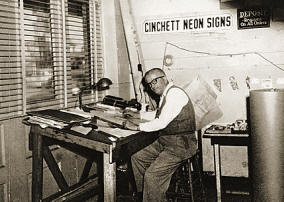
Frank Cinchett brought his neon sign
business to Tampa from Philadelphia in 1948. His son, John
F. Cinchett, joined the business and raised it to a new level of
creativity.
John V. Cinchett worked at his
grandfather’s sign shop until the late 1980s. A third-generation
Floridian and Tampa native, John is the organist at various
historic Tampa-area churches. He is enamored with the 1950s,
the years when his father was supplying neon signs to a growing,
bustling Tampa.
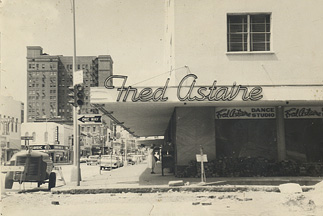
Captured in photographs taken by the Cinchett family for their
neon sign shop in Tampa, these never-before-seen images will take
you back to the day when Tampa was a bustling haven of popular
stores and restaurants.
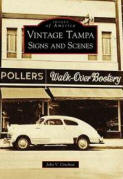
John
V. Cinchett's passion for the
1950s and his love of commercial neon art finally came together.
Compiling and organizing rare old photos of Tampa, he authored
Vintage Tampa Signs & Scenes.The book is about
family history as much as civic history.
Photos here
are copyrighted property of John V. Cinchett and used with his
permission.
Alphabetic
listing of all Tampapix photo feature pages:
Tampapix theme song "This Land is Your
Land" is one of the United States' most famous folk songs. Its lyrics were
written by
Woody Guthrie in 1940 on an existing melody, in response to Irving Berlin's
"God Bless America," which Guthrie considered unrealistic and complacent. Tired
of hearing Kate Smith sing it on the radio, he wrote a response originally
called "God Blessed America for Me". Guthrie varied the lyrics over time,
sometimes including more overtly political verses than appear in recordings or
publications.
Partly inspired by his experiences
during a cross-country trip and his distaste for God Bless America, Guthrie
penned his most famous song, "This Land Is Your Land" in February 1940.
Though the song was written in 1940, it would be four years before Moses Asch
recorded Guthrie in April 1944, and even longer until sheet music was produced
and given to schools by Howie Richmond.
Some say Guthrie lifted the melody of "This Land Is Your Land" essentially
note-for-note from "When the World's on Fire," a Baptist hymn recorded by
country legends the
Carter Family ten years earlier. Others say the melody is based on the
gospel song "Oh My Loving Brother", best known as "Little Darling, Pal of Mine",
sung by the country group The Carter Family.
Guthrie signed the manuscript with the comment "All you can write is what you
see." He protested class inequality in the
final verses which are not widely known and never sung except in political
protest.
IMPORTANT NOTE: Before
playing this video, stop the Tampapix theme music by clicking
on the "X" (stop) at the top of your browser window, usually located
near the refresh button.



 In
1946 it became the site of Tampa Municipal Airport.
Then in 1952, a brand new terminal was built on the
south side of the east-west runway, and this became
Tampa's first international airport.
In
1946 it became the site of Tampa Municipal Airport.
Then in 1952, a brand new terminal was built on the
south side of the east-west runway, and this became
Tampa's first international airport.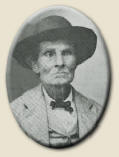
 After exploring the Tampa Bay area, Hernando de Soto's 16th
century expedition was the first to document the discovery of
the Mississippi River and the vast plains of the Midwest.
In a multi-volume historical account of the history of
Colorado, historian Frank Hall describes the Native Americans'
reaction to their first encounter with the conquistadores'
horses. "We find in the narrative of Coronado's march
that the natives were astounded at the sight of horses, and
were inclined to worship them as gods. Like incidents
occurred all along the line of de Soto's expeditions from
Tampa [Florida] to Kansas."
After exploring the Tampa Bay area, Hernando de Soto's 16th
century expedition was the first to document the discovery of
the Mississippi River and the vast plains of the Midwest.
In a multi-volume historical account of the history of
Colorado, historian Frank Hall describes the Native Americans'
reaction to their first encounter with the conquistadores'
horses. "We find in the narrative of Coronado's march
that the natives were astounded at the sight of horses, and
were inclined to worship them as gods. Like incidents
occurred all along the line of de Soto's expeditions from
Tampa [Florida] to Kansas."

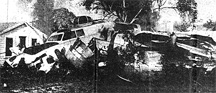 Shortly before 7 a.m. on May 19, 1944, a four-engine
B-17 bomber crashed on Abdella Street in West Tampa just
east of Drew Field, the giant wartime base where
today's Tampa International Airport is located.
Shortly before 7 a.m. on May 19, 1944, a four-engine
B-17 bomber crashed on Abdella Street in West Tampa just
east of Drew Field, the giant wartime base where
today's Tampa International Airport is located.

 DID YOU KNOW?
Thelma McQueen was a Tampa Native.
DID YOU KNOW?
Thelma McQueen was a Tampa Native.
 Either way,
there's not much variation in the recipe and preparation.
Either way,
there's not much variation in the recipe and preparation.
 When one examines the
labor that went in to making an old-fashioned Cuban, it is
more under-standable that today's sandwiches fall short so
often. Like so many simple things in early Ybor City, the
Cuban sandwich was elevated to an art and craft. Restaurateurs
prepared every ingredient in painstaking fashion. If modern
sandwich slingers take some short cuts, it is hard to blame
them. Their profits may not suffer, but the cult of the Cuban
does.
When one examines the
labor that went in to making an old-fashioned Cuban, it is
more under-standable that today's sandwiches fall short so
often. Like so many simple things in early Ybor City, the
Cuban sandwich was elevated to an art and craft. Restaurateurs
prepared every ingredient in painstaking fashion. If modern
sandwich slingers take some short cuts, it is hard to blame
them. Their profits may not suffer, but the cult of the Cuban
does.

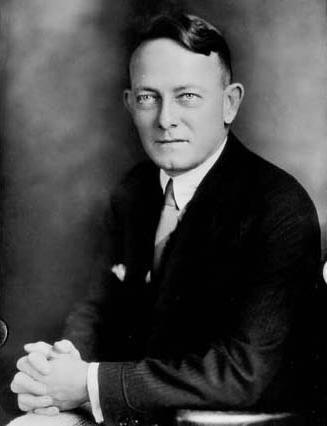
 George
Sheppard "Dad" Gandy was one of those fellows who laughed at the
word “impossible.” He has a long list of achievements to his credit
and many of those achievements represent the completion of ideas
which once were branded as absurd. The original Gandy Bridge was the
work of a dreamer--unquestionably. Only a dreamer of the most
pronounced type could have conceived such a project and only a
dreamer could have believed that it would some day be completed.
But there was nothing dream-like about the struggle which Gandy had
to make his dream materialize.
George
Sheppard "Dad" Gandy was one of those fellows who laughed at the
word “impossible.” He has a long list of achievements to his credit
and many of those achievements represent the completion of ideas
which once were branded as absurd. The original Gandy Bridge was the
work of a dreamer--unquestionably. Only a dreamer of the most
pronounced type could have conceived such a project and only a
dreamer could have believed that it would some day be completed.
But there was nothing dream-like about the struggle which Gandy had
to make his dream materialize.
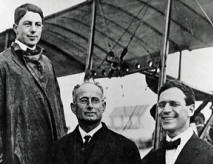 The
First Scheduled Airline Passenger Service, Jan 1, 1914
The
First Scheduled Airline Passenger Service, Jan 1, 1914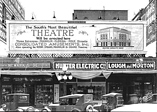 Three
Franklin St businesses in 1924 bit the dust to make way for the
South's most beautiful theatre. See photos of these
businesses, the clearing of the property and construction of the
Tampa Theatre from 1924 to 1926 at
Three
Franklin St businesses in 1924 bit the dust to make way for the
South's most beautiful theatre. See photos of these
businesses, the clearing of the property and construction of the
Tampa Theatre from 1924 to 1926 at
 New
video of Bay Area Renaissance Festival
New
video of Bay Area Renaissance Festival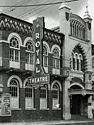

 In
1521 Juan Ponce de Leon was the first European to discover present
day Tampa Bay. De Leon was allegedly slain in this area by the
Calusa Indians “as a response to information they received of
Spanish mistreatment of Indians (Calusa and Caribe) in Cuba”. De
Leon’s body was first taken to Europe and now resides in the
cathedral of St. John the Baptist in San Juan, Puerto Rico.
In
1521 Juan Ponce de Leon was the first European to discover present
day Tampa Bay. De Leon was allegedly slain in this area by the
Calusa Indians “as a response to information they received of
Spanish mistreatment of Indians (Calusa and Caribe) in Cuba”. De
Leon’s body was first taken to Europe and now resides in the
cathedral of St. John the Baptist in San Juan, Puerto Rico.
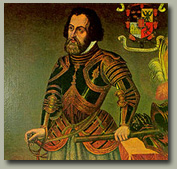 Panfilio de Narvaez landed in Tampa
Bay on Good Friday, April 1528, with the intention of starting a
colony. He declared it “the best port in the world.” After
being told by the natives of better riches to the north, Narvaez
immediately got into an argument with a local Indian chief who in
turn sliced off Narvaez’s nose and chased him out of the area.
They abandoned their camp after only a week. A dozen years later, a
surviving member of the expedition named Juan Ortiz was rescued by
Hernando de Soto's expedition.
Panfilio de Narvaez landed in Tampa
Bay on Good Friday, April 1528, with the intention of starting a
colony. He declared it “the best port in the world.” After
being told by the natives of better riches to the north, Narvaez
immediately got into an argument with a local Indian chief who in
turn sliced off Narvaez’s nose and chased him out of the area.
They abandoned their camp after only a week. A dozen years later, a
surviving member of the expedition named Juan Ortiz was rescued by
Hernando de Soto's expedition.
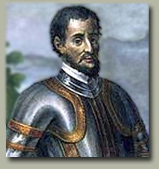 Hernando de Soto
arrived in the area on May 25, 1539, calling Tampa Bay “La Bahia Del
Espiritu Santo” (the Bay of the Holy Spirit) and met with native Indians
under the Charter Oak (or De Soto Oak) near present day Plant Park
at the University of Tampa. A peace treaty was conducted with
the local Tocobaga Indians, and a short-lived Spanish outpost was
established. However, this was abandoned when it became clear that
there was no gold in the area, that the local Indians were not
interested in converting to Catholicism, and that they were too
skilled as warriors to easily conquer. The Tampa area would be
effectively ignored by its colonial owners for the next 200+ years.
Hernando de Soto
arrived in the area on May 25, 1539, calling Tampa Bay “La Bahia Del
Espiritu Santo” (the Bay of the Holy Spirit) and met with native Indians
under the Charter Oak (or De Soto Oak) near present day Plant Park
at the University of Tampa. A peace treaty was conducted with
the local Tocobaga Indians, and a short-lived Spanish outpost was
established. However, this was abandoned when it became clear that
there was no gold in the area, that the local Indians were not
interested in converting to Catholicism, and that they were too
skilled as warriors to easily conquer. The Tampa area would be
effectively ignored by its colonial owners for the next 200+ years.


 Did
you know?
Did
you know?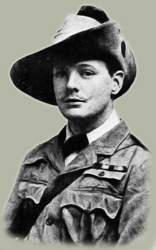 Did
you know?
Did
you know?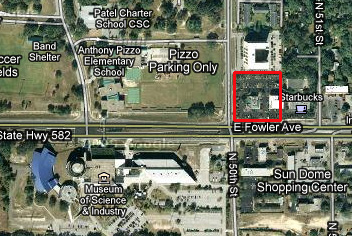 Did you know?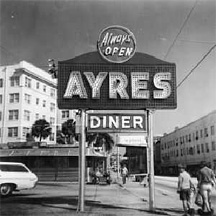

 John
V. Cinchett's passion for the
1950s and his love of commercial neon art finally came together.
Compiling and organizing rare old photos of Tampa, he authored
John
V. Cinchett's passion for the
1950s and his love of commercial neon art finally came together.
Compiling and organizing rare old photos of Tampa, he authored