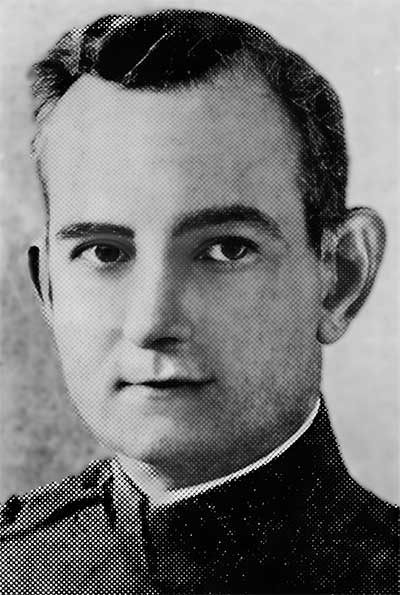
DALE MABRY
SON OF MILTON HARVEY MABRY, SR. AND ELLA DALE BRAMLETT
This is a breakout page from the Descendants of Milton H. Mabry.
Read about the life of Milton H. Mabry, Sr. on Page 1 of this feature.


Dale Mabry - The seventh child of Milton H. Mabry, Sr. & Ella Dale Bramlett


EARLY LIFE AND EDUCATION


Dale Mabry was born March 22,** 1891 in Tallahassee during his father's first term as Supreme Court justice.  In 1890 Milton Sr, had built a large home on a hill overlooking Dade City, so Dale moved there with his family by1900 where he attended the public schools of Pasco County. 

**Dale's WW1 draft registration and some military records that provide his birth date, show March 27, 1891.  His application for a passport in 1921 shows March 22, 1891.


1900 CENSUS, DADE CITY, PASCO COUNTY, FLA.
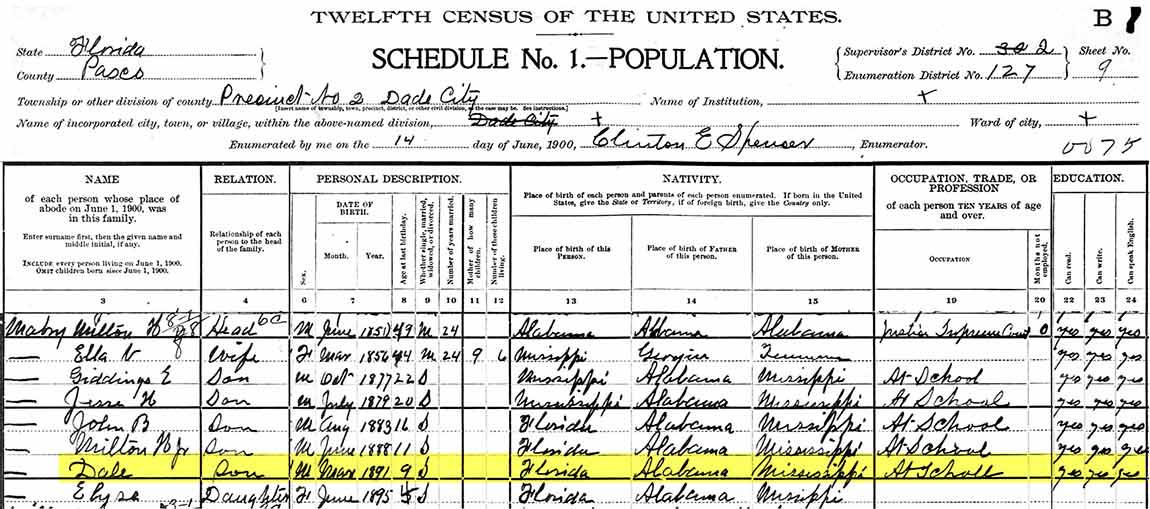
Dale was 9 years old and attending school.  Below him, "Elyse" was Eloise, the Mabrys' only daughter.
 

In 1903 at the age of 10, Dale moved with his parents to a home on Bayshore Blvd, due to his father having joined Dale's oldest brother in his private law practice.  But upon the death of Dale's mother in 1904, Milton decided to leave Tampa and serve as Clerk of the Supreme Court in Tallahassee.  Moving there with his father, Dale continued his education and Irene Washburne became his stepmother in 1906, Milton having married her in Nov. 1906.  


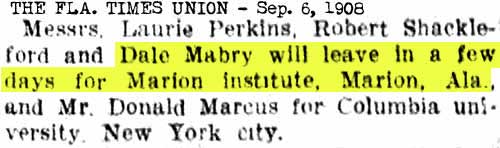
Dale then entered at the Marion Military Institute in Marion, Ala. at the age of 17 in Sept. 1908.  After a year, he returned to Tallahassee where he became a clerk at the Capitol building and lived the life of a socialite attending parties, dances, contests and playing games.
 

1910 CENSUS, TALLAHASSEE, LEON CO., FLA.
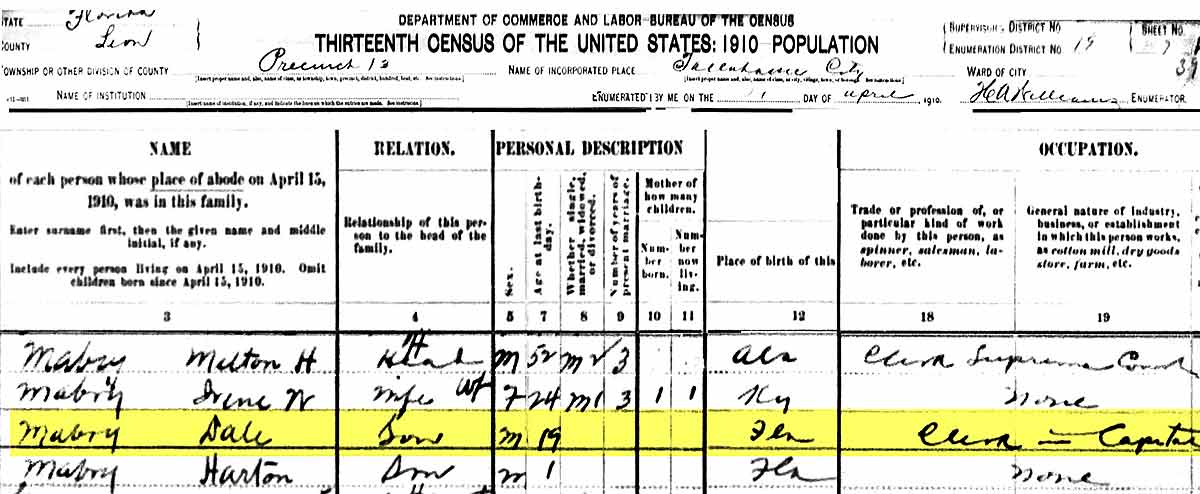
Dale was 19 and working as a clerk at the Capitol building The Mabrys were living about 3 blocks north of the State Capitol.  Milton was recorded as being 52, but he was actually 59 to turn 60 next month.  This was his 2nd marriage, indicated by the "M2," and he was a Clerk, Supreme Court. Irene was recorded as 24, but she was actually 38.  Her tombstone shows she was born March 28, 1872.  It's possible that only Dale was home and may have provided the information.  This was Irene's first marriage, mother of 1 child, 1 living.  Milton & Irene's son Harton was 1 year old.


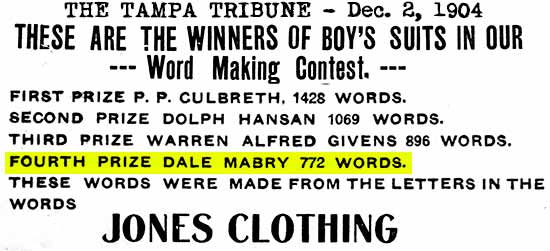
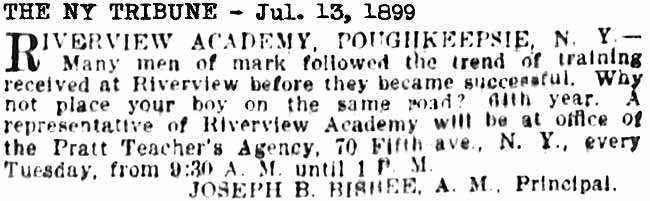
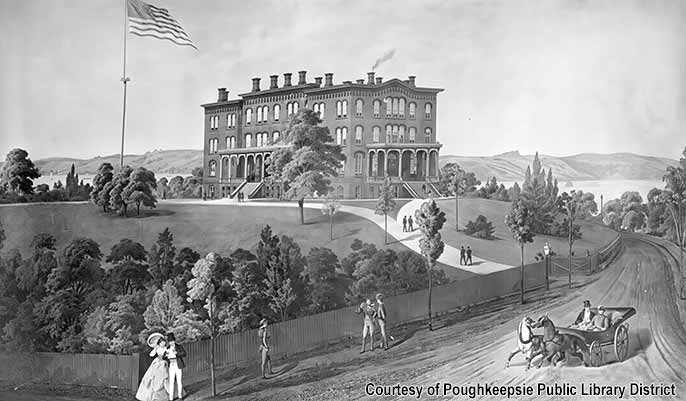
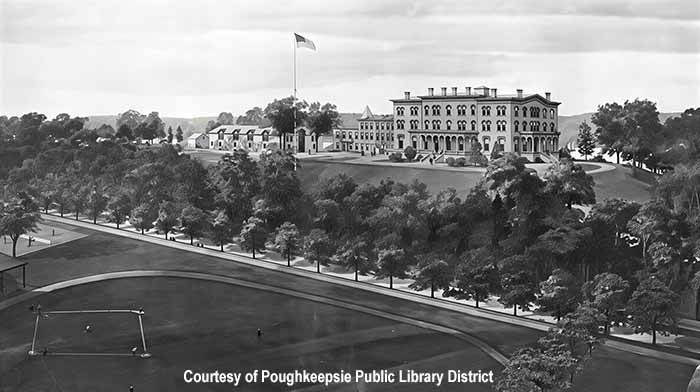
An Oct. 9, 1910 Florida Times-Union (Jax) article printed in its "Tallahassee News" section, "Mr. Dale Mabry, son of Hon. M. H. Mabry, left a few days ago to enter Poughkeepsie."  This may have been the Riverview Military Academy at Poughkeepsie where he would have prepared for college and a career in business.


Several articles in the Pensacola and Jacksonville papers of Dec. 1911 to Feb. 1912 mention Dale going home several times to Tallahassee to visit his parents while attending school in Atlanta. The Atlanta Journal of Mar, 3, 1912, published "Dale Mabry, who has been visiting his father, Judge Mabry of the Supreme Court, left this week for Tampa where he will study law with his brother." (Milton was a clerk of the Supreme Court at this time, not a Justice.)


DALE MABRY IN REAL ESTATE BUSINESS


But Dale wasn't coming to Tampa to study law with his brother, as he had no legal education. He came to join his brothers in the real estate business. His first sale in the news was the sale of property in early June 1912 for a lot in Suwanee Heights to Robert Walden of the Tampa Hardware Co. This was quickly followed by two more lots at the same development on June 15 and many more over the coming months.
 

In early Aug. 1912, Dale was elected secretary of the Baracas class  at a meeting at the YMCA of Tampa.  The Baracas was a newly formed class of the First Baptist church, the members of which resolved to do what they could to stop the Sunday operating of shows and other amusements. They believed that the running of amusement places on Sunday was unnecessary, a violation of the Sabbath, and some thought was a violation of the city and state laws.


Ironically, in Nov. 1912, Dale sold 5 lots in Suwanee Heights, to two men, one being the manager of the Alcazar and Bonita movie theaters. His father's company, the Mutual Development Company, had opened its new subdivision, "East Suwanee Heights." in early December that year.   Dale became highly successful selling lots in Suwanee Heights as reports of his sales appeared in just about every issue of the Times and Tribune.


The Mabry Realty Co. served as the agents for Suwanee Heights, while the Mutual Development Co. was the owner.


Dale continued to be mentioned on the society page section as he often attending various entertainments--luncheons, meetings, dances, picnics, boating trips, weddings and parties.


The ad at right appeared almost daily in the Tampa newspapers, until it changed to a vertical format in Sep. 1913 with Dale as Sales Manager.


In Jan. 1915 the Tampa Real Estate board voted to enter a float in the Gasparilla parade, representative of the board and its objects. Dale Mabry was appointed the chairman of the float committee. Hugh C. Macfarlane was to appear in full Scottish regalia, including a kilt. Dale was unanimously elected to choose a young lady to occupy the seat of honor on the float and determine the costs and manage the construction of it.


In the summer of 1915, Dale traveled to Tallahassee to assist his father in conclusion of his affairs, having announced his retirement as clerk of the Supreme Court. 


July 30, 1915 - SERIOUS AUTO ACCIDENT INJURY, but which Mabry was it??
The July 31, 1915 Tampa Times says it was Dale Mabry, the July 31, 1915 Lakeland Ledger says it was G. E. Mabry.
 

MABRY "MEAT" IN "AUTO SANDWICH" subtitled "REAL ESTATE MAN PINNED BETWEEN TWO CARS.
Dale Mabry of the Mabry Realty Co. drove a Henderson automobile with Mr. & Mrs  G. E Mabry and Mr.& Mrs. Trice to Lakeland to attend a meeting at the Lakeland Baptist Church. From this point on, only "Mr. Mabry" is referred to. The car was parked in front of the church and when the meeting was over, "Mr Mabry" came out to crank start the car. Not realizing he had left the car in gear, the car started forward, pinning Mr. Mabry between it and the car parked in front of it.  The cars proceeded 75 to 100 feet down the street with Mabry pinned between them, ultimately stopping when the front car ran up on a sidewalk and smashed into a telephone pole. People rushed to the cars to find Mr. Mabry "seriously injured," and pulled the Henderson back.  Mr. Mabry stepped from between the two machines and at the insistence of his brother, they called on a doctor at the Kibler hotel.  The physician found no broken bones or internal injuries, and the party returned to Tampa.  With Mr. Mabry not having any broken bones or internal injuries, and except for a little soreness, he said he felt no effects of the experience.  He showed up for work at his office on time the next morning.
The July 31, 1915 Lakeland Ledger says it was G. E. Mabry who was pinned.  Read about their version.


DALE MABRY THE BOWLER


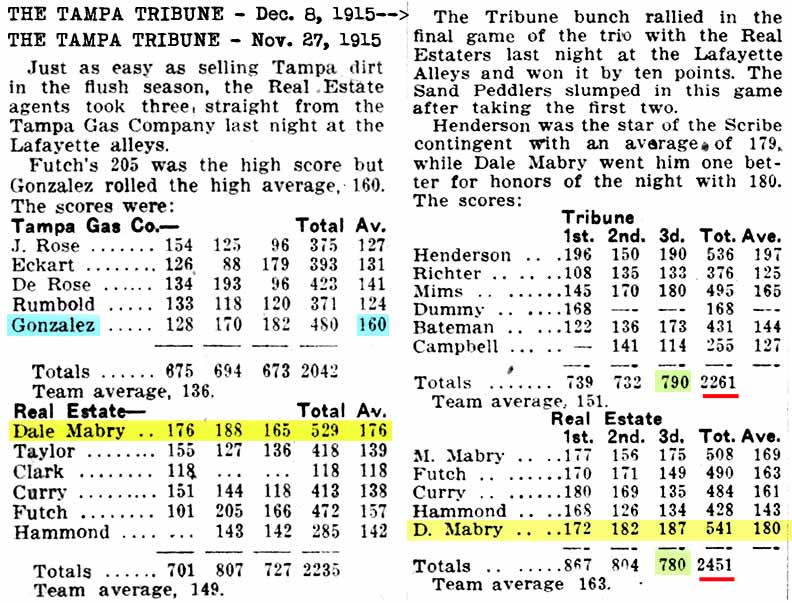
In Tampa, Dale enjoyed bowling on the  Real Estate team in the Tampa leagues and was quite a good bowler.  These leagues played at the "Lafayette alleys."


The Tribune's reporting is deceptive, whether intended or not.  For the Nov. 27 match, it claims Gonzalez had the high average, but that was only for The Tampa Gas Co. team. Dale had a higher average.


For the Dec. 8 match against the Tribune's team, it describes a rally by the Trib in the final game, winning by 10 pins, and the "Sand Peddlers" slumping after taking the first two.  It fails to mention that the Tribune lost the match by 190 pins.


It's likely that the pins were reset manually by boys or young men, as mechanical pin setters didn't begin to make their way into bowling alleys until the early 1920s, and they weren't automatic.


Dale was also a competitive tennis player, winning many tournaments, mostly in doubles.


DALE MABRY FIRES A PISTOL AT MIDNIGHT


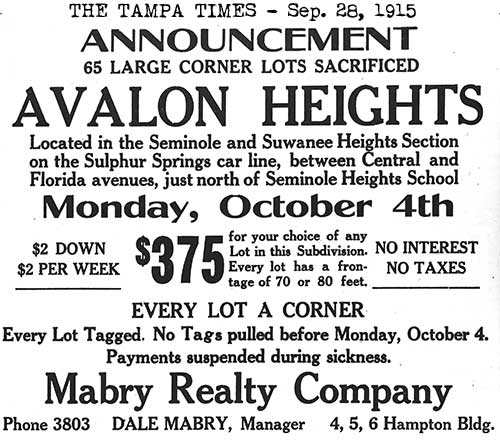
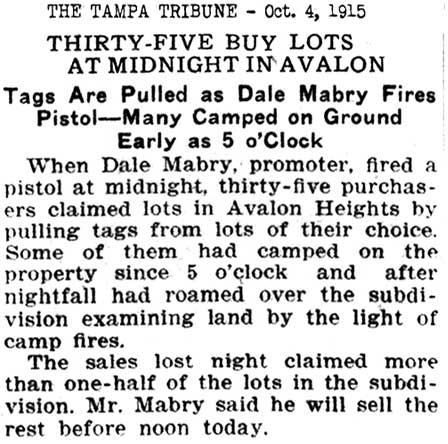
In early Oct. 1915 Dale is described as a "promoter," firing a pistol at midnight to mark the start of lot sales in a new subdivision in the Seminole Heights and Suwanee Heights section--Avalon Heights.  Buyers then raced to the lot of their choice to pull the tag and stake their claim.


SUBURB BEAUTIFUL
The development of "Suburb Beautiful" began between 1905 and 1910 with Alfred Reuben Swann who became a major figure in Tampa's residential and commercial development.


Swann, along with Eugene Holtsinger, a fellow Tennessean, developed a large residential subdivision on Hillsborough Bay named Suburb Beautiful. Their Bayshore Boulevard development featured a seawall and a roadway between the residences and the bay, giving Tampa its beautiful scenic drive. Swann envisioned Tampa as a major American city.


Swann was soon joined by his son, James T. Swann, Sr., and grandson James T. Swann, Jr.


Holtsinger teamed up with Alfred Swann in a land-development business and built homes in Hyde Park, Ridgewood Park, Ybor City and West Tampa, as well as Suburb Beautiful. Holtsinger was also the developer of the area known today as Channelside.

Read more about the Swanns.


The bridge over the Hillsborough River at North Blvd. was completed in 1959 and named in honor of Eugene Holtsinger.
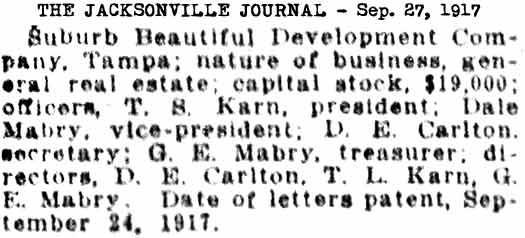


In late Sep. 1917 the Suburb Beautiful Development Company was incorporated in Tampa with Dale Mabry as VP.  G. E. Mabry was Dale's brother, Giddings Mabry, who was in law practice with Doyle E. Carlton as  Mabry & Carlton.  Carlton would be elected governor of Florida in 1929.


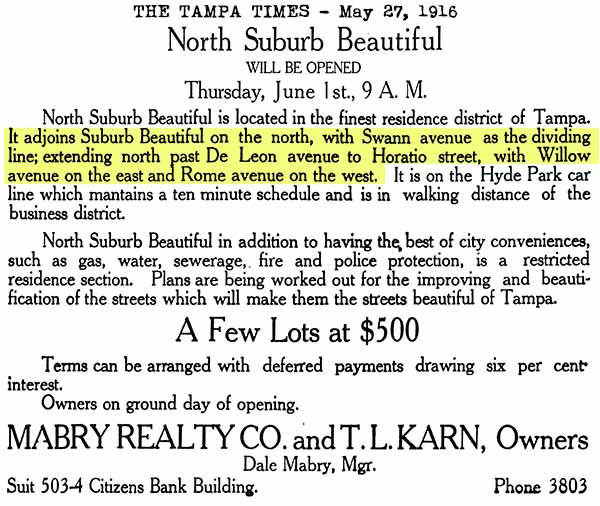
THE LOCATION OF NORTH SUBURB BEAUTIFUL
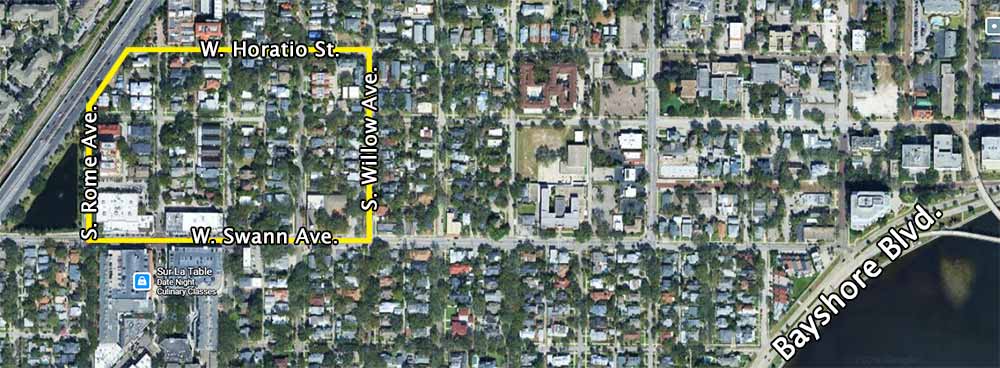


Read the rest of this ad.


DALE MABRY MILITARY SERVICE


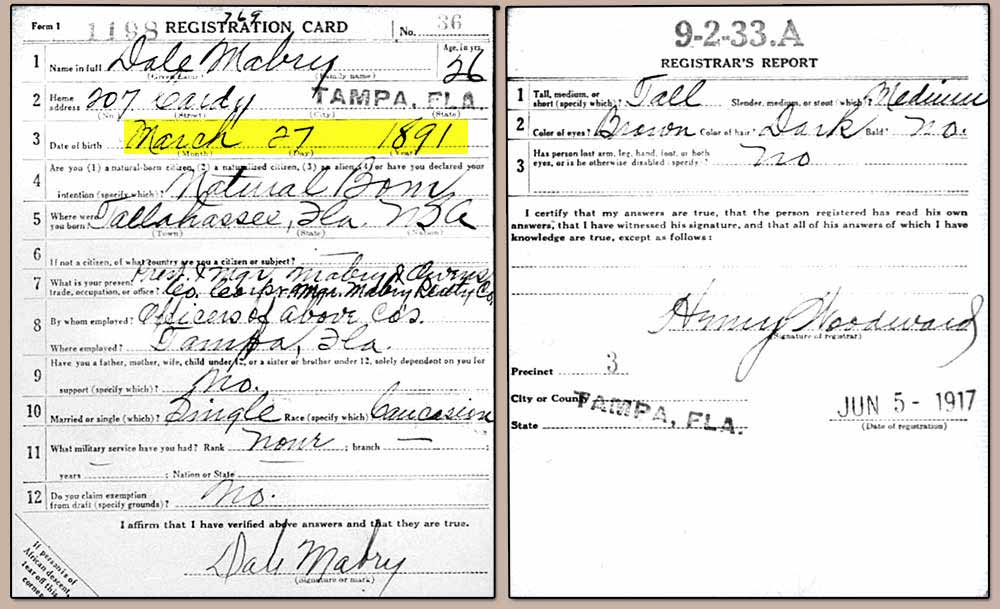
Dale registered for the WW1 draft on Jun. 5, 1917 and immediately thereafter joined the Army.  At the time he was living at 207 Cardy in Hyde Park; his brother Giddings' home.  Dale was president & sales manager of Mabry & Owens Co. and corporate manager of Mabry Realty Co., employed by its officers.

DALE MABRY WW1 DRAFT REGISTRATION CARD


Notice here his birthday is recorded as March 27, not March 22 as in other sources.


OFFICERS BOOT CAMP
 

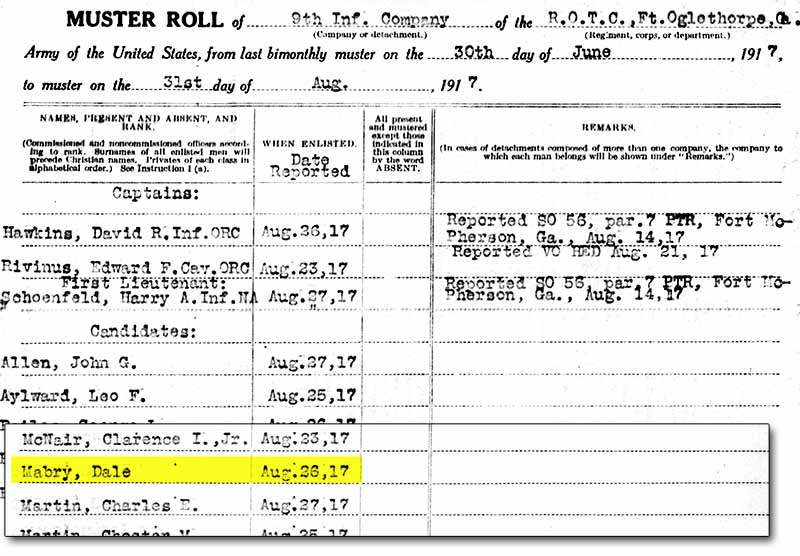
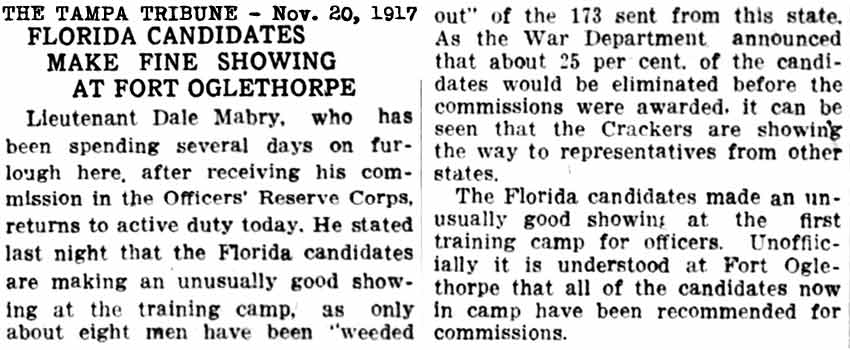
On Aug. 25, 1917 Dale and 13 other Tampa men were sent to Fort Oglethorpe, Ga., with the train picking up more men between Tampa and Jacksonville along the way.  The muster roll of the 9th Infantry ROTC at Ft. Oglethorpe of Aug 31st, 1917 lists Dale as arriving on Aug. 26, 1917.


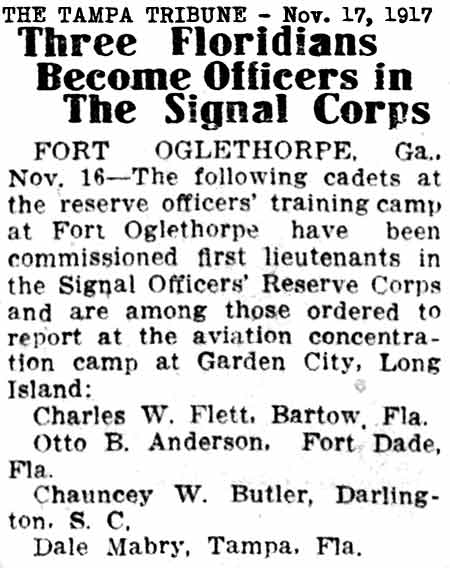
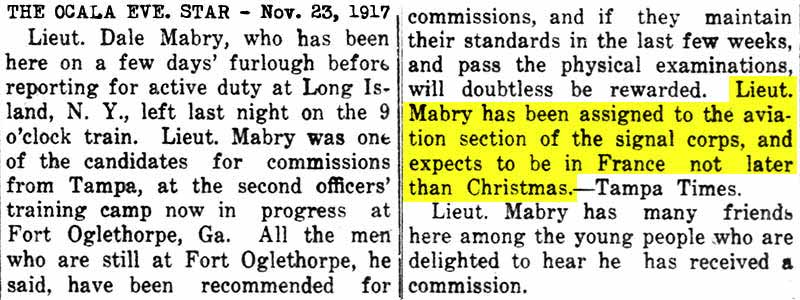
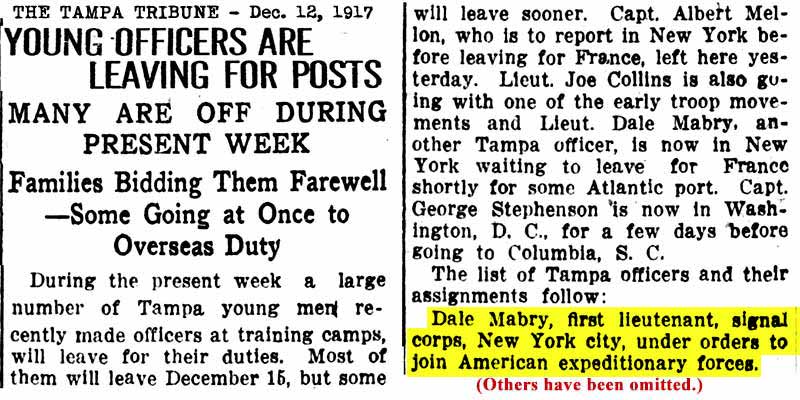
Just before completing his training at Ft. Oglethorpe, Dale went to Atlanta and took the exam for the Army Air Service.  In Nov. 1917 Dale was one of four cadets commissioned as First Lieutenants in the signal officers reserve corps.  They were ordered to report to the aviation camp at Garden City, Long Island, NY.


The Dec. 27, 1917 Tampa Tribune reported that "word was received from Giddings Mabry stating that his brother, Lieut. Dale Mabry, has arrived safely 'somewhere in France' ...having been assigned to the signal corps for active service in France."


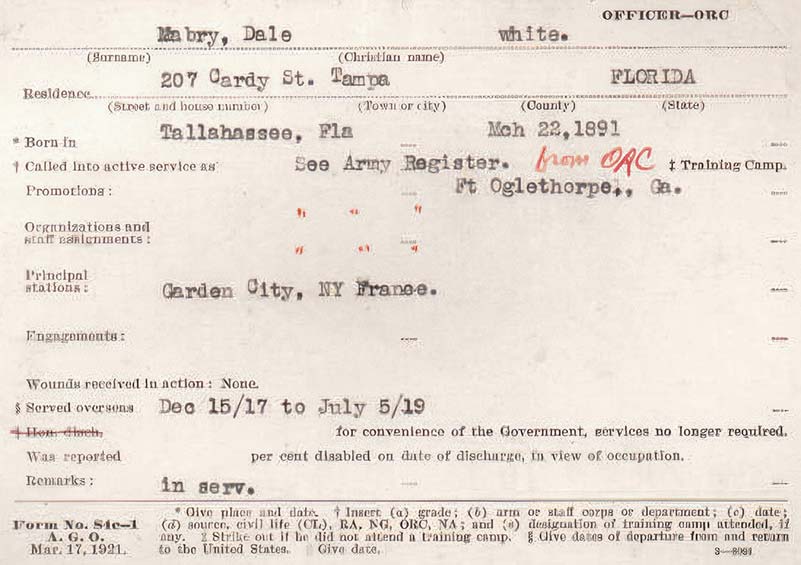
According to his military service card, Dale was at Garden City, NY which was his departure station.  Dale served overseas as a 1st Lieut. from Dec. 15, 1917 to Jul. 5, 1919 in the American Expeditionary Forces Signal Corps in France. 


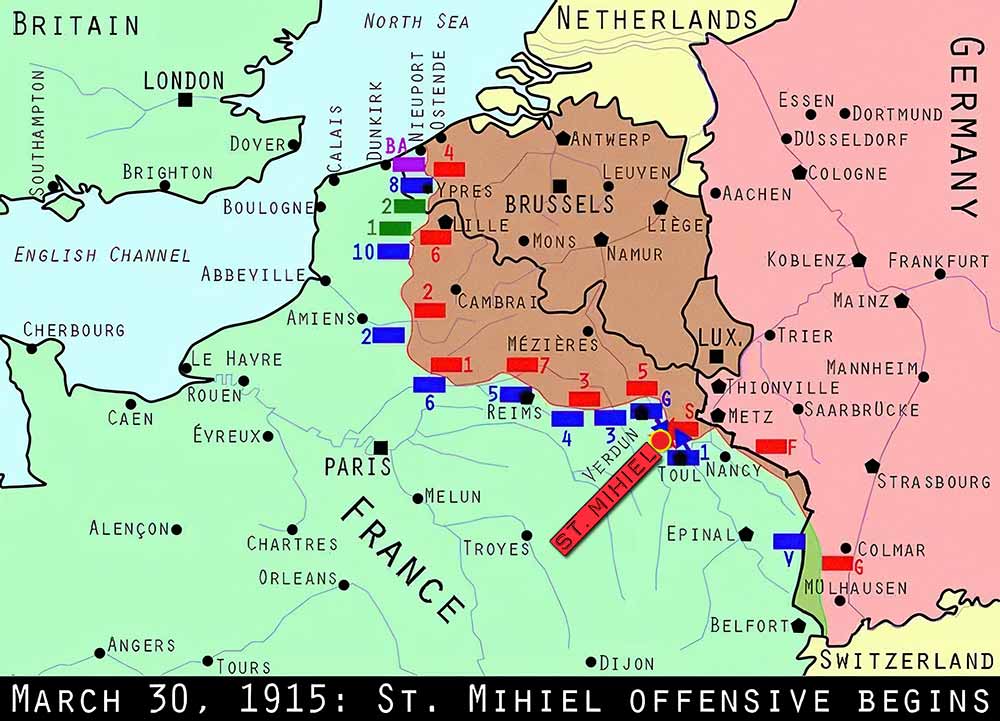
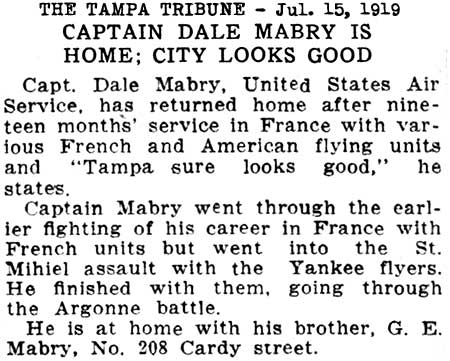
A Jul. 15, 1919 Tampa Tribune article published after Mabry's return home, says "for the first few weeks in France, he was stationed with the French air forces, but was then sent to Saint-Mihiel salient with the Americans, remaining with his own countrymen throughout the war.  


(During World War I, Saint-Mihiel was captured by the Germans in 1914, and was recaptured during the Battle of Saint-Mihiel by the American Expeditionary Forces (AEF) from 12 Sep. 12, 1918 to 19 Sep. 19, 1918) 


Dale's military service card shows his correct birth date.


ABOUT THE 10TH BALLOON CO. from Dept. of the Air Force Organizational Histories, presented here in the green sections. DEPARTMENT OF THE AIR FORCE UNIT HISTORIES, Created: 15 Feb 2014  Sources: US Army Order of Battle 1919-1941. Steven E. Clay. Combat Studies Institute Press. US Army Combined Arms Center. Fort Leavenworth, KS. Nd.


LINEAGE

B Co, 4 Squadron organized November 13, 1917 Redesignated 10th Balloon Company


COMMANDERS

Lt Koenig, Lt Palmer, 27 Nov 1917,  Lt Henske, 18 Jan 1918,  Lt Lavers, 4 Apr 1918 1, Lt Dale Mabry, 25 Jul 1918


OPERATIONS

The company was organized November 13, 1917, at Fort Omaha, Nebr., with Lt. Koenig commanding. On November 27, 1917, Lt. Palmer assumed command, Lt. Koenig being transferred to a unit proceeding overseas. January 18, 1918, the enlisted strength of the company was increased from ninety-one to two hundred men, with Lt. Henske replacing Lt. Palmer as Commanding Officer.


The first week in February orders were received to move to Camp Morrison, Virginia. On February 6th Company B boarded the train bound for Camp Morrison. Three days later, February 9th, the company arrived at Camp Morrison.


We embarked on the U. S. T. America on June 29, 1918. The thermometer was hovering around a hundred or more, but not a man fell by the way, side or dropped out en route. At 5:30 p.m. the company was lined up at the pier ready to board and in short time were started across the gang plank, onto the Steamship America, a name sufficient to stir up plenty of sentiment. After getting on board it was found out that the ship was an old Italian liner, manned by an Italian crew; sentiment somewhat dropped. At 7 the same evening the ship slipped down the river to the lower bay and lay at anchor until the following afternoon at 4:30 p.m. when the anchor was pulled in and the ship started down the bay.  Newport News does not have a Statue of Liberty, but still, the receding shores of the United States of America was sufficient statue of Liberty to give all the attendant thrills at the thought of leaving home and country.


The next morning at sunrise several other transports hove into sight, gathered together in a convoy, and were joined by a fleet of light destroyers and a portion of the mosquito fleet. At noon several other transports and a cruiser joined the transports, completing the convoy. (Dale Mabry was probably on board one of these.)   Although the sea was calm end the weather excellent, many of the men took to their hammocks early in the day. Nothing special happened the next few days until after the fourth day out, the escorting cruiser let go of a terrific broadside followed by several more shots. Every one rushed to see to the submarine but when the smoke cleared away Old Glory was floating out on the breeze from the main mast of the cruiser and one by one the transports raised the flag-- it was the Fourth of July. The remainder of the voyage was very uneventful, in fact, decidedly monotonous especially with the orders at night "Lights out; no smoking."


Early in the morning on July 11th, fifteen American destroyers met the convoy as the cruiser that escorted the convoy all the way across returned. On Friday, July the l2th, at 6:00 in the evening, land was sighted. No one knew just where the convoy was expected to land so rumor was rife as to the port of debarkation. The question was settled that evening when the ship anchored in the bay of Brest. At 9:00 the next morning lighters came out and the company was taken to shore.


After the company had all come ashore it was marched to the outskirts of Brest to a rest camp known as Pontaten Barracks, supposedly at one time headquarters of Napoleon and his troops.  During a short stay at this rest camp Dr Pryor, the company surgeon, earned undying fame with the company when he ordered all men out at two o'clock in the morning to take a bath; the water was cold, the night colder. On July 16; the enlisted strength of the company was reduced to one hundred and seventy men, the men transferred out of the company being sent to the Balloon School, Camp de Souge.


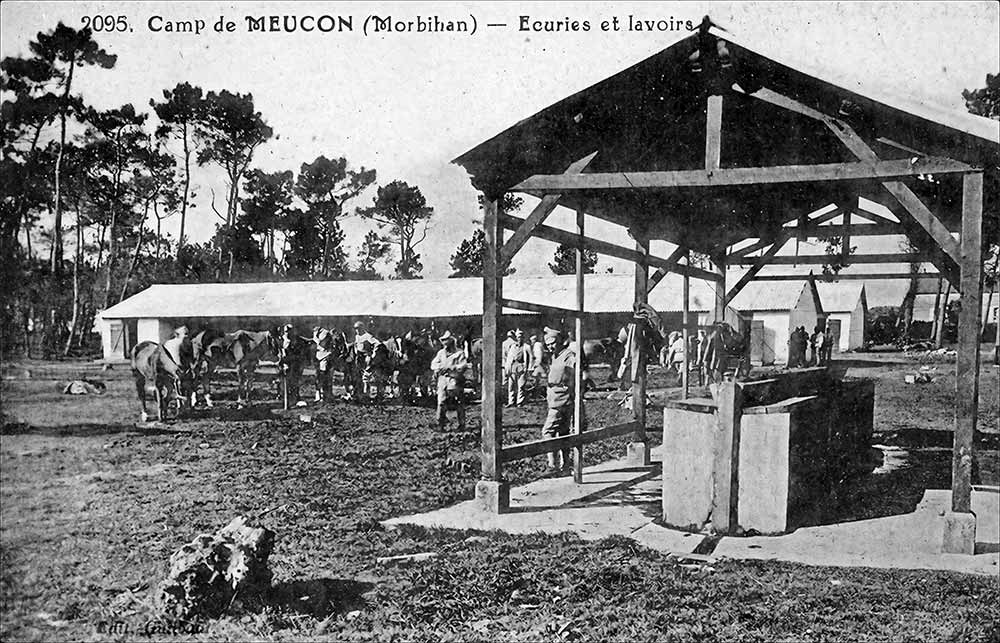
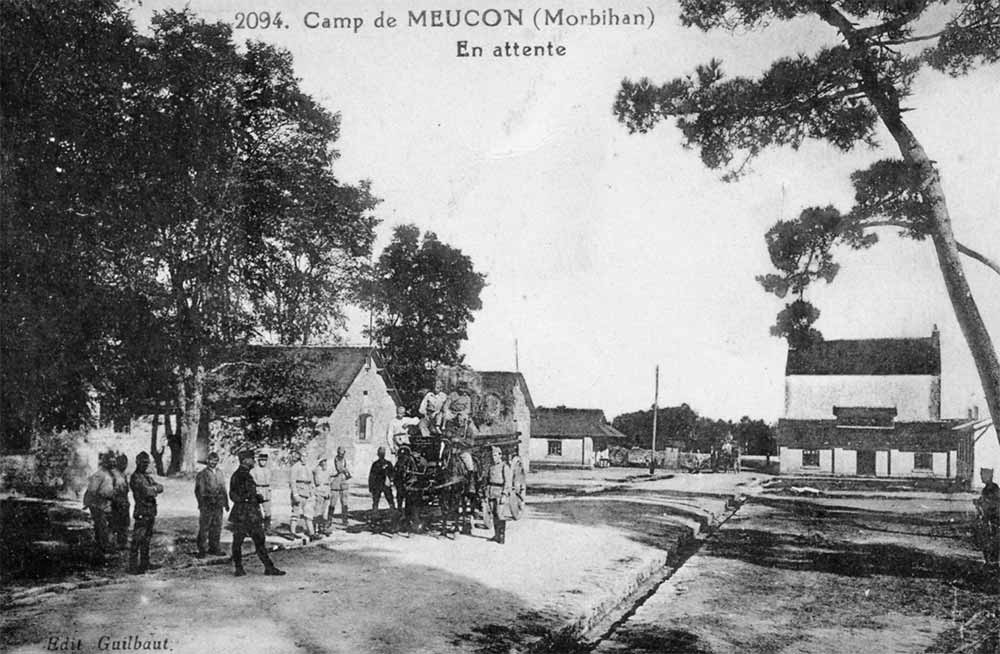
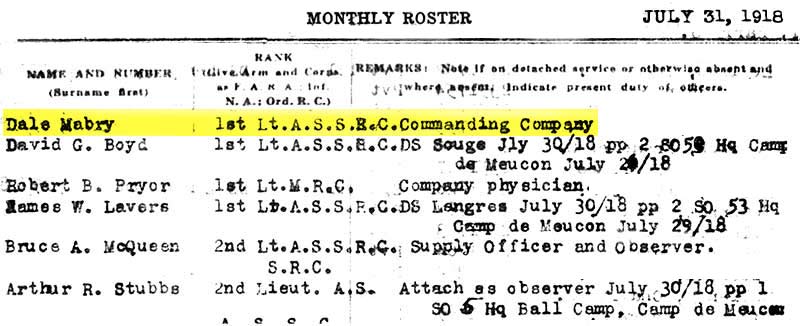
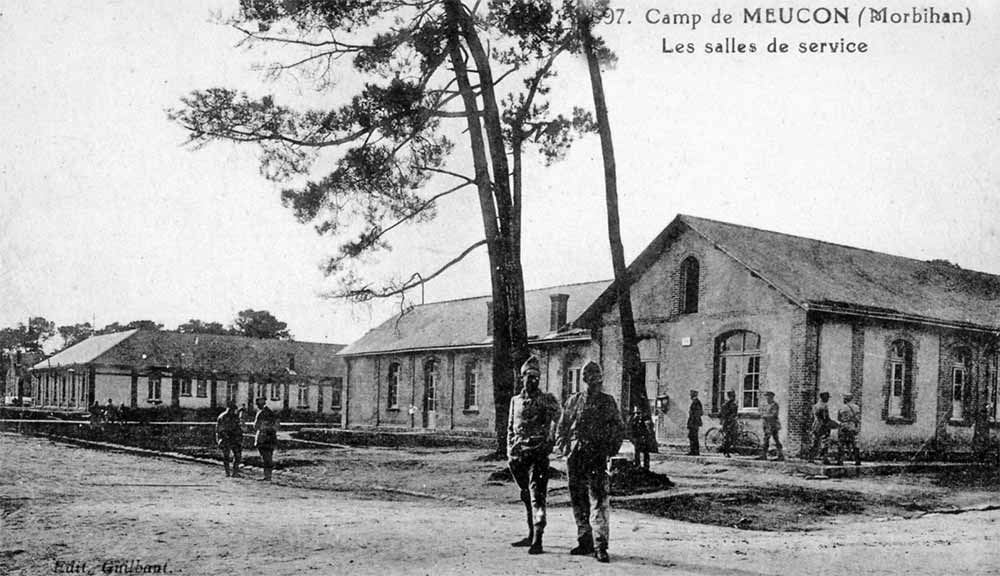
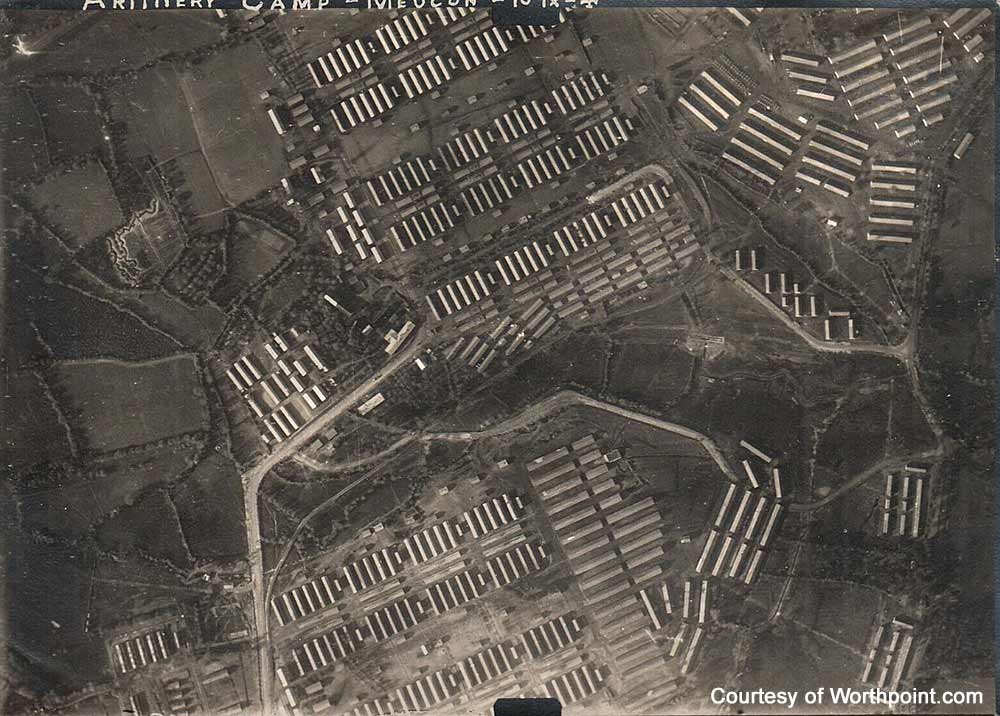
We arrived at our training camp, Camp de Meucon, July 17, where we were taught "how the French do it." On July 25 Lt. Mabry assumed command, relieving Lt. Lavers.


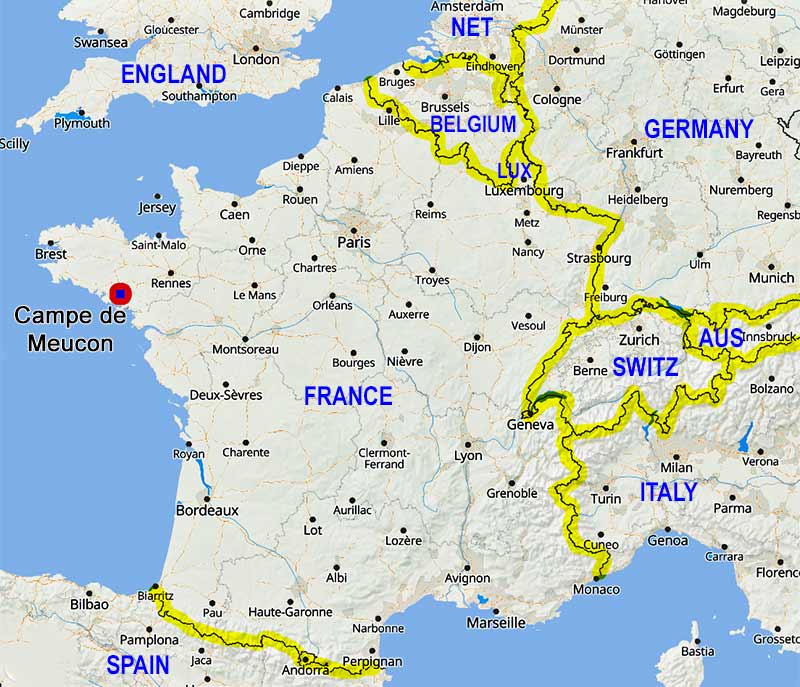
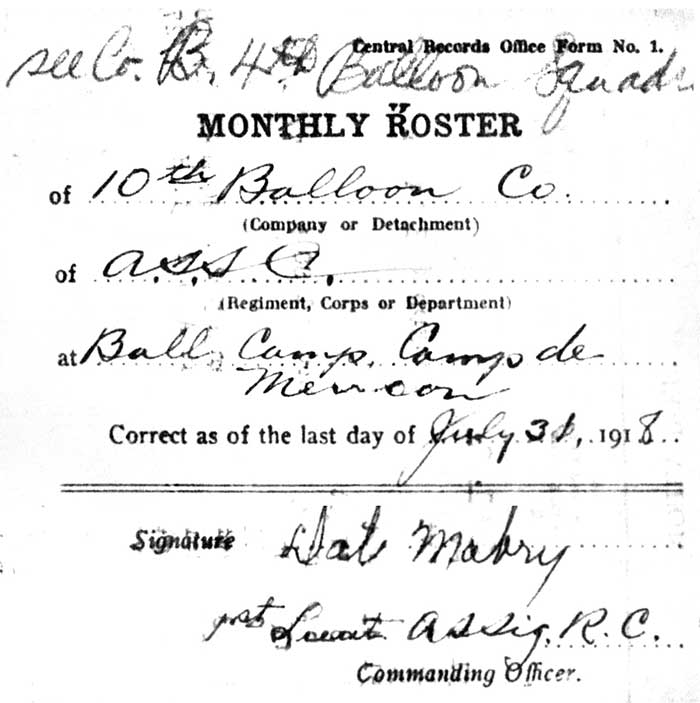
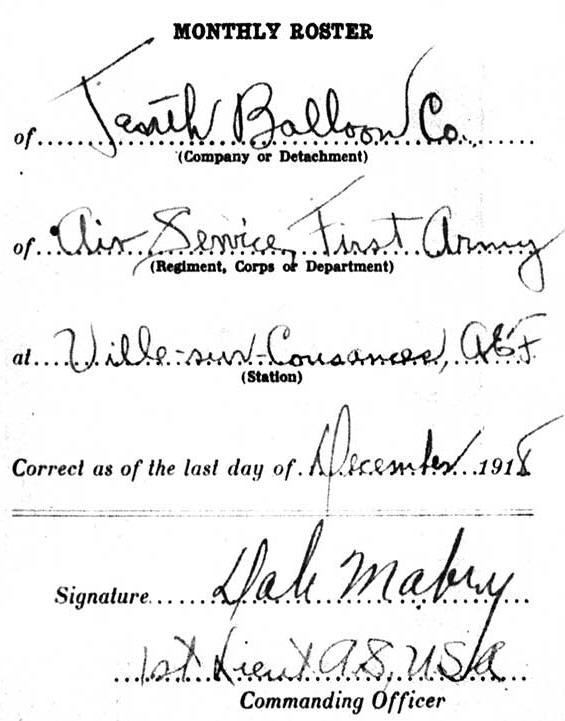
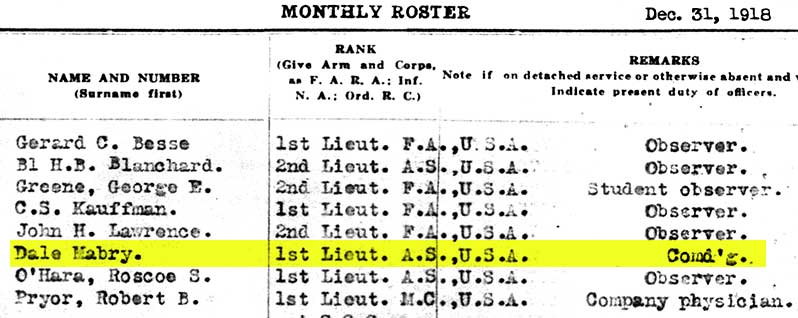
According to monthly Army rosters for WW1, in July 1918, 1st Lt. Dale Mabry was put in command of  the 10th Balloon Co. (which was previously known as the 4th Balloon Squadron,) at balloon camp, Campe de Meucon France. This was in the south of France about 5 miles north of Vannes near the southern coast of France. 


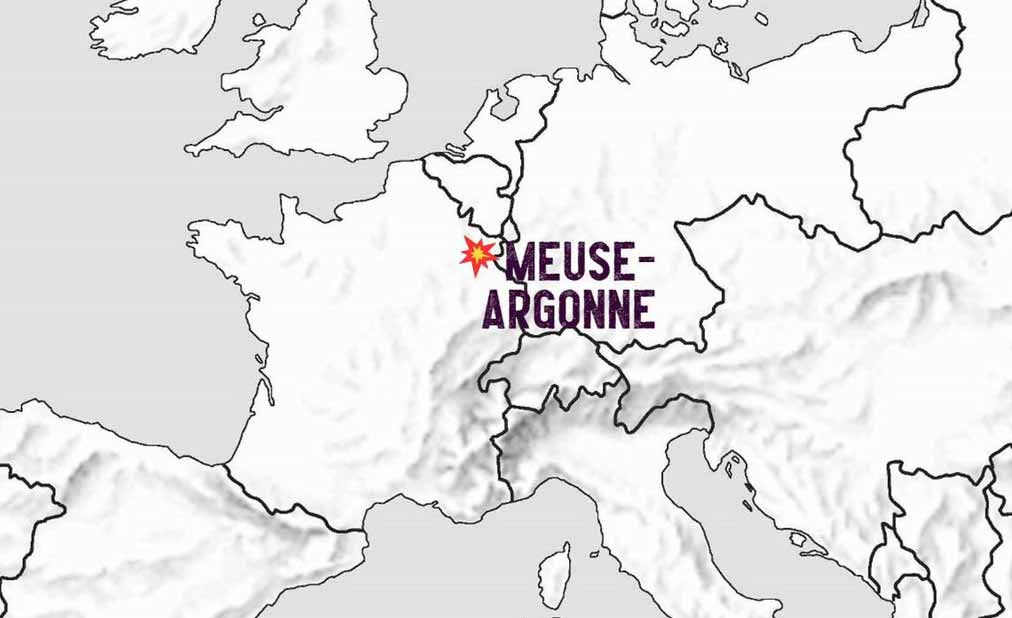
An article in the Tampa Tribune of Jul. 15, 1919 says Dale took part in the battles at Saint-Mihiel and Argonne, remaining there through the end of the war.


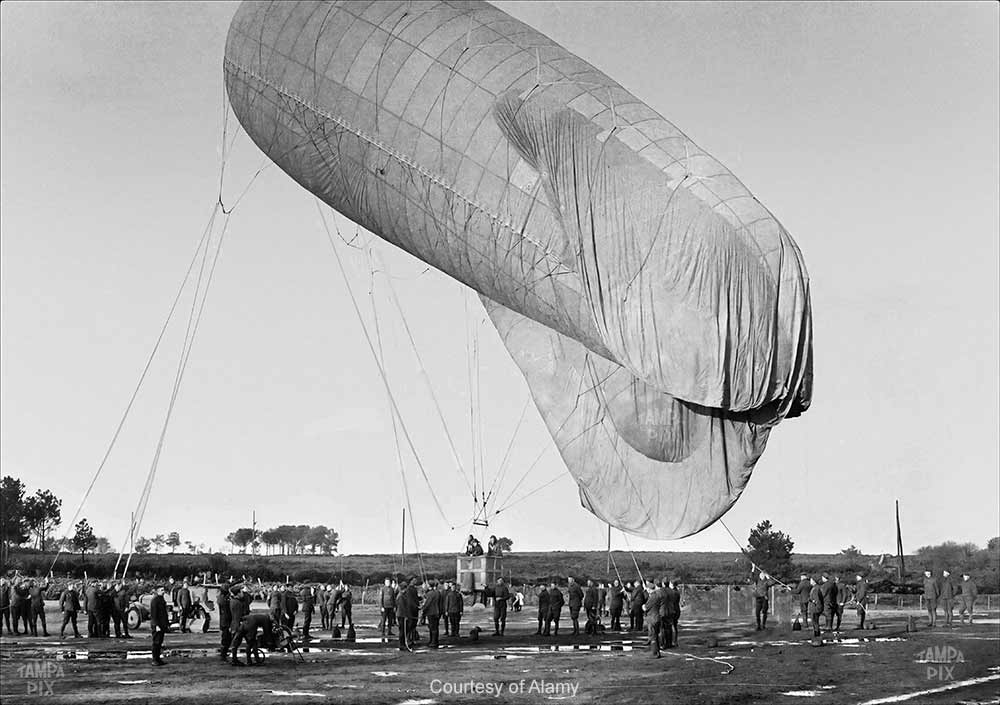
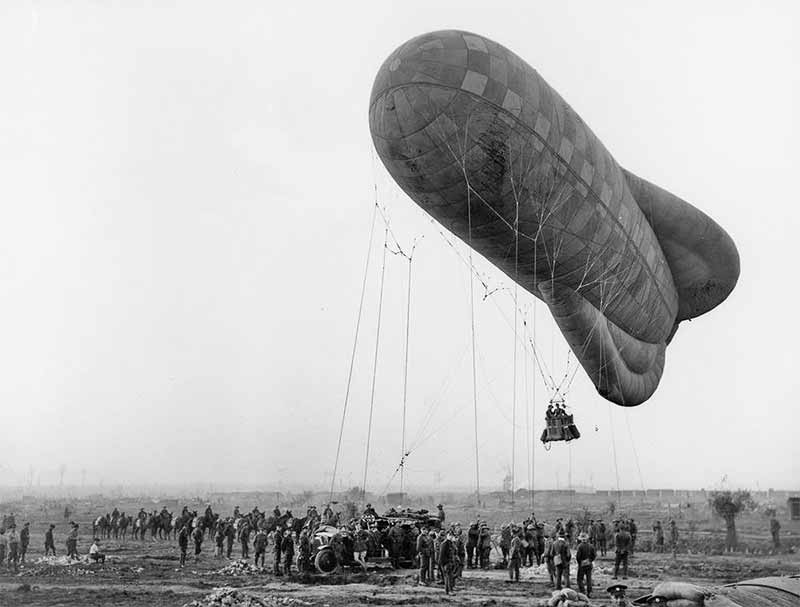
Service in the balloon corps was for reconnaissance and observation, not for combat.  The balloons did not have a propulsion system (no motors, engines, propellers).  They remained tethered to the ground as they were raised high enough to be able to observe the enemy.  The basket was manned by "observers" who would use a wired telephone connection to report the enemy's maneuvers.


On August 26 we boarded a French train and proceeded at last toward the Front, arriving at Toul, the jumping off place for the Lorraine Front, the 30th of August. At dusk, the company piled aboard trucks and our journey towards Berlin began. The Boche had succeeded in dropping a shell on a large ammunition dump near Menil-la-Tour. Because of the fact that it was burning and the fixed ammunition was exploding, it was necessary for us to proceed by side roads that were congested with all kinds of traffic.


Approaching nearer the front lines, we observed the signal rockets, flares and Very lights being thrown up all along the front trenches, these helping to increase our nervousness at being up there for the first time. We all breathed easier when at last we arrived at our new camp in a woods between Menil-la-Tour and Ansauville.

Our first night was spent in rat and "cootie" infested old French barracks. The next morning, because it was still raining, there were no big guns firing. We were very much surprised that things could be so quiet up, there. Fortunately the trip lasted only one day, the train arriving at Vannes at 9 the next morning. Trucks carried the company to a camp 12 kilometers away; quite an unattractive place, quite inviting after the box cars and the French trains with their shrike whistles.

At this camp training began for active service on the front; everything taught in the States had to be relearned for as one man wrote home in his letter, everything is changed, we have to learn everything over again except how to handle the pick and shovel. The company was put through daily drills, taught the use of gas masks how to use helmets.  Special selected men were sent to various schools for training, lectures were given on ballooning on the front, tactical disposition of the balloon, building of balloon and everything else connected with the proper handling of balloons. 

During all this time the company had absolutely no transportation of any kind or description so the first week in August, Lt. Lavers was sent away with orders to get our allotment of transportation. On Aug. 14 he came back with 7 Kelly Springfield trucks, 3 Fords and one old Martini touring car that had been rescued from the salvage pile and coaxed all the way across France. The transportation has survived to date in spite of the most strenuous use.

On Aug. 24 orders for duty at the front were received, equipment was packed, everything gotten in readiness and on Aug. 26th the company left camp for Toul this time traveling in regular third class coaches and not box cars.  We arrived at Toul early on the morning of Aug. 30. As the company was bound for the zone of advance all traveling had to be accomplished at night as the company layover in Toul until evening. The night was as black as pitch, lights of any kind meant aerial bombs galore. The sensation of nearing the actual front where the fighting was going on gave sufficient incentive for compliance with any order regarding safety of lives. Along about midnight the road became crowded with vehicles of all kinds, guns, transports, of every description. Darkness everywhere except in the distance where the shells were bursting in the air.

The truck drivers were all tense and nervous, this was their first experience driving trunks at night without lights and over strange roads; the men were all keyed up to high pitch. Suddenly without warning there was a terrific bombarding up ahead a few kilometers, shells wont screeching bombs bursting and bullets flying and the whole sky lighted up for miles around; ammunition dump had been fired by the Boche shells. This meant a wide detour to avoid the bursting shells so it was nearly three in the morning before the company finally arrived at the place to be set for the camp. Just after noon on September 1 we were brought to a nearer realization of the war when a big Hun shell fell and exploded about two hundred metersfrom the Camp. Half the company started on the run to get souvenirs, the other half did their running towards-their gas masks, and tin derbies. No more shells fell nearby, so it was a fifty-fifty proposition between those who were so anxious to procure souvenirs and those who played "safety first.


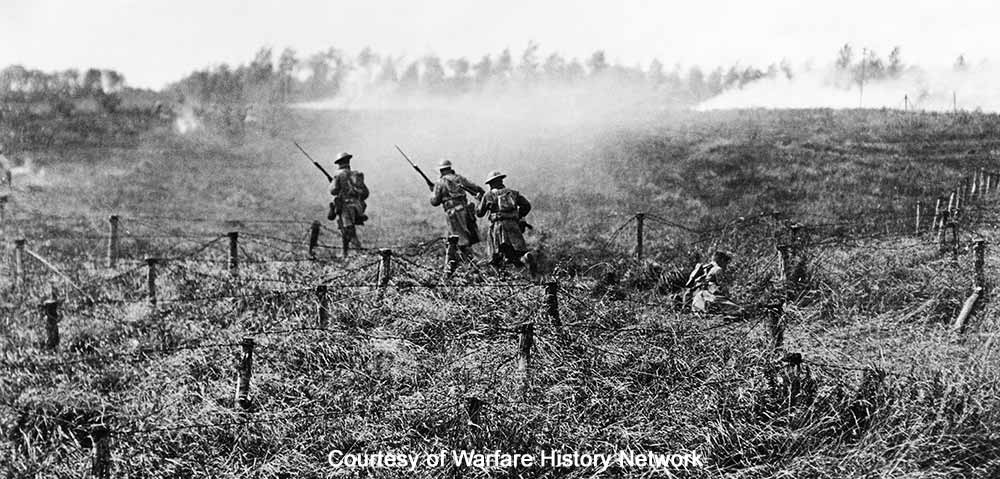
The Battle of Saint-Mihiel was a major World War I battle fought from 12 to 16 Sep.1918, involving the American Expeditionary Forces (AEF) and 110,000 French troops under the command of General John J. Pershing of the United States against German positions. The U.S. Army Air Service played a significant role in this action.


Along about midnight the road became crowded with vehicles of all kinds, guns, transports, of every description. Darkness everywhere except in the distance where the shells were bursting in the air. The truck drivers were all tense and nervous, this was their first experience driving trunks at night without lights and over strange roads; the men were all keyed up to high pitch. Suddenly without warning there was a terrific bombarding up ahead a few kilometers, shells wont screeching bombs bursting and bullets flying and the whole sky lighted up for miles around; ammunition dump had been fired by the Boche shells. This meant a wide detour to avoid the bursting shells so it was nearly three in the morning before the company finally arrived at the place to be set for the camp.

Just after noon on Sep. 1 we were brought to a nearer realization of the war when a big Hun shell fell and exploded about two hundred meters from the Camp. Half the company started on the run to get souvenirs, the other half did their running towards-their gas masks, and tin derbies. No more shells fell nearby, so it was a fifty-fifty proposition between those who were so anxious to procure souvenirs and those who played "safety first."

At 4.30 a. m., on Sep. 4, and after balloon 146 was taken from the bed and adjusted to the winch, two observers climbed into the basket. The balloon arose to 300 meters and the journey to the forward position began, we had just left the forward position to bring the big gas bag back to its bed, because of poor visibility, when five enemy planes made their appearance. They looked things over but flew away without making any attempt to shoot down our balloon because the anti-aircraft batteries began pegging away at them.

The balloon was taken from the bed again at 12.30 p.m., and we journeyed back to the forward position. The bag was at about 500 meters altitude when the corporal of the lookouts reported he heard the humming motor of an-enemy plane. The balloon was ordered to be "hauled down." It was' descending rapidly when at an altitude of about 350 meters an enemy plane dove at it from the clouds. The machine gunners opened fire and as the first clip in their guns started to spit, several anti-aircraft batteries opened up and the battle was on.

Both observers, Lieutenants Likens and Boyd, 'jumped and" their parachutes carried them through the heavy barrage to a safe landing in a nearby field. In his first and second attempts to fire the gas in the balloon, the Boche failed but his third attempt was successful and the balloon fell to the ground a mass of flames. The enemy turned towards their own lines and by doing a number of spectacular stunts escaped the barrage. When we last saw them, they were crossing our lines closely pursued by two "Spades," trying to "sit on his tail." Infantry observation posts reported that the enemy's plane came to earth behind their lines "out of control."


The Battle of Saint-Mihiel


On the morning of Sep. 12th, the great St. Mihiel drive opened with a heavy artillery barrage at one o'clock. The great guns roared about us and a battery of 240s that were emplaced directly behind us shook our barracks and made sleep or rest impossible.

The next morning, during a heavy wind, our balloon took a "nose dive" into the trees, destroying the balloon and throwing both observers out of the basket. Lt. Likens escaped uninjured but Lt. Boyd received injuries so severe that he was subsequently invalided home. We immediately procured a new balloon, inflated it, and started forward the next night. We moved each night under cover of darkness along roads all shell torn and terribly congested with all sorts of traffic going forward ammunition and food for the infantry; ammunition, food-and forage for the artillery, and reserve troops.

Our last move took us into the woods 2 kilometers south of Essay and this was our position until September 21. While in these Essay woods, we received our first real taste of shell fire. A German battery of 105s opened up about midnight and immediately a company race towards the old German dugout was on. No fatalities resulted but there were a number of narrow escapes racing around corners and plunging into the trenches leading into the dugouts. About thirty shells fell, two so close that dirt was thrown around our tents from their bursting.


Observation was an incredibly important role in aerial warfare in World War I. All major combatants used observation balloons to observe their enemies’ trench lines and troop movements. These hovering mammoths were used for directing artillery, which required spotters and observation well beyond the visual range of ground-based observers. As much as planes were able to record enemy positions and movement on film, having real time spotters and observational balloon baskets linked to the ground by telephone was essential. It allowed the artillery to take advantage of increasingly large guns with vastly longer ranges.

See rare photos of balloon uses during World War 1. 


An artillery-spotting balloon goes into the sky above Ypres, Belgium.

Photo from the World War 1 Centennial Commission "Observation Balloons."


At the start of World War I, the organization of the Air Service of the American Expeditionary Force included observation balloon units organized into companies, squadrons, and wings and each company was equipped with one balloon. Five companies comprised a squadron, and three squadrons made up a wing. By the end of the war 110 companies had been created. In the field Balloon companies were allotted to the ground units they supported as needed. In 1918 June, with squadron organization discontinued, company designations were numbered and organized into groups. Only 35 companies made it to France with the American Expeditionary Force (AEF). 17 companies served at the front, making 1,642 combat ascensions, while six other groups were en route to the front at the armistice.


American observation balloon service in World War 1.


On Sep. 21, we moved to Jezainville arriving there at noon. After the company had been fed, a balloon bed was constructed and the balloon inflated. There was no observation here the first few days because of poor visibility. The men busied themselves by picking up odd bits of lumber lying around the hill and built a regular settlement of small shacks, with the result that our observers reported that the camp from the air looked more like a Divisional Training Area in the S.O.S., than a balloon company on the Front. 

We remained at this position until the signing of the Armistice and during our stay there, the Boche aviators were successful in burning two of our balloons. On the first of these occasions, Sep. 25, Lt. Lavers jumped, and on the second, Oct. 6, Lt. Likens made his second drop at the Front.


See also Balloons Up -- The short life of the army balloon service. 
 

The enemy artillery made several attempts to shoot our balloons down and while their deflection was perfect the range was always short and no damage was ever accomplished. Night bombers were very active here and they dropped a number of bombs on roads leading into camp, too close for comfort.

We took part in several demonstrations here, compelling the Germans to hold heavy reserves in this Sector as our aid to the Americans that were making the drive along, the Argonne. Infantry observers reported a big fire within the German lines one night and we received orders to fly the balloon at once. Two observers went up and after several hours working in a heavy rain that made accurate observation next to impossible the balloon was hauled down.

The observers reported the fire was in Noveant, a small town south of Metz, and that it had probably been caused by our artillery, which, assisted by our balloon, had shelled the Noveant Bridge that afternoon. It was while we were at Jezainville that the "dugout slide" was invented and we found our helmets were not surplus weight as they had been back in the S.O.S., for the big shells whizzed and rumbled overhead frequently.

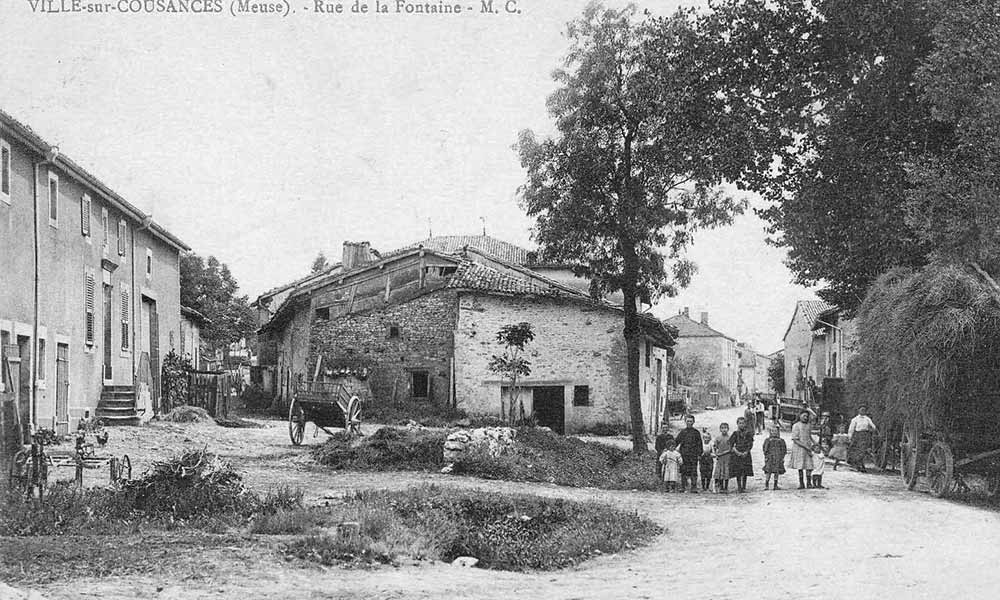
The company had completed all plans for taking part in the long expected drive on the fortress of Metz, scheduled to begin on the morning of November 12, but instead of a victorious advance, the Armistice was signed, and as far as the company was concerned, the world relapsed into a period of prolonged silence, a silence unbroken by the roar of huge guns, the scream of Boche shells, and the hum of Boche planes, a silence which persists to this day, even as the Tenth Balloon Company sinks deeper and deeper into the bottomless mud of Ville-sur-Cousances".

Arrival in France 12 Jul 1918
Arrival at the front 30 Aug 1918

ABOUT THE 10TH BALLOON CO. from Dept. of the Air Force Organizational Histories, presented here in the green sections. DEPARTMENT OF THE AIR FORCE UNIT HISTORIES, Created: 15 Feb 2014
Sources: US Army Order of Battle 1919-1941. Steven E. Clay. Combat Studies Institute Press. US Army Combined Arms Center.
Fort Leavenworth, KS. Nd.

Read this account in its entirety at USAF Unit History website. Some information presented here has been omitted, and some has been edited for clarity.


The Meuse-Argonne Offensive was a part of the final Allied offensive of World War I. It was one of the attacks that brought an end to the War and was fought from September 26 – November 11, 1918, when the Armistice was signed. The Meuse-Argonne Offensive was the largest operation of the American Expeditionary Forces (AEF) in World War I, with over a million American soldiers participating. It was also the deadliest campaign in American history, resulting in over 26,000 soldiers being killed in action (KIA) and over 120,000 total casualties. Indeed, the number of graves in the American military cemetery at Romagne is far larger than those in the more commonly known site at Omaha Beach in Normandy.


Military Records, Meuse-Argonne Offensive at National Archives

See a detailed description of this battle, with maps and photos.


END OF THE WAR


World War 1 came to an end with the Armistice of Nov. 11, 1918, ending the fighting on land, at sea, and in the air between the Allies and their last remaining opponent, Germany.


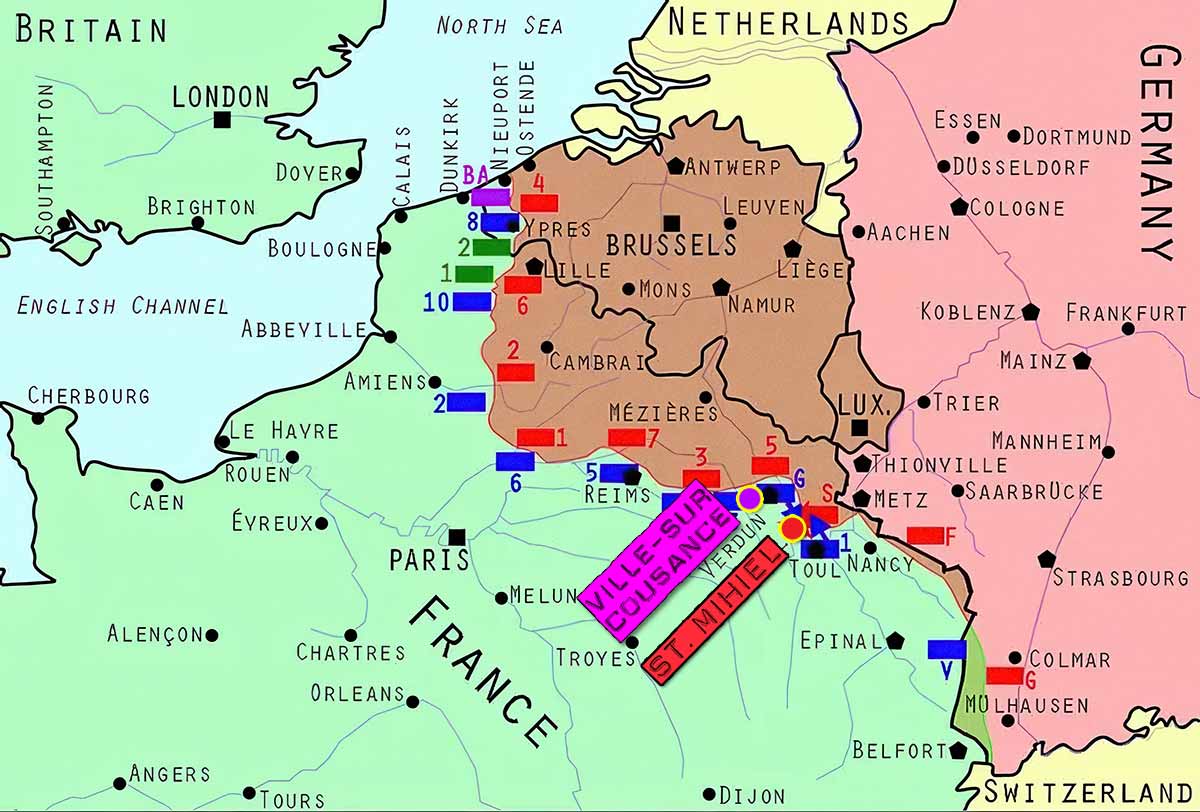
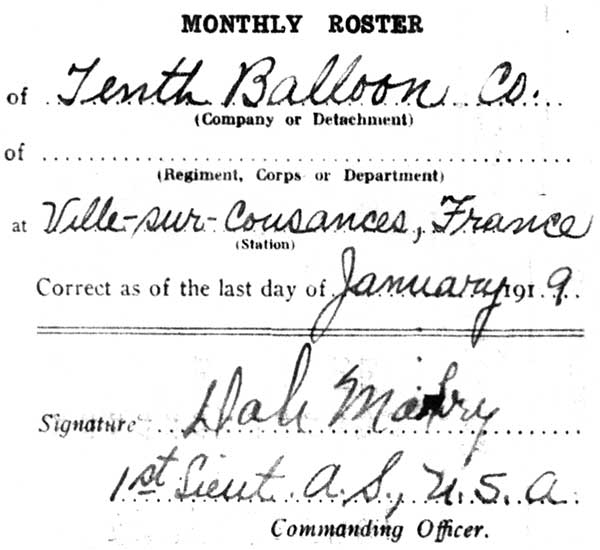
Dale was was stationed at Meucon until he was transferred to the American Expeditionary Force at Ville-sur-Cousances in Dec. 1918 where he continued as 1st. Lieut. commanding the 10th Balloon Co. This was located about 27 miles northwest of Saint-Mihiel in the northeast of France, which today is about 48 miles from the border with Luxembourg and Germany.


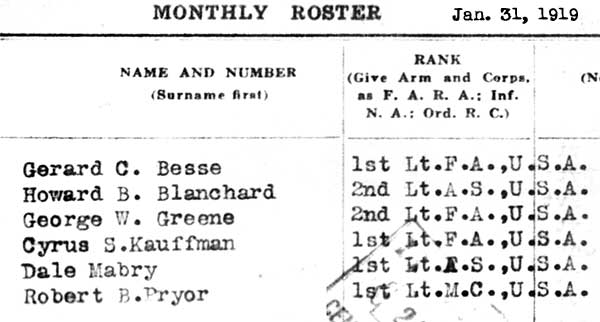
By the end of Jan. 1919, Dale was was still stationed at Ville-sur-Cousances commanding the 10th Balloon Co as a First Lieutenant.


The Feb. 28, 1919 roster of the 10th Balloon Co. lists four 1st Lieutenants but Dale is not among them.  Their captain is listed first--Oscar Roman. This is the first roster to list a captain in the company.


The Mar. 31, 1919 roster of the 10th Balloon Co. lists Captain Samuel T. Moore and 3 first Lieutenants, none are Mabry. The page lists the captain, 5 First Lieutenants, a 2nd Lieut., 2 master Electricians, 12 Sergeants 1st Class, 10 Sergeants,  14 Corporals,  4 Chauffeurs 1st Class, 17 Chauffeurs, and 3 cooks. The next page begins  with "Privates (cont'd)" listing 9 Privates in alpha order of last name, from V to W.  Clearly at least one page is missing between the 1st and 2nd pages. It would have listed the Privates from A to V.   Below this, it lists Medical personnel, a corporal and 2 privates.  Then titled LOSSES DURING THE MONTH it lists 1st Lt. Dale Mabry transferred on the 15th, but it does not give the month or year anywhere on the page nor does it show where he was transferred. SEE THIS PAGE.  More men are listed as either transferred or dropped.  Next is the page which appears to have been the first page of March 31, 1919.  Listing all the ranks and names, ending with Privates First Class and 5 men of surnames starting with B, C, and E.


In May 1919 the 10the Balloon Company was demobilized but it would be reinstated four months later.


DALE MABRY BACK IN TAMPA


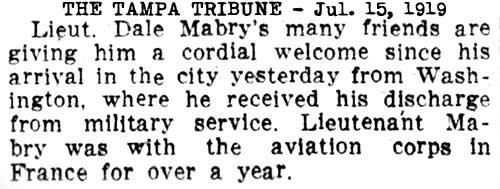
Dale arrived in Tampa on Jul. 14, 1919.   A Jul. 15, 1919 Tribune article (at left) says he arrived from Washington  "where he received his discharge"..


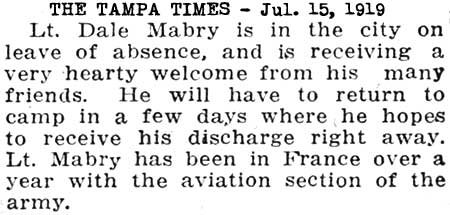
A Jul. 15, 1919 Times article (below) said he was on leave of absence and would have to return to camp "in a few days where he hopes to receive his discharge right away."  But Dale had already been discharged on July 5, 1919.  Another Tribune article on the same day (below) gives a brief summary of his service in France; he "went into the St. Mihiel assault with the Yankee flyers" finishing with them through the Argonne Battle. His duty was for balloon surveilance, not as a combat pilot of a plane.  His military service card presented above shows he was discharged Jul. 5, 1919.


DALE MABRY REJOINS THE 10TH BALLOON CO AT LANGLEY FIELD
 

Army records indicate that the 10th Balloon Company was demobilized in May 1919 and reorganized in Sept. 1919.  By Jan. 1, 1920, Dale had returned to Langley Field and had been promoted to headquarters as a captain.


CAPTAIN DALE MABRY ON THE 1920 CENSUS, LANGLEY FIELD, VA.
 

Dale Mabry was recorded on the 1920 Census of Langley Field, Va.  It shows he was 28 years old, single, born in Fla, occupation Captain U.S. Army.  The official census date was Jan. 1, 1920, so all data recorded was to be as with respect to that date. Which means he moved to Langley Field in 1919 and re-enlisted.


Non relevant columns have been removed.  See this whole page.


In Jun. 1920 Dale was assigned from captain at headquarters to captain in the 19th Airship Company.


On Aug. 2, 1920, the entries in the Sept. 11, 1920 national balloon race at Indianapolis were announced.  Dale was the captain of the Army Air Service's entry with five Lieutenants.


                   See these monthly rosters and the memo.  When it opens, click it to see it full size.


INTERNATIONAL BALLOON RACE


In early August 1920 newspapers around the country buzzed with numerous articles about an international balloon race for the James Gordon Bennett trophy.  It was to start Oct.23, 1920 at the Indianapolis motor speedway and finishing in Labrador. 


There would first be a qualifying elimination race to start from Indianapolis on Sept. 11, 1920 to determine the American balloon entries for the International race.  The U.S. Army Air Service planned three entries for the Sept. 11 elimination race at Indianapolis.  Capt. Mabry along with five Lieutenants were going to represent the Army Air Service (AAS).


But on Aug. 15, 1920, the committee of the U.S. Aero Club announced that both races would start at White City Park, Chicago, due to no suitable field at Indianapolis with the necessary gas connections for the race. A million cubic feet of gas would be required. 


Then a week later, the Aero Club of America made an offer to the Birmingham Chamber of Commerce to hold the races there.  Again, the reason was that the new site at Chicago could also not furnish the amount of gas needed. The Birmingham site was adjacent to the Sloss-Sheffield steel by-product plant which could supply sufficient coal gas for the race.  Coal gas was a mixture largely of hydrogen, methane and carbon monoxide. Naturally, it was flammable and dangerous. Made by pyrolysing coal, it provided light, heat and power for homes and industry in Britain for 150 years until it was replaced by North Sea Gas (methane) in the period from 1967 to 1977. 


Birmingham having accepted the offer on Aug. 31; the qualifying race was to start on Sep. 23 for the honor of representing the USA in the international race to also be held in Birmingham.  Belgium, England, France, and Italy planned entries in the finals for October.


BACK AT LANGLEY AIR FIELD
 

Meanwhile, the Army Air Service was conducting fleet maneuvers at Langley Field, Va.  Dale was commanding the French-built airship Zodiac, known as the ZS-1. 


Army air service officials have received a report on the first fleet maneuvers of dirigible airships held at Langley Field. Three semi-rigid craft participated, and under command of Capt. Bryan B. Daggett, fleet commander, battle evolutions, including an attack formation, were carried out in the air above Hampton Roads and the naval base. The French-built airship Zodiac, officially known as the ZD-1, was the flagship, commanded by Capt. Dale Mabry. She is a 300-foot vessel, and carried three officers and ten men during the maneuvers, which lasted two hours and fifteen minutes. The other craft were the C-2, a navy type “blimp,’ commanded by Lieut. Bruce Martin and carrying two officers and eight men, and the A-4, a training ship, Lieut. Winford Clare commanding. A 400-foot Italian ship is soon to be added to the army fleet. Arrangements for its purchase have been completed. (Aviation Age Weekly, Oct. 4, 1920.)


Army’s Largest Dirigible Flies to Richmond and Return (Aviation Age Weekly, Oct. 11, 1920)


Residents of Richmond, Va., were treated to the spectacle of a large army dirigible flying over their city recently, when the Zodiac, the largest airship in the United States, under the command of Captain Dale Mabry, flew over their city. The start was made at Langley Field, Va., and the entire trip was flown without trouble. Some very valuable photographs were made from the airship, including views of strategic points in and around Richmond. During the entire trip the Zodiac was in constant touch by radio telephone and radio telegraph with the Langley Field radio station.


It is no uncommon sight now at the balloon and airship center, Langley Field, Va., to see the three army airships in the air at once, making practice flights to train and qualify officers as airship pilots. The A-4, C-2, and the Zodiac are frequently in the air together and make frequent practice flight to surrounding points of interest. Occasionally the navy airship stationed at Norfolk pays a friendly visit to the airship center and on one occasion all four dirigibles were to be seen in the air at the same time. All of the army dirigibles are equipped ‘with radio telephone by means of which the dirigible commanders are in constant communication with the ground, and with one another.


Three large dirigibles of the Army Air Service made a very successful flight in formation at Langley Field, Va. Taking the air at eight A. M., for two hours the Zodiac, A-4, and C-2, maneuvered back and forth across the sky in formation, file formation, and front formation, at the will of the commander. The radio telephone was used for communications between the dirigibles. Major William N. Hensley, Jr., commanding officer of Langley Field, was a passenger on the Zodiac.


The Zodiac ZDUS-1 was built in France in 1919 on order of the U.S. Navy. The dirigible was transferred to the U.S. Army which used it at Langley Field. Its name was changed to ZD-1 and then to RN-1

Photos and info from Library of Congress


Army Airship Zodiac Flies Over Washington DC.  Aviation Age Weekly, Nov. 1, 1920

On October 12, about the hour of 2 p.m., an unusual buzzing and humming was heard in the air, and presently spectators saw the largest airship in America, the great U.S.Z.D. No. 1 sailing over Washington city. The ship had made the flight from Langley Field, Va., a distance of 159 miles in 2 hours, the occasion having been arranged by the Army Air Service tor the purpose of having a series of moving pictures taken from the giant dirigible while in flight, the first attempt of its kind in America. In reality, there were three series of pictures being shot, one being made at Langley of the Z.D. No. 1 taken from another ship; another, a series of the terrain taken from: the vA D. No. 1 itself, and a third being a series of shadow pictures shot from the big ship and showing the shadows made by itself in flying. These pictures, which will appear in the weekly news, will be of unusual interest.

The ship was in command of Capt. Dale Mabry, with Lieuts. Wilfred M. Clare and Geo. W. McEntire, and a crew of five enlisted men.

From Langley Field comes the report that the big dirigible, under the command of Captain Mabry, made a trip to Richmond where they maneuvered over the State Fair Grounds. Moving pictures of the complete trip were made by the Langley Field Photo Detachment, over 4,000 feet of film being exposed. During the trip a very high wind-arose, but the return to the field was made without accident and the big ship was successfully landed and stowed away in her hangar. During the whole trip the ship was in constant communication with Langley Field by radio.


THE PRELIMINARY BALLOON CONTEST BEGINS


The start of the race at Birmingham was delayed to Saturday, Sep. 25. The event combined the national race, the elimination race for the international race, and the Army-Navy race.


THE BIRMINGHAM NEWS - Sep. 26, 1920
Due to the poor quality of this article, some of the contents are summarized here.

Eleven balloons were launched Saturday evening between 5 pm and 6 pm, sailing smoothly in a wind that carried them west-northwest on their voyage in the national elimination balloon race. It is estimated that 20,000 people witnessed the start of the race. The huge crowds swarmed to the field to see Warren Rasor, veteran aeronaut of Brookfield, Ohio, and his aide take to the air at 4:54 pm.  

Three minutes later, Army Balloon No. 4 with pilot Lt. E.W. McEntire and Capt. Dale Mabry was loosed by the soldiers and civilians holding it, and it trailed off in the wake of the Ohioan's "gas bag."  

At 5 pm, Army Balloon No. 2, piloted by Lt. Byron T. Burt, with Lt. R.E. Olmstead as aide, was the third to launch.  Army Balloon Army Balloon No. 1 launched next, piloted by Lt. Richard E. Thompson and Lt. Harold E. Weeks as his aide.

Next to launch was the "Elsie Delight" with pilot A. Leo Stevens, the pilot who earlier tried to reach an altitude of 4 miles in an effort to signal MARS, with aide Western.  Theirs was the only entry to be equipped with a huge parachute, which trailed behind the basket.

The 6th balloon to launch was Ralph Upson, holder of the international title, in  his Akron, Ohio Goodyear balloon, with aide Van Ormand.  The 7th balloon was pilot J.S. McKibbon and aide Seiberling.  Five minutes later, two youths, pilot Bernard von Hoffman and aide Heller,  launched in a balloon bearing the colors of the University of Missouri.  They headed straight for another balloon and had to release a huge quantity of sand that liberally sprinkle the spectators below.  With a shouted apology, they waved goodbye as they shot into the air.  Next to launch was the 9th, a balloon named "The Kansas City II" piloted by Homer E. Honeywell and his aide, Dr. Jerome Kingsberry.  The 10th balloon to launch was R.F. Donaldson and his aide J.R. King.  They loosed a string of tiny American flags that trailed away from the passenger basket. At 5:46 pm, the 11th and final entry to launch was the big silver balloon of the U.S. Navy, piloted by Lt. Rasfe Emerson and aide Lt. Frank Sloman.  One entry did not launch successfully.  Pilot William Asmann and his aide Capt. J.M. O'Rielly, whose balloon burst its net shortly before their starting time arrived, forced them to drop out.
 

It was the Navy entry, whose huge egg-shaped balloon with its half-net of shining silver, that gathered the most attention, catching and holding the greatest admiration of the crowd.

It required 55 minutes to launch the 11 balloons, which Arthur Hawley, president of the Aero Club of America, and Maj. A.B. Lambert, president of the Missouri Aeronautical Society, the official starters, declared this to be the best time ever made in opening a national balloon race.

Sunday morning government weather experts estimated that they would be over western Tennessee


See the map.  Color, as well as the landing place of the Navy balloon,  has been added by TampaPix,
 

On Monday, Sep. 27, 1920, the Birmingham News announced that 9 of the 11 balloons that launched on the 25th were forced to land by 2 pm, according to dispatches received over  press wires and by the Birmingham Chamber of Commerce from the aeronauts themselves

The Kansas City II" piloted by Homer E. Honeywell of St. Louis, apparently was leading in the race.  It was the only balloon still flying from which reports had been received in Birmingham.  At 7 am, Monday, it had passed over Toledo, Ohio and soon was skirting Lake Erie headed east.

Army balloon No. 1, the Ft. Omaha entry piloted by piloted by Lt. Richard E. Thompson, was believed to be still in the air on Monday morning due to no reports of them landing. A Sep. 28th article reported a storm raised them to 30,000 feet before they landed on Sep. 27 at 9:14 am in a field near Lake Erie, two miles east of Ridgetown, Ontario--a distance of 900 miles from Birmingham.

The "Elsie Delight" piloted by A. Leo Stevens, was forced to land at Drakesboro, Ky. on Sunday morning, according to a telegram received from Cincinnati where Stevens and his aide arrived on Monday.

Army balloon No. 2 piloted by Lt. Burt landed 6 miles east of Hanson, Ky at 2:30 pm  Sunday.  Their landing was forced when the balloon lost gas.

The first balloon reported down was the one piloted by Warren Rasor.  It landed near Grayville, Ind. 30 miles north of Evansville at 4:30 pm Sunday. But other balloons came down earlier according to later reports. 

The balloon representing the Missouri State University, piloted by Bernard von Hoffman, landed 8 miles west of Caneyville, Ky. on Sunday.

F.R. Donaldson in the Missouri Aeronautical Society's entry, landed near Owensboro, Ky late Sunday afternoon. He was at an altitude of 5,500 ft. when the balloon began "reaking heavily, and was forced to release 35 fifty-pound bags of ballast to reach the earth safely."
 

Army balloon No.4 piloted by Lt. McEntire with aide Capt. Dale Mabry, landed near Lewisport, Ky at 10:08 pm Sunday. The Sloss-Sheffield Steel & Iron Company's by-product plant at North Birmingham received a telegram Monday from McEntire and Mabry:  "Foot slipped; landed at Lewisport Ky., U.S. Army No. 4"

Ralph Upson, world's champion balloon pilot in the Goodyear entry, landed Monday morning near Elyria, Ohio, on his own choice rather than risk a crossing at Lake Erie.  His balloon passed four miles north of Hagerstown, Ind at 12:15 am Monday

The balloon piloted by J.S. McKibbon landed 3 miles northeast of Vanwert, Ohio, at 2:16 am Monday.  It had travelled for 32 hours, 46 min. and had traveled mor than 500 miles.

The last balloon reported down was the U.S. Navy entry, the Goodyear II,  piloted by Lt. Raafe Emerson.  A telegram received from him from Graytown, Ohio, state that their balloon was forced to land at Port Clinton, Ohio at 6:50 am Monday due to an approaching storm blowing easterly over Lake Erie.  Read the rest of the article at right.

Three winners, determined by distance traveled, would be chosen to represent the U.S. in the international race to start in Birmingham on Oct. 23.

QUALIFIERS FOR INTERNATIONAL RACE

Not counted as part of the three qualifiers, by virtue of being the current international champion, Ralph Upson, who landed near Elyria, Ohio, along with his aide von Ormann, was an automatic qualifier for the upcoming international race in Birmingham.

The first place contestant to qualify was Lt. Thompson with his aide, Lt. Weeks, in the Army No. 1 balloon, who landed at Richmond, Ontario, about 40 miles southwest of Ottawa.

The second place qualifying contestant was the Navy balloon, with Lt. Emerson and aide Lt. Sloman, who landed basketless on the shores of Lake Erie near Elyria, Ohio.

The third place and final contestant to qualify was H.E. Honeywell, the civilian pilot of Kansas City, and his aide Dr. Kingsbury of NY, landing near Chatham, Ontario, about 40 miles northeast of Detroit.

But there would be a question of validity of the Navy qualification due to their basket being cut off before coming down. Why it was cut away could determine whether or not it was a violation.

INTERNATIONAL BALLOON RACE ENTRIES

On Oct. 7, 1920, there  were 7 entries in the International race..  But the next day, the Birmingham Chamber of Commerce announced that the city of Birmingham was going to have an "independent entry" as well as allowing Lt. Raafe Emerson, who was eliminated in the preliminary race, would be another independent entry in an effort to break the American endurance record.  Apparently, this wasn't allowed.

THE FINAL STANDINGS
Articles vary in regard to the spelling of the foreign balloon occupants' and their balloons. The Trionfale V spelling was obtained from the photo of it.  Absence of the Navy entry is an indication that the cutting loose of their basket in the qualifier race was a violation.

1 Belgium "Belgica" Abt. 1,100 mi., Hero Island, Lake Champlain, Vt.
Demuyter & LaBrousse
2 USA "Kansas City II" Abt. 1,000 mi.Tongue Mountain, near Lake George, NY.
Honeywell & Kingsbury
3 Italy "Audions"  
Villa & Leone
4 Italy "Trionfale V"  
 Maderi & Anselmo
5 US Army "U.S. Army 1" South of Charlotte, Mich.
Thompson & Weeks
6 USA "Goodyear II" - Qualified for the finals due to being the current champions.
Upson & van Orman
7 France No name  
L. Hirschauer & L Nathan


Aug. 31, 1920 Oct. 31, 1920 (19th Airship Co.)
Sep. 30, 1920 Nov. 30, 1920 (19th Airship Co.)
Sep. 31, 1920 (18th Airship Co.) Dec. 31, 1920  Capt. Mabry at OIC Training, Airship School
Oct. 31, 1920  


THE ITALIAN SEMI-RIGID DIRIGIBLE ROMA

Aviation Historian magazine

information concerning the Roma's capabilities, engine horsepower and top speed vary among sources, including historical accounts and news articles.

There is also conflicting information in historical accounts regarding the original reason the Italians built the Roma, even among news articles of the period.  Some say it was built by the Italian government for use in WW1, but was not completed in time.  Some say it was built for transportation purposes across the Atlantic, but soon determined to be too risky.  Some say it was built for the U.S. Navy who then turned it over to the U.S. Army Air Service, and some say it was built for the U.S. Army. 

There is also a range of dates among sources for the U.S. purchase of the Roma.  Late Dec. 1920 news articles showing a photo of King Vittorio Emanuele on board the Roma claim the U.S. had just purchased it. Then Feb. 1921 articles says the War Dept. announced on Feb. 2 that the Roma has been purchased by the U.S. Army.  Some authors who have written books on the history of the Roma say it was purchased after the U.S. Ambassador took the first test flight from Compagna, Italy in mid-March 1921.

Before the Roma was bought by the U.S, government, this flight with King Vittorio Emanuele III took place on Sep. 20, 1920.

Regardless of the purpose of its construction by the Italians, the Roma was sold to the U.S. Government in late Dec. 1920.


PURCHASE OF THE ROMA
 

At the urging of Army Brigadier General William Mitchell, the Army authorized the purchase of the Roma in Mar. 1921** for $194k. 


It was the understanding of Maj. John H. Jouett, commander at Brooks Field, Texas, that the Roma would eventually be sent there for use in training, as soon as a larger hangar could be completed.  Officers there believed that the Roma would be filled with helium, to minimize dirigible accidents. A large helium plant was located in the oil fields of North Texas near Ft. Worth.


**According to Wings of Valor, Wings of Gold  by Amy W. Yarinske, 1998.

An article In Aerial Age Weekly of Feb. 14, 1921 states "Italy's giant airship Roma described in detail in Aerial Age recently, is to be purchased by the War Dept.  The cost to the American Government is 4M lire."


The Italian's test flight of late December, 1920

Place your cursor on the photo to see a close up of the cabin.  Notice that the Roma did NOT have a direct forward facing window due to being enclosed in the keel.  The cabin had a section projecting outward a short distance on the left and right side, so that two crew members could look forward. 


DALE MABRY PASSPORT APPLICATION
 

On Jan. 29, 1921, Dale applied for a passport to travel to Belgium, France, Italy and Switzerland for military service. He intended to travel from the Port of New York on a U.S. transport on Feb. 5th, 1921.  This trip would be for the purpose of bringing the Italian airship Roma back to the U.S.  See the entire document.


  DALE MABRY AND THE ROMA


DALE MABRY IN BELGIUM AND ITALY


On Feb. 4, 1921, The Tampa Tribune announced that Dale would sail from New York to Italy on the 5th along with Lt. Robert Reid and 5 non-commissioned officers.  According to the 2-page roster of officers at Langley Field, there was no Robert Reid, nor any Reid.  It was 1st. Lt. WALTER J. REED who was among those accompanying Dale.  (They were actually headed for Antwerp, Belgium.)


The Langley Field roster of officers shows Captain Dale Mabry and Lt. Walter J Reed on Detached Service at at Antwerp, Belgium since Feb. 1.


At a Washington DC meeting of the Press Club on Feb. 4, 1921, Secretary of State Bainbridge Colby spoke at the event with mention of the Roma and Dale Mabry.  Adding, "He flew over Washington not long ago taking pictures of the government buildings here."  (This flight was detailed above.)


From all early indications, the Army planned to disassemble the Roma and send it to the USA by ship to Langley, then have it reassembled in a hangar there.


Detailed to Go to Italy “Roma For the purpose of bringing back the giant airship “Roma,” recently purchased by the United States from the Italian Government, the following officers and men from the U. S. Army Air Service have been detailed to go to Italy:


Maj. John G. Thornell, Capt. Dale Mabry, 1st Lt. Walter J. Reed, Master Sgts. Roger C. McNally and Harry A Chapman, Staff Sgt. Marion J. Beall, Sgt. Joseph M. Bledenbach, and Corp. Virgil C. Hoffman.


DALE MABRY IN ITALY


Hundreds of newspapers across the country published this photo and the incorrect title claiming the men would be flying the ship back to the U.S.


The Army entourage arrived in Antwerp, Belgium, on Feb. 26, 1921 and proceeded to Rome to take charge of the Roma.


Photos and info below are courtesy of:

Of the semi-rigid Usuelli type, the “Roma” was believed to be the largest semi-rigid airship in the world. Sold to the United States Government for approximately $200,000, it would cost at present to duplicate probably $1,250.000.


Designed originally for commercial purposes, the “Roma” was to be used by the Italian Government for military purposes during the war. but due not being finished in time, the Italian government decided to sell it.  The big airship was constructed under the direction of her designer, Celestino Usuelli, whose name designates the type, and of the Engineers Prassone and Umberto Nobile and Colonel Arturo Crocco.


The Roma had a capacity of 1,200,000 cubic feet; is 410 feet long, 82 feet wide, 88 feet 6 inches high, and had a cruising radius of 3,500 miles at full speed. Equipped with six 12- cylinder Ansaldo-San Giorgio engines of 400 h.p. each, the Roma’s speed was estimated to be 80** mph; her gross lift about 65,000 pounds, or 32.5 tons; and her disposable or useful load, about 38,000 pounds, or 19 tons, which is 58% of the gross lift. She had carrying capacity for 60 passengers in addition to the crew. (Statistics in the press concerning the Roma vary greatly.)


**This speed estimate would later prove to be optimistic.

The American crew that took delivery of Roma in Italy.

Standing, L to R: Sergeants J.M Biedenback, V.C. Hoffman , M.J. Beale , H. A. Chapman , R.C. McNally 

Sitting, L to R:  Lt. Walter .J. Reed, Maj. John G. Thornell, Capt. Dale Mabry.


The photo below, also from LIBRARY OF CONGRESS, does not have the names of the men in the back row written on it.  Only the front 3 men are identified (in the same writing style as the first one.)   It appears that the Library of Congress has used the same order of the names from the above photo for their title of the below photo. 


After all, Reed, Thornell, and Mabry are in the same positions.
Also, there's no mistaking Lt. Beale, back row center. 


So the logical assumption would be they are in the same positions in both photos.  BUT LOOK AGAIN.


TampaPix has studied these two photos extensively, and has concluded that the men in the back row aren't in the same positions...IT'S THE EARS.

Sgt. McNally's relatively small ear moves him from #5 to #4 position.

Sgt. Chapman's left ear and square chin moves him from #4 to #5 position.

Sgt. Beale remains steadfast at #3.

Sgt Biedenback's right ear & hint of a smile (or lack of a frown) and face shape moves him from #1 to #2 position.

Sgt. Hoffman's ear, but a more prominent characteristic--his V-shaped face-- moves him from #2 to #1 position. 


Simply put, the men on each end in the first photo have switched places with the man next to them for the second photo.


NOTE: Some dates of the events and photos below vary among the various sources.


Three photos below:  Airship T.34, later named Roma, is prepared for its first flight by the Italians at Ciampino Airfield, southeast of Rome, Italy, March 19, 1920. 


The airfield was completed in 1916 as a cantiere dirigibili (airship base) due to its calm wind conditions and proximity to major strategic road and rail networks.


The T.34 (Roma) on one of its test flights over Italy, 1921.


FIRST TEST FLIGHT WITH U.S. AMBASSADOR - MAR. 3, 1921
 

U.S. Ambassador to Italy, Robert Underwood Johnson, arrived at Roma's hangar in Campagna on Mar. 3, 1921.  As he arrived, the ground crew of 100 soldiers and workmen had already guided the Roma from its berth and held fast to the ropes holding her down.


Robert U. Johnson was an American poet, editor and diplomat.  He served as the U.S. Ambassador to Italy from April 1920 to July 1921 and represented the United States as an observer at the San Remo conference of the Supreme Council of the League. The Italian government decorated him in recognition of his work to promote good relations between Italy and the United States.


The Roma launched at 9 a.m. As some passenger seated themselves, Johnson moved about the ship with a crewman.  The frame of the Roma was aluminum, the envelope of rubberized cotton, and silk was used throughout certain points. The view of Rome was spectacular to the ambassador, who later described seeing St. Peter's in the distance and "the whole of the Eternal City in one comprehensive glance"  and "the Piazza, which seemed to occupy a third of Rome."  Johnson's only complaint on his first Roma voyage seemed to be the noise of the engines "which pained the ear."


JOHNSON IMPRESSED


Johnson was enamored with his hour-and-a-half flight over Rome and Lake Albano, and as a result, he recommended to the Secretary of War that the U.S. Army retain the name "Roma" in honor of its designer, Usuelli, its builder Umberto Nobile, and the airship's craftsmen.  Upon hearing this, Nobile announced on Apr. 23, 1921, ...This constitutes the highest honor of the most ambitious satisfaction that the Italian technicians could have expected as the crowning of their work.. 


SECOND FLIGHT OF THE ROMA WITH AMERICANS - MAR. 15, 1921


Johnson then awaited the arrival of American experts sent to make a trial run prior to painstakingly dismantling and shipping it to Langley Field.  His second flight on the Roma was on Mar. 15, 1921, this time in the company of eight Army Air Servicemen (the same crewmen who would be on the Roma less than a year later on her fateful flight.)


BELOW:  Mar.15,1921, the Roma is handed over to its American crew before undertaking a long sightseeing tour from Rome with numerous dignitaries aboard.  Notice the passenger/crew compartment is built into the V-shaped keel that runs the length of the airship.  BOTTOM:  Photo of the Isle of Capri as seen from the Roma, and the luxury menu presented to the guests aboard the flight.  Aviation Historian magazine,


FLIGHT WITH AMERICAN EXPERTS,  MARCH 15, 1921


The flight from Campagna to Naples and back was to enable the Americans, commanded by Maj. John Thornell, a veteran lighter-than-air flyer, Capt. Dale Mabry and 1st. Lt. Walter Reed to become familiar with the workings of the Roma.   On the flight with them were the Italian instructors, along with Prince Viggo of Denmark (4th son of King Christian) and the prince's aide, Signor Cortesi of the Associated Press, the Roma's designer Signor Usuelli, the Roma's builder Umberto Nobile, General A. di Siebert (the head of the Italian Aviation Force,) Kenneth Roberts of the Saturday Evening Post, and Signor Zezi, an expert on the subject of parachute jumping,  


As they passed over Rome, Johnson sent a wireless message to the Secretary of War: "American Embassy Rome. For Sec. Weeks, Washington, by wireless from airship Roma above Naples.  Successful trip carrying American flag for the first time. American aviation officers and military and Naval attaches and American guests send greetings and congratulations.  Robert Underwood Johnson, Ambassador."    Thornell, Mabry and Reed accepted the Roma for the USA after this flight.


The Roma was fast for its time, able to do 40 mph on six Ansaldo-San Giorgio engines turning nearly 2,500 combined HP.  During this first flight, Johnson remarked that "an interesting feature, and almost the only dangerous one, was the operation of two men in one of the six projecting motors, who at full speed, transferred the propeller from one motor to another to show it could be done...Only four of the motors were in operation or we could have had greater speed.  We went at an altitude of from 700 to 850 feet so that we had no difficulty in making out details below us."


BELOW: Mar. 15, 1921 - "Happy landings after the Italian flight."  Lt. Walter J. Reed, Maj. John G. Thornell, Maj. Chaney (Air attaché in Italy), Maria Reed, Marie Thornell, and Capt. Dale Mabry.  Sgt. Biedenbach is seen at distance in profile to the right of Capt. Mabry.  Place your cursor on the photo to see the VIPs identified larger.  Images and description courtesy of the The Hampton History Museum on Facebook.


THE VOYAGE TO LANGLEY, VA.


For Roma’s transfer to the USA, the American officers initially considered making a direct transatlantic crossing.  But the possibility of summer storms or even hurricanes on the Atlantic voyage was too high to risk so they kept the decision to dismantle the airship and transport it by sea to the Port of New York.  The semi-rigid airship Roma was dismantled and shipped from Genoa, Italy on the naval transport Mars on May 28, 1921.


The USS Mars in dry dock at Norfolk, Va., Mar. 16, 1921


This article reveals that Maj. Thornell tried to negotiate in Italy for a new gas bag for Roma, but fluctuating exchange rates prevented this.  Her external cover was described as having "seen a good deal of service" and that any future replacement would need to be made in Italy.


ASSEMBLY OF THE ROMA

A little over a month after Roma left Italy, assembly of the dirigible commenced at Langley, Virginia, arriving by rail on the last leg of its journey on Aug. 5, 1921  A large hangar had been built, along with laboratories established for generating hydrogen.

An inspection of the Roma at Langley found the covering of the airship had been weakened by mildew during its voyage across the Atlantic Ocean. BELOW:  Inspection and repair of Roma's gas compartment #1. Normally filled with hydrogen, the Roma's gas bag was filled with air to allow workmen to repair any leaks.
Info and photo courtesy of the National Museum of the U.S. Air Force


BELOW:  The Roma anchored to the floor in the hangar at Langley Field, with steel** framing for the keel visible. The framework for the nose cap can be seen at lower left.


**Other sources say it was made of aluminum, which is much lighter than steel.


With the outer skin of the keel not yet in place during re-assembly, the passenger cabin is seen  here.  The steel struts arranged in a V-shape comprised the skeleton of the keel, which ran the length of the ship. It also served as an rigid support for each of the 6 engines and the tail assembly.

The Roma was delivered to Langley with 400 H.P. Ansaldo San Giorgio engines, seen here after removal from the Roma.

One of the Roma's Ansaldo San Giorgio engines on a test block.
Courtesy of the National Museum of the U.S. Air Force.

Engineers in the airship shed at Langley in the late summer of 1921 are dwarfed by Roma's giant multi-plane box-kite tail assembly.   The tail unit consisted of three superimposed horizontal stabilizers with hinging elevators at each end, plus eight vertical stabilizers with rudders mounted on the rear.

The Aviation Historian describes the photo below as:  "Roma pokes its nose out of the airship hangar at Langley before its first flight on Nov. 15, 1921.  The largest semi-rigid airship in the world, Roma maintained its aerodynamic shape using internal gas pressure but had a rigid keel which distributed loads and provided structural integrity during maneuvering."  Obviously, this was quite a while before its first flight because Roma's forward keel and nose cap are unfinished here.


Front row, L to R: Lt. Walter Jay Reed, Maj. John G. Thornell, Capt. Dale Mabry.

This photo was formerly on MacDill Air Force Base's website but the page containing it was removed.  However, the image itself is still online as described at Welweb.org.  It is undated but the condition of the Roma's (lack of a) keel indicates it was around the time the photo above it was taken, probably in the late spring of 1921.
 

The Roma's reassembly was completed at Langley by Nov, 5, 1921, and on the morning of Nov. 15th more than 1,000 spectators arrived at the field to see its rollout for its first flight in American air space. At the controls was Major John Thornell; the silver dirigible, on the prow of which was painted the word “ROMA” and a white five-pointed star, majestically emerged from the hangar, pumped full of 1.17M cubic feet of highly flammable hydrogen


BELOW:  Roma emerges from her hangar at Langley Field for her first flight since reassembly.  The Hampton History Museum on Facebook.


OneSource Auctions photo


At 1030 hrs, after almost an hour of pre-flight preparations, the airship began to lift slowly into the air, although problems quickly developed with the Ansaldo San Giorgio engines, which failed to deliver their full power. Despite this problem, the flight was continued with no further issues until 1130 hrs, when a leakage of hydrogen was detected. The technicians on board managed to repair the leak, and at 1300 hrs the dirigible commenced the docking operation, concluding successfully after half an hour. 


The 1st flight of the Roma at Langley Field, Va., Nov. 15, 1921. (U.S. Air Force photo)

There are conflicting accounts of this flight as to when the hydrogen leak occurred. An article in the Boston Globe of Nov. 16, 1921, says it received a special dispatch from Norfolk that upon attempting to land, the Roma struck a tree stump and a small hole was torn in the bag and two members of the crew were overcome by gas fumes.**  "They were picked up unconscious and rushed to the Army Post Hospital at Langley" where the men recovered. 


The Nov. 17, 1921 Staunton, Va. News painted a rosier picture of the flight, not mentioning any issues.

Many newspapers around the country mentioned the "gassing" of two crew members overcome by fumes. Some say it was exhaust fumes from the engines as the Roma was being maneuvered into its hangar, some say it hit a tree stump while landing and gas escaped from a hole torn in the covering.


READ THE WHOLE ARTICLE.


**It is unlikely that the Roma would have its engines running while being put it her hangar.   Also, the Roma was constructed with ballonets--internal balloons to control the attitude of ship. In a letter dated Feb. 1, 1922, Dale Mabry emphasized to the commandant of the Airship School the necessity of replacing the external envelope and ballonets. A small hole in the external envelope wouldn't be a big problem if the hydrogen was contained in inner ballonets but a  puncture of a hydrogen ballonet would be no trivial matter.  The  were contained in the keel and filled with air for adjusting attitude and buoyancy.


Ballonet - Any of several small balloons, inside a dirigible, that can be inflated or deflated to control buoyancy during flight.


SECOND TEST FLIGHT - NOV. 23, 1921


Another rather more successful flight was conducted on November 23, flying over Hampton, Phoebus, Newport News and Norfolk.  The Newport News Daily Press reported "It is said that the second trip of the big balloon was most successful, and that the blimp behaved nicely from start to finish."  


Below: The Roma over Norfolk, Va., during its 2nd test flight on Nov. 23, 1921.  The original Ansaldo-San Giorgio engines were still in use here.

The flight would be followed by a troubled trip to her christening ceremony in Washington DC.   

ROMA PLANNED TO FLY TO AKRON, OH.
 

A handful of Virginia newspapers announced in the few days after this second test flight that plans were being made at Langley and Washington DC for the Roma to cross the Appalachians to Akron, Ohio, with the date not yet determined.  These articles reveal some interesting information:  Only 5 hangars in the U.S. were large enough to house the Roma, One being at Wingfoot Lake Air Station, Akron.  The hangar was 400 ft. long, so the nose of the Roma would project out of the door "a little ways."  The Roma carried 4,500 gallons of gasoline and was still equipped with its original 6 Italian-made engines.  The Akron trip was expected to be in mid-December.


EXPERIMENTAL HELIUM


By early December, the Navy dirigible C-7 had been successfully flown for 15 minutes over Hampton Roads using helium.  The article concludes by stating the successful use of helium by the Navy may result in a delay of Roma's flight to Akron as the advisability of deferring the flight until re-inflation with helium is being considered.  Read about this and the issue of helium vs. hydrogen in the full article in the Portsmouth Star of Dec. 2, 1921.  The Akron flight never took place and the Roma was never filled with helium.


THE ROMA'S CHRISTENING CEREMONY, WASHINGTON D.C.

.

The ceremony for the official christening of the airship had been organized for Dec. 9 at Bolling Field in Washington D.C.  That morning, however, the unreliable Ansaldo engines created more problems. Before the launch at Langley Field, 3 of the ship's 6 engines failed, delaying the departure of the airship and forcing the ceremony to be postponed until December 21.


On Dec. 21, 1921, again the airship suffered technical problems, arriving just before noon at Bolling Field where it would be hindered by a strong gusting wind.  In the course of the ceremony, the Italian Ambassador, Rolando Ricci, thanked the American government and military leaders for giving their permission to retain the original name of the airship, stating: “I thank all the authorities for the courtesy they have demonstrated, which is a courtesy towards all of Italy”. For his part, American Secretary of War John W. Weeks offered his compliments and thanks to the Italian technicians and to the American crew, which, despite the unfavorable conditions, had managed to complete the flight from Langley.

Read the whole article


Just before the christening, Italian Chief of Staff Gen Giuseppe Vaccari, together with Maj. Thornell, unveiled a new American flag on Roma’s stern.   On this flight, the Roma presented itself to the public flying in an erratic manner and with a portion of the envelope detached. Thanks to the efforts of the aircrew and ground support personnel, however, it was possible to anchor the airship, but the eagerly anticipated demonstration flight in the afternoon, which was to carry various civil and military dignitaries, had to be cancelled.  See below more details about the christening from Aerial Age Weekly Jan. 2, 1922. (Champagne was not used, read the article.)


On the way home to Langley Field, only one of the Ansaldo engines worked.  The rough flight increased doubts about the airship's performance with the Italian engines. Capt. Mabry, an ardent proponent of dirigibles, was certain she could open new avenues in military aviation.

Read another account of the christening from Proceedings of the U.S. Naval Institute at the bottom of this feature.


ROMA COMMAND PASSED TO DALE MABRY


On December 31, 1921, Maj. Thornell passed command of Roma to Capt. Mabry, who was given the task of supervising the replacement of the airship’s Ansaldo engines with more powerful and more reliable engines--six U.S-built Liberty L-12 Engines capable of 400 horsepower each.  The Roma's speed would increase to 80 mph once technicians at Langley swapped the Italian engines for 6 American Liberty engines.  At the same time, repair work was undertaken on the envelope and internal compartments, although Mabry, in a letter dated February 1, 1922, emphasized to the commandant of the Airship School the necessity of replacing the external envelope and ballonets.


Four months earlier, on August 23, 1921, U.S. Navy airship ZR-2 (former British rigid dirigible R38) had crashed near Hull, England, killing 47 of its crew.  Only 2 men escaped.  The disaster was caused by structural failure and subsequent fire, with the loss of most of its crew; 47 U.S. . As a result of the tragedy, a request was advanced to replace the use of highly flammable hydrogen with helium, an inert gas that does not burn, but which was expensive. Unfortunately, the request was denied for budgetary reasons. It was a decision that was to have a profound effect on Roma and its crew.


THE TRAGIC DAY


After a few weeks of work to install the new engines, it was planned that Roma would resume flying in late February 1922 for the purpose of testing the new engines.  On Feb. 21st, the morning
was overcast with intermittent showers.  Following a morning spent waiting for an improvement in the weather, despite the conditions, the airship was pulled out of its hangar just after 1200 hrs.  Forty-five people including flight crew, technicians and VIPs, took their places in its passenger gondola. Roma took off in the early afternoon, just as one rain storm ended and another was expected.

The Roma on launch day, Feb. 21, 1922
Wings of Valor, Wings of Gold


TWO VERSIONS OF THE LAUNCH
 

Aviation Historian magazine
From the moment of the release of the docking cables, Mabry had to work hard to control the airship. The dirigible immediately started to gain height too quickly, assuming a pronounced nose-up attitude, and only after some decisive intervention on the bleed-air valves was the correct flying attitude resumed.


After this initial problem, the flight proceeded well at first, with Roma achieving a speed of 75 mph, a speed never obtained with the Ansaldo engines. It was noted that the American engines functioned perfectly, generating less vibration through the airframe than their Italian predecessors


Wings of Valor, Wings of Gold
Capt. Mabry was in command, Maj. Thornell and 1st Lt. Walter Reed were aboard.  Contrary to some accounts of the airship's last flight, the Roma handled perfectly for Lt. Reed, her pilot, as he maneuvered her for 45 minutes over Newport News, Hampton and Norfolk.  Reed, recovering from the flu, was relieved when Capt. Mabry tapped him on the shoulder and replaced him at the controls (according to accounts by the few crewmen who survived the crash.)


But the calm nature of the flight was disturbed by the detection of a loss of gas in the forward part of the airship. However, because it seemed to have stabilized, Mabry decided to continue the sortie.


Mabry was a devoted follower of Billy Mitchell and a highly experienced World War 1 airship officer.  He turned the Roma on course for Willoughby Spit and headed toward Naval Station Norfolk over which the crewmen were to run further tests on the Liberty engines. 


BELOW IS IN PROGRESS


THE FINAL FATAL MOMENTS


From August 1918 to July 1921, Naval Air Station Norfolk was known as “Naval Air Station Hampton Roads”, today it is the Naval Station Norfolk.


The Roma began making her way eastward to Chesapeake Bay, then turned south-southwest along the shoreline, toward Fort Monroe. The crew surely waved at people below and at Fort Monroe where crowds likely gathered. The Roma headed out over the water toward Willoughby Spit (the peninsula which separates the Chesapeake Bay from tiny Willoughby Bay, crossed today by Interstate 64). Cruising over Willoughby Bay, she headed on to the Norfolk Naval Station.


Mabry had just passed over the U.S. Army Quartermaster Intermediate Depot when two problems occurred simultaneously.  Just before 1400 hrs an abnormal vibration was detected in the command cabin, and a loss of gas was detected in the No. 1 gas compartment, a valve controlling air intake into one of the Roma's six ballonets had failed.  As a result, air could not be added to the cell and the upper curve of the gas bag's nose began to flatten and the alarm was raised.


At 1410 hrs, while still over the Army Quarter-master Depot at Elizabeth River, Lt Byron G. Burt, who was at the elevator controls, noted that the controls were not functioning.


Click to see larger  


Having lost control of the airship, Mabry gave the order to shut down the engines immediately and make an emergency landing, aiming the airship towards the fairways of the Norfolk Country Club beyond the Lafayette river.


Accounts of what happened vary as she was now over land and many people witnessed the fatal moments, but the most likely scenario is this: The Roma became unmanageable when at an elevation of about 1500 ft, observers below noticed the huge box rudder had come loose and was hanging at about 45 degrees.  Despite all the efforts of the crew, Roma was now doomed. By this point completely out of control, Roma pitched nose-down 45°


Onlookers at Naval Air Station Hampton Roads watched in stunned disbelief as the box-kite elevator on Roma's stern went awry, causing the jamming the airship's flight controls.   Botswain's Mate Richard E. Deal, a young sailor on the ground, gazed upwards from his work at the air station as the Roma nose cap began collapsing, as the airship pitched nose-first toward the ground beyond the flying field.   


As the Roma plummeted earthward, her crew began throwing out ballast and equipment in a last desperate attempt to lighten the airship's load. 


The Roma cut through numerous high voltage power lines within the compound, resulting in a fierce hydrogen fire. The explosion set off the airship's gasoline tanks and the ignited hydrogen became a sea of liquid flame.


Accounts of survivors and of eye witnesses appeared to agree that the huge kite-like structure of the stern rudder, itself as large as a bombing plane, had slipped to one side as the Roma drove along a thousand feet above the army base.


BELOW Rescue workers look on as a crane removes the twisted metal of the destroyed Roma at the US Army Quartermaster’s Depot in Norfolk after its crash on February 21, 1922.  The metal framing of the box-kite tail and supporting keel came to rest on telephone poles, electrical wires and railroad tracks.

Tampa Tribune - Feb. 22, 1922


Click an area to read the entire article larger.CAUTION: Graphic descriptions of victims

Notice in the article "Mabry was at wheel.." that there was an "observer's pit on top of the bag" and the occupant Albert Sloras said "...I tried to go back down inside but decided to come out forward again..."  It would not have been possible for him to go inside the gas bag if the hydrogen supported the entire bag. Access to an observation pit is only possible if the lifting gas is contained in inner ballonets (gas cells) anchored to internal framework. UNLESS the observation pit was in the forward part of the keel, but that would not be "on top."  Photos of the Roma that show the top of the airship do NOT show any type of observation pit or platform.

Notice also engineer Lt. Joseph Biedenbach stated "I didn't see any fire..." surely referring to while in the air.  "It took about 20 seconds for us to hit the ground and an EXPLOSION FOLLOWED."  Then backtracks and says he was pinned and waited for the fabric to burn through so he could get out, "..All the time I was afraid that the BIG GAS ENVELOPE behind us would explode.  As it happened the fire reached the fabric BEFORE THE EXPLOSION."  This is a clue that the initial fire was due to GASOLINE fumes igniting from the Roma's engine gasoline tanks before the hydrogen exploded.   See this diagram of the dirigible "Shenandoah" from Airships.net.
 

Incredibly, 11 of the 45 men aboard survived.   Lt. Reed survived the disaster by leaping from the airship at the last possible moment.  Mabry and Thornell didn't make it.  Mabry was incinerated at the helm still gripping the controls.  Lt. William Riley jumped too soon and according to the Newport News Daily Press, "he drove his knee bones through his skin and dashed his brains out against the pavement."  Master Sgt. Harry Chapman used his knife to cut a hole in the flaming gas bag but courageously did not escape the inferno until he had helped eight other crewmen out of his emergency exit.


Only the metal skeleton of the Roma remained once the flames were put out.  It was a grizzly scene as sailors from Naval Air Station Hampton Roads helped Army investigators sift through wreckage for the bodies of 34 crewmen, and the cause of the disaster.


The US Army Air Service immediately ordered an inquiry to determine the reasons for the loss of Roma.  One of the first discoveries was that the majority of the victims had been killed by the ensuing hydrogen fire.  It was confirmed through the questioning of witnesses.


It was determined that the crash had been caused by a complete loss of control, and it was suggested that some of the control lines had severed after the forward rigid structure of the airship had suddenly collapsed owing to a loss of gas in the No 1 compartment.  Although it was not possible to determine with certainty the reason for the loss of gas, it was decided that the principal cause of the incident was linked to the degradation of Roma’s covering.  Indeed, it had been noted at take-off that the external covering was in poor condition, and some witnesses confirmed that pieces of the envelope fell to the ground as Roma lifted off.


Survivors

Captain WALTER J. REED
Major JOHN D. REARDON
First Lieutenant CLARENCE H. WELCH
Lieut. B. G. BURT, pilot,
Sergeant HARRY A. CHAPMAN
Sergeant VIRDEN T. PECK
Sergeant JOSEPH M. BIEDENBACH
Corporals FLORES; CHARLES DWORACK, RAY HURLEY, WALTER A. McNAIR

It is unknown as to why Albert Sloras, the airship's observation man named in the "Mabry Was at the Wheel..." article, was not listed among survivors, unless he is "Corporal Flores."

FUNERALS


The Roma disaster plunged the Peninsula into mourning--it was the worst disaster in American history at that time.  What remained of the bodies was taken to Rouse's Undertaking Firm at Newport News where every effort was made to identify them.  They were shipped to hometowns if requested by family members, but many were unidentifiable. 


Capt. Mabry's brother, Dr. Jesse Hughes Mabry, who lived and practiced at Newport News, soon arrived at the scene.  He was the only relative of the victims allowed to view the bodies for identification. 


Capt. Mabry was buried at Arlington National Cemetery.  Sgt. James Murray was laid to rest at National Cemetery in Hampton, Va.  Pvt. John Thompson, who had no one to claim him, was buried at Greenlawn Cemetery in Newport News.


A public funeral to honor the Roma dead was held at St. Paul's Church in downtown N. News on Feb. 24. Local American Legion posts, civic clubs, and a band from Fort Monroe marched in the funeral procession, as did troops from Langley Field.  Businesses were closed.  Virginia Att. General John P. Saunders delivered the eulogy. At the close of his oration, the bugler played Taps, troops saluted, and aircraft from Langley Field swooped low and dropped flowers on the coffin of one of the unidentified victims of the crash, who served as a symbol of Roma's lost crew.


[FUNERAL PHOTOS]


Bitter arguments broke out at senior military level over the failure to assign funding for the replacement of hydrogen with helium.  In Italy the tragedy naturally had great resonance, and engendered numerous discussions and inquests, resulting in an absolution of the airship’s design, given that Roma was flying too low, leaving little room for maneuver for the crew in case of an emergency.  Umberto Nobile declared that the accident was “caused by a series of unfortunate circumstances which resulted in the dirigible impacting an area with numerous power lines”.


The Roma's survivors claimed that had Capt. Mabry lived, he would have continued to champion airships.  The Army took the disaster as a sign that the service should not pursue airship development, and turned its efforts toward research of heavier-than-air craft.  The Navy, however, adopted lighter-than-air, often with disastrous results.  Within a few days of the Roma crash, Congress decided to continue development of helium airships.


THE AFTERMATH
 

The tragic accident, like most, was the result of a series of interlinked events, some partly down to misfortune and some caused by human error. Roma’s final flight was conducted at very low altitude, around 150m (500ft**) and, thanks to its new engines, achieved speeds that the airship had never reached before. These two facts, combined with the poor condition of the external envelope and internal gas compartments, which needed to be replaced (as suggested by Mabry), could have led to the loss of hydrogen from the forward compartment, engendering structural stress that was beyond the limit for Roma’s keel. The consequent collapse of the frontal rigid structure resulted in the severing of the control lines, also constructed from rigid material, leaving the elevator positioned at an angle of descent of around 45°. The inquiry also established that the crew, at the beginning of the flight, had not adequately compensated for the difference in weight of the American engines and had not uploaded sufficient ballast; actions which may have contributed to the initial problems encountered on take-off.


**The Roma's altitude varies widely among various sources.


The only point which remained unresolved was the reason why the forward engines remained functioning at the time of the crash. The only plausible hypothesis was that in the sequence of a fast-moving chain of events the order to shut down the engines did not reach the relevant engineers. The incident stoked the fires of debate in the USA on the validity of dirigibles, but also resulted in the decision to cease the use of hydrogen in favor of the adoption of helium.
 

As a memorial to the tragedy, a commemorative plaque was mounted at the place where Roma fell to earth, in memory of the 34 occupants who lost their lives. In addition, the National Museum of the USAF in Dayton, Ohio, houses one of the Roma’s original Ansaldo engines


ROMA MONUMENTS (Welweb.org - The Roma)

T
here is no formal monument for the Roma and its heroic crew.  But there are two markers to commemorate the accident. The first was placed in 1926, and the second in 2020 (see below).
 

ROMA MEMORIAM (Welweb.org - The Roma)

IT READS:


Erected in 1926 by workers of the old shipping board of Maritime Commission. This monument is in memoriam to the 34 persons who perished aboard the Roma, a U.S. Army Flying Service dirigible which crashed on this spot February 21, 1922.
 

Personnel of the Army Hampton Roads Port of Embarkation paid tribute to the victims for their role in advancing aviation at commemoration exercises held February 21, 1953.


The marker is presently sitting in its THIRD location since it was dedicated in 1926. This tiny memorial does not do justice for the memory of these aviators. May the right people come forward and a proper monument, accessible to the public, be built for the brave souls of the Roma. These US service men deserved better than this. On February 21, 2018, on the 96th anniversary of the crash of the Roma, Author-Historian Nancy Sheppard had the good fortune of visiting the marker again. She reported that the marker had been cleaned, and was in good shape. Here is the photo taken on the 96th anniversary:


Roma Historical Marker, Norfolk, VA:

Thanks to the herculean and honorable efforts of Historian/Author Nancy Sheppard, a new historical marker was placed just 0.8 miles due east of the actual crash site of the Roma. This historical marker is accessible to all!

It was placed on 28 February, 2020 - just under 2-years before the 100th anniversary of the fateful disaster.


https://floridaairmuseum.org/latest-news/dale-mabry-and-the-roma/  LANGLEY FIELD TIMES


Historical Marker Database ROMA historic marker


PHOTO CREW OF ROMA POSING IN FRONT OF ROMA IN HANGAR - SOURCE PAGE NO LONGER EXISTS. https://www.macdill.af.mil/News/Features/Display/Article/765428/much-more-than-a-gateway-dale-mabry/


 https://media.defense.gov/2015/Mar/01/2001021845/1200/1200/0/111111-F-AA111-996.JPG


The Aviation Historian https://archive.org/details/issue-31/Issue%2034/mode/2up?q=%22Capt.+Dale+Mabry%22


Photos of the Roma https://archive.org/details/wingsofvalorwing0000yars/page/66/mode/2up?q=roma

Wings of valor, wings of gold by Yarsinske, Amy Waters, 1998


To Captain Dale Mabry https://archive.org/details/songsofchallenge0000robe/page/176/mode/2up?q=%22Captain+Dale+Mabry%22


Aerial age 1922 Photo of Mabry with crew of Roma https://archive.org/details/aerialage1219unse/page/628/mode/2up?q=%22Captain+Dale+Mabry%22


.
Proceedings of the United States Naval Institute by United States Naval Institute Jan. - Jun. 1922


The Roma Christened
The 400-foot army airship Roma fought her way for five hours and a half against a head wind from Langley Field to Washington December 21 to be named and put in commission officially by Miss Fenrose Wainwright, daughter of the Assistant Secretary of War, who broke a bottle of liquid air on the prow of the dirigible.


Secretary Weeks, Secretary Denby and Senator Rolandi-Ricci, the Italian Ambassador, who participated in the ceremonies, waited for three hours in the chilling wind which blew from the northwest, for the ship to arrive. They were to have taken a flight in her over the city and to Baltimore with other invited guests, but the wind was rising steadily, and Major General Patrick, Chief of the Army Air Service, ordered the Roma back to her hangar at Langley Field as soon as she could be refueled.


The great dolphin-like craft arrived at Boiling Field at noon and departed at 2:30, scurrying home with the wind behind her, in two hours and forty minutes. A crowd of guests and officers of the two air services awaited the arrival of the army's new semi-rigid, the largest lighter-than-air ship in this country, at Boiling Field from 9 o'clock, impatiently stamping their feet and trudging back and forth in an effort to keep warm. Aeroplanes left the field from time to time to search out the great ship, which was continually reported by radio as approaching from the southeast, but did not appear. Finally she was reported as over Alexandria, making slow progress against a stiff wind, with three of her motors frozen.

Suddenly in the southwest there appeared a great, dull-gray shape, scarcely distinguishable against the slate-colored sky. It was the Roma — a massive, fat dirigible, moving a little toward the east, slowly and majestically lifting her nose over the encircling hills. Gradually her bulk loomed up, and she swung toward the west, heading directly for the field, With her motors roaring deafeningly. Approaching quite low, she seemed barely to miss the trees and hangars as she pushed against the wind and finally, reaching the center of the field, put her nose down and slowly settled.

A door in the V-shaped keel, near the bow flew open and a great coil of rope dropped to the "handling" crew below. All hands took hold and slowly the great craft came to earth.

The wind, sweeping from the north and west, swung the great ship back and forth as the men strained at the rope, while stay wires with cables attached were dropped out of ports along the keel to other men who stood by to steady her. Leveling off, but under the blast of her propellers, she settled on her "bumpers" and was landed, but she never stayed still a minute, swaying back and forth and carrying the men clinging to the ropes with her;

Then followed the naming by Miss Wainwright, who stood on a stepladder under the great curving bows as she broke the bottle of liquid air, which flew into a bluish-gray cloud of vapor as the glass crashed.

Speaking for Italy, Ambassador Rolandi-Ricca expressed his pleasure that America should have bought her.  Secretary Weeks, in accepting the airship for the War Department, said that the pleasure and opportunity were rather his, that the army should be so fortunate in securing a ship developed by the skill of Italian craftsmen.

Major J. G. Thornell and his staff of pilots and navigators were also thanked personally by Secretary Weeks for their successful trip, despite their handicap of an adverse wind and disabled motors.

After the naming, the color presentation took place, Assistant Secretary Wainwright replying to Lieut. Gen. Giuseppe Vaccari, who spoke feelingly of the cordial relations between Italy and America as he presented the new American ensign for the Roma. The old ensign (FLAG) was then replaced by a new one presented by the Italians and hoisted high on the stern over her curious box-like rudder.

General Patrick then ordered the field cleared and the ship gassed and rebalanced for homeward flight. As the motors were tuned up the handling crew eased up on the hauling cable and the big ship rose slowly on an even keel.

As soon as she was clear of the field the "let go" signal was given and the cables were hauled up. She slowly forged ahead into the wind, turned to the southeast as she reached the edge of the field. At a height of a few hundred feet the engines were speeded up, and, assisted by the wind, she began her homeward trip at a high rate of speed, disappearing over the hills to the south. — Aerial Age Weekly, 2 January, 1922
 

Thirty-four Killed in Crash of the Roma.

Thirty-four officers, enlisted men and civilians were killed on February 21 when the Army dirigible airship Roma plunged a thousand feet and crashed to earth in flames near the Hampton Roads army base. Only eleven of the forty-five men aloft with her were saved, and some of them were terribly hurt. Three were slightly injured.


The breaking of, the rudder with its vertical controls, affixed in box-kite fashion to the stern, is believed the original cause of the disaster. Just as the craft plummeted into the earth the metal-clad nose struck high-tension electric power wires, and the dirigible was fired from stem to stern. Only those whose fortunate positions in the car enabled them to leap before the flames ran with lightning speed through the gas bag, had the faintest chance for their lives. The thirty-three who couldn't jump died, One officer broke his neck in a dive to earth and was dead before he could be got to a hospital.


The Roma's gas bag, with its cubical capacity of 1,100,000 cubic feet, was filled with hydrogen. Non-flammable helium was the levitating gas used when the Roma, which was bought from the Italian Government, went on her first trial flight last December.** But it had been planned to send the ship — the largest semi-rigid airship in the world — on a spring cruise over the country to demonstrate her fitness to cross the Atlantic. In her bag had been the whole available supply of helium in the United States. Flying officials wanted that for the spring journey, so they pumped it into tanks and substituted hydrogen.


**Roma's first trial flight was in NOVEMBER.  In December, she flew to Washington DC for her christening. So she may have been filled with helium for the Dec. 21 christening or as early as Nov. for her first test flight.


Trip to Test Liberty Motors

The occasion for the fatal flight was a desire to test the Liberty Motors which had been installed to replace the Italian motors. In charge of Captain Dale Mabry, with a full complement of officers and men and a few civilian guests, the huge craft went aloft from Langley Field at 1 130 o'clock in the afternoon. It was just forty-nine minutes later that she lay in ruins, with most of those who had gone up in gay holiday mood dead in the wreckage. The whole story was compressed into the last minute or so. In that time Captain Mabry and Lieut. Byron G. Burt, at the control wheels, had striven with every resource of courage and skill to guide the wobbling airship to a safe landing. Others trained for swift action in just such pinched seconds had played their part by hurling overboard bag after bag of sand ballast. An instant later the falling airship came into contact with the electric wires, charged with 2,300 volts, that supply current to the army base, and the explosion and fire followed.


Many Officers Among Dead

The crushed, misshapen mass that thudded onto the field was a funeral pyre of such intense heat that the agonies of those who were not killed in the crash must have been mercifully brief. The bodies were burned beyond recognition and the slow work of listing the victims was carried out partly by a process of elimination and partly through non-combustible objects that the aviators had carried in their pockets. That list when it was completed showed that two majors, four captains, and seven Lieutenants were among the lost.


Lt. W. E. Riley, a member of the official crew, jumped from a window of the cabin when the explosion came. His parachute failed to work properly and he struck the street pavement on his head. His neck was broken and he died before reaching the hospital.


There was just one man who leaped and landed on soft ground. He escaped almost unhurt with the exception of a few burns on his face and hands. He is Lt. Byron G. Burt. He jumped from the Roma when she was about thirty feet in the air. He landed in the mud on the shore of Hampton Roads.


Captain Walter G.[sic] Reed, who stood by the ship to the last and did all he could to help others, came out of the burning mass of steel and wood and rags with just a few scars on his ears and hands. He says he does not know why he is alive. Of all the line officers on the Roma only two escaped death — Captain Reed and Lt. Burt.


Falls Across Railroad Track

The airship fell directly across a railroad track, the elevator and rudder falling on and remaining suspended from a telegraph pole. At one side of the track was a stack of steel parts of railway cars, on the other was a big heap of pig iron. It was into the pile of iron scraps that the passenger car of the dirigible smashed.


Rescuers from the Army Supply Depot rushed to the scene, and many daring attempts were made to penetrate the smoke and gas to rescue those in the ship. It was several hours before the car of the airship could be reached, and then only after army, navy, and civilian fire-fighting forces had quenched the flames. The rescue work was also delayed until huge army derricks were brought to the scene to lift the steel wreckage from the car.


Major General Mason M. Patrick, Chief of Air Service, who flew to the scene of the disaster a few hours after it occurred, sent the following telegram to the Adjutant General on February 22:

"Have ordered thorough investigation to determine cause of Roma disaster. Information already gathered indicates that cable to elevating rudders broke. Ship nosed down. Struck live wires carrying high tension electric current and this started fire. There was no explosion and no fire until after those wires were hit and broken. "PATRICK."

General Patrick also reported orally that the accident to the elevating rudders of the Roma occurred at an elevation of only 600 feet.


Crew of Picked Men

The Roma's crew was picked from the men stationed at Langley Field. They were said to be among the best airmen at the big army post. Each man was assigned to certain duties, and each man was an expert at the duties assigned to him.


It is the opinion of all survivors, as well as of observers of the disaster, that the officers in charge of the craft, the operating crew, and others aboard acted most admirably and coolly under the harrowing circumstances. They are declared to have stuck to their posts as long as it was possible to do anything with the ship, a number dying at their posts of duty.


In the flight, on what was to have been a speed trial with her four Liberty motors, each of 400 horsepower, the Roma was to have tried to maintain a speed of 100 -miles an hour. It was the first time up with the new motors, and the first time she had ever attempted to make any unusual speed.


The Roma had not been out of her hangar at Langley Field for several weeks. — Army and Navy Journal, 25 February, 1922.


THE MABRYS

Read about the life of Milton Harvey Mabry, Sr.
A Supreme Court Justice, a Lawyer, a Doctor, a Real Estate Developer, an Army Captain

With Histories of the Knight Building, Hampton building, Stovall office building,
First National Bank buildings, First Florida Tower, Citizens Bank building,
Exchange Bank buildings, and Wolf Bros.

FIRST NATIONAL BANK OF TAMPA HISTORY
with events concerning the Stovall office bldg, the Whiskey bottle water tank, Wolf Bros., the Citizens Bank bldg., the Tampa Gas Co. building, and Lykes Gaslight Park

THE EXCHANGE NATIONAL BANK OF TAMPA

TAMPA'S MABRY FAMILY ANCESTRY
and
DESCENDANTS OF MILTON HARVEY MABRY SR.
AND ELLA DALE BRAMLETT
with separate page for
DALE MABRY
(This page.)


Tampapix Home