|
THE GIDDINGS
ELDON MABRY FAMILY
and
THE EVOLUTION OF HIS 1901 LAW PRACTICE IN TAMPA
This page is in the process of
being updated.
| The Mabrys were a prominent family
in Sumter Co, Florida, Tallahassee and later in Tampa, with roots in
Mississippi,
Alabama and S. Carolina. TampaPix cannot vouch for the accuracy of information beyond
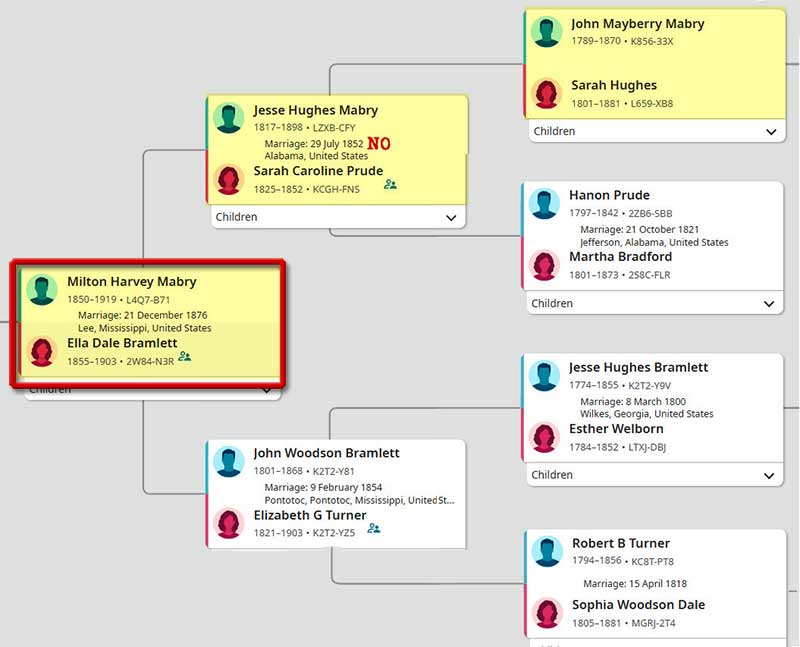
Jesse Hughes Mabry in the chart below; this is user-submitted data at familysearch.org.
Many of the sources cited by users for the ancestors of Milton H. Mabry don't apply to the level of
detail for data they submitted.
This page concerns
the families highlighted below in yellow.
Click tree chart to see it larger. Click the larger image to see it full size.
|
|
SKIP TO MILTON H. MABRY |
 |
|

JOHN MAYBERRY* MABRY
Giddings Mabry's paternal great-grandfather, John Mabry, is found on the
1830 Census of South Carolina in the Union District. Censuses before
1850 only listed a count of males and females in the household according
to age group. *TampaPix has little confidence that his middle name was
Mayberry.
JOHN & SARAH MABRY, 1830 CENSUS, UNION DISTRICT, SOUTH CAROLINA
|
1830
Union Dist. SC |
Males |
Females |
|
Head |
>5 |
5 to
<10 |
10 to
<15 |
15 to
<20 |
20 to
<30 |
30 to
<40 |
40 to
<50 |
50 to
<60 |
60 to
<70 |
70 to
<80 |
80 to
<90 |
90 to
<100 |
100 &
over |
>5 |
5 to
<10 |
10 to
<15 |
15 to
<20 |
20 to
<30 |
30 to
<40 |
40 to
<50 |
50 to
<60 |
60 to
<70 |
70 to
<80 |
80 to
<90 |
90 to
<100 |
100 &
over |
|
John Mabry |
1 |
1 |
2 |
|
|
|
1 |
|
|
|
|
|
|
3 |
|
|
|
1 |
|
|
|
|
|
|
|
|
Later records show John was born around 1789 so John is the male
age 40 to under 50. He would have been around 40 to 41 in
1830.
Later records of Sarah show she was born around 1801 so she would be
the female age 20 to under 30. She would have been around 29
in 1830.
Their son, Jesse Hughes Mabry was born around 1817 and would have
been around 13 in 1830 so he one of the two males 10 to under 15.
JOHN & SARAH MABRY,
1840 CENSUS, PICKENS CO., ALABAMA
These Mabrys arrived in Pickens Co., Alabama by 1840.
|
1840
Pickens Ala. |
Males |
Females |
|
Head |
>5 |
5 to
<10 |
10 to
<15 |
15 to
<20 |
20 to
<30 |
30 to
<40 |
40 to
<50 |
50 to
<60 |
60 to
<70 |
70 to
<80 |
80 to
<90 |
90 to
<100 |
100 &
over |
>5 |
5 to
<10 |
10 to
<15 |
15 to
<20 |
20 to
<30 |
30 to
<40 |
40 to
<50 |
50 to
<60 |
60 to
<70 |
70 to
<80 |
80 to
<90 |
90 to
<100 |
100 &
over |
|
John Mabry |
1 |
1 |
1 |
1 |
1 |
|
|
1 |
|
|
|
|
|
1 |
|
2 |
|
|
1 |
|
|
|
|
|
|
|
There is a consistency
between these 1830 and 1840 censuses. John and Sarah have both
moved up one age group. A new male and a new female are now in
the household, under 5. The four males under 15 in 1830 have all
moved up an age group. Jesse Mabry born ca. 1817 would
have been around 23 here and is the lone male 20 to under 30. The 2
of the 3 females under 5 in 1830 are 10 years older and are
now age 10 to under 15. One of the females under 5 in 1830 is
no longer living.

1850 - JOHN MABRY FAMILY IN MISSISSIPPI
By 1850 John and Sarah had migrated
to Mississippi and are on the 1850
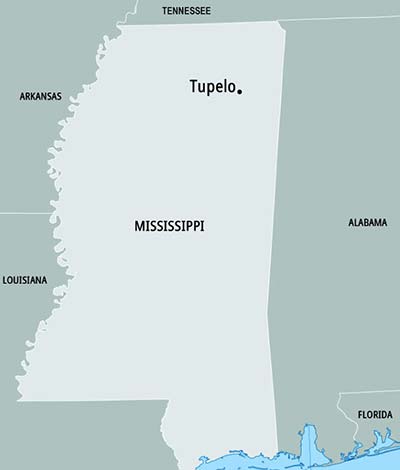
Census of Itawamaba County. This county is in the far northeast
corner of the state and is bordered by Alabama to the east.
John was 60, a farmer, with $3,500
in real estate. This is considerably more than others on the page.
His wife, Sarah (Hughes) Mabry was 48. Both show they were born in
S. Carolina. Their son Jesse is not in their home as he was
married and still living in Pickens Co., Alabama.
1850 CENSUS, ITAWAMBA CO., MISS.
John and Sarah's first three children were
born in SC: James M. b. ca.1828, Eliza June (poss. Jane) b. ca.1829, and
Thomas, b. ca. 1832. Their last three children were born in
Alabama: Roderick W, b. ca. 1839, Leonidas(?) b. ca. 1841, and Elbert
B,
b. ca. 1843. This is more evidence that John and Sarah came to Alabama
from South Carolina between 1832 and 1839.

Their son, Jesse Mabry, is not in the
home because he had married in Pickens Co., Alabama and was still living
there in 1850

1850 - JESSE HUGHES MABRY &
CAROLINE PRUDE MABRY STILL IN ALABAMA
John and Sarah Mabry's son, Jesse Hughes Mabry (b.
ca.1816 in S. Carolina,) and Martha Bradford were married in Alabama in Pickens County, around 1842. She was a
daughter of Hanon Prude and Martha Bradford Prude. Their estimated
marriage year is concluded from the age of their first son on the 1850
Census. On the
1850 Census of Pickens County, Alabama, their children were John
(b.c1843), David (b.c1845) and Malcolm (b.c1847), all born in Alabama.
The "NO" next to their marriage date means this date, July 29, 1852, is
incorrect. If it was correct, they certainly would not be found
living together with three children born before 1850--ages 6, 4, and
2--on the 1850 Census.
1850 CENSUS,
PICKENS CO., ALABAMA

Sarah Caroline Prude Mabry, wife of Jesse Mabry, daughter of Hanan Prude and Martha Bradford Prude,
died on Aug 3, 1852.
After Sarah's death in 1852, on Dec. 23, 1853* Jesse Mabry married Martha Bradford in Pickens Co.,
Ala. She was a daughter of David Bradford & Jane Thompson
Bradford. *This date is user submitted data, no marriage record has been
found.
1860 - JESSE MABRY AND MARTHA BRADFORD MABRY IN MISSISSIPPI
Jesse Mabry was a merchant and did business
in Bridgeville until 1856 when he and his family
moved to DeSoto Parish in Louisiana. (DeSoto borders Texas to the west
in the upper portion of Louisiana.) Afterwards they returned to Lee Co.,
Miss. in 1860.
By August of 1860 the Jesse Mabrys had
moved back in Mississippi to Pontotoc County which is on the west side of
Itawamba County. The record shows Martha was 39
and born
in Alabama. Jesse's age is incorrect, he would have been 43.
Seen
here are Jesse's five children by his first wife Sarah Prude: John Hanon
Mabry, David Prude Mabry, Malcolm Mabry, Milton Harvey Mabry, and
Martha Caroline Mabry, and two children by his second wife: Groves (b.
ca.1855), and James B. age 1 month (b. ca.Jun 1860). Milton H. Mabry was 10 years
old and born just after the 1850 Census.
Although Jesse has no occupations
indicated in 1850 and 1860, the value of his 1860 personal property is
huge. Jesse's name has been written in the old style of writing a
"double s" which looks like "fs" which often looks like a "p"
with a tall ascender.
1860 Census,
Verona, Pontotoc Co., Miss.
| |
Children by Sarah Prude |
Born |
Where |
|
A.) |
John Hanon Mabry |
1845 |
Pickens Co., Alabama |
|
B.) |
David Prude Mabry |
1847 |
Pickens Co., Alabama |
|
C.) |
Malcolm Mabry |
1849 |
Pickens Co., Alabama |
|
D.) |
Milton
Harvey Mabry |
1850, June 17 |
Pickens Co., Alabama |
|
E.) |
Martha Caroline Mabry |
1852 |
Pickens Co., Alabama |
| |
|
|
|
| |
Children by Martha Bradford |
|
|
|
F.) |
Groves Mabry |
1856 |
Pickens Co., Alabama |
|
G.) |
James B. Mabry |
1859 |
Louisiana |
|
|
In 1860, Pontotoc and Itawamba
counties were adjacent counties in the far northeast corner of
Mississippi.

1860 Census, Plantersville,
Itawamba County, Mississippi
Jesse's parents, John and Sarah, are
on the 1860 Census of Itawamaba County, Miss. The record shows
John Mabry was 71, a farmer, with $3,200 in Real Estate and 11,385 in
personal property, again, considerably more than others on the page.
Sarah was 58, giving her a calculated birth year of abt. 1801.
Albert was probably their youngest son Elbert who appeared on their 1850
Census.

1870 JESSE H. MABRY & MARTHA BRADFORD
MABRY, Tupelo, Lee Co., Miss.
By September of 1870 the Jesse Mabrys
were living in Lee County, MS in the area of Tupelo. It is likely
that they didn't move there. Lee County was established by the
Mississippi Legislature on October 26, 1866, and named for General
Robert E. Lee. It was formed from Pontotoc and Itawamba counties with
Lee county between the two.

1870 CENSUS, Tupelo, Lee Co., Miss.
Jesse was listed as a merchant with
$2,000 worth of real estate and & $6,000 worth of personal property.
This was considerably more than others on this page. Malcolm was a clerk
in a store, probably his father's store. Milton was 20 and the Mabry's
had a 68 year old cook named Violet, which indicates they were doing
quite well.

Jesse's father, John M. Mabry, died
sometime after his 1870 Census in Itawamba County, Miss. where he last
appears with his wife Sarah (Hughes) Mabry. John was listed at 80
years old, a farm laborer, with considerably less value in real estate
and personal property. Sarah was listed as 78, but she was
actually around 68 according to her prior censuses. As with his son
Jesse, John probably didn't relocate, this is likely the area of
Itawamba County that became Lee County in 1866.
1870 CENSUS, VERONA, ITAWAMBA CO.,
MISS.

Thomas was probably their son.
1880 - JESSE MABRY & WIFE
MARTHA
No record or news article has been
located concerning the death of John Mayberry Mabry. (TampaPix has
little confidence that his middle name was Mayberry.) By the time of the
1880 Census, Jesse's mother, widowed Sarah Hughes Mabry, was living with
Jesse and his wife Martha.
Sarah
Hughes Mabry was born 19 December 1801 died on 24 January 1881
in Verona, Lee County, Mississippi.
.jpg)
This is the first census to record
every person's relationship to the head of house. None were
recorded for the Mabry household.
NO 1890 CENSUS
On January 10, 1921, a fire in the
Commerce Department building, Washington, DC, resulted in the
destruction of most of the 1890 census. Most of the damage was
from the water used to put out the fire. None had been microfilmed.
 |
DEATH OF JESSE HUGHES
MABRY
Jesse Hughes Mabry died at age 80 on Apr. 18, 1898
at the home of his
son, Groves Mabry, in Kosciusko, Miss.
Kosciusko, Mississippi is the county seat of Attala County
and is located in the center of the state.
 |
|
"Col."
isn't a military rank, it is a term commonly used in the
South as a title of respect, honor, age, and social status.
Younger men are often "Maj." and "Capt." There is an
aristocratic tinge to the social usage of the title
"Colonel", which most often today designates a Southern
gentleman, and is archetypal of the Southern aristocrat from
days past. There is also a different perceptive level of
respect for colonels that are reciprocally addressed as
"Honorable" or "Colonel" in writing style. While the honor
of colonel in the civil usage has no actual military role,
the title did evolve from the military. |
|
|
TUPELO
In 1830, Congress passed the Indian
Removal Act and authorized the relocation of all the Southeast Native
Americans to federal territory west of the Mississippi River, which was
completed by the end of the 1830s. In the early years of settlement,
European-Americans named this town "Gum Pond", supposedly due to its
numerous tupelo trees, known locally as "blackgum". The city still hosts
the annual Gumtree Arts Festival. During the Civil War, Union and
Confederate forces fought in the area in 1864 in the Battle of Tupelo
and the Battle of Old Town Creek. Designated the Tupelo National
Battlefield, the battlefield is administered by the National Park
Service (NPS). With expansion, the town changed its name to
Tupelo, in honor of the battle. It was incorporated in 1870.
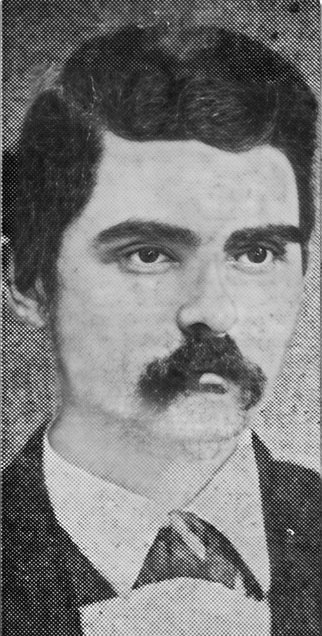
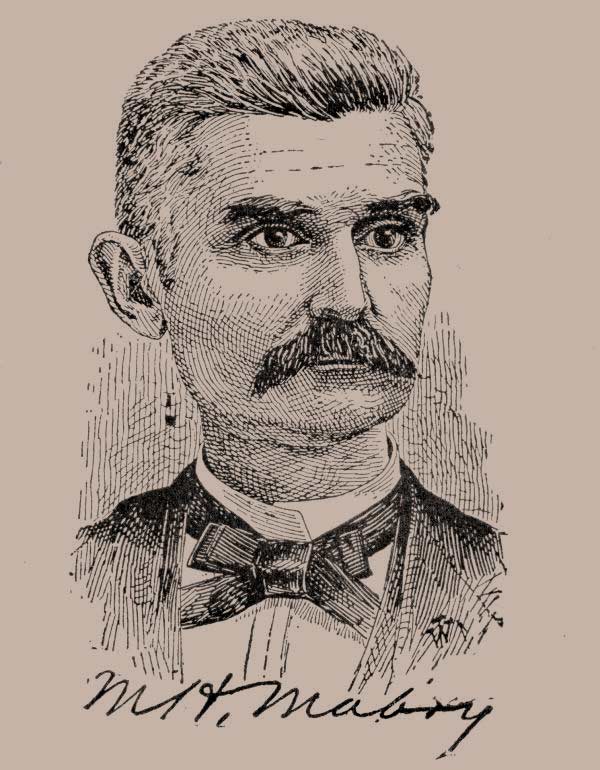
MILTON HARVEY MABRY
Born
on June 17, 1850 in Pickens County, Alabama, Milton Mabry spent his
infancy there until his parents moved to northeastern Mississippi by the
mid-1850s. In 1856, his father being an itinerant merchant, moved with his
family to DeSoto Parish in Louisiana for about 4 years until they
returned to Mississippi in early 1860. Milton spent the rest of his
childhood years at Tupelo.
MILTON MABRY'S EDUCATION and MARRIAGE
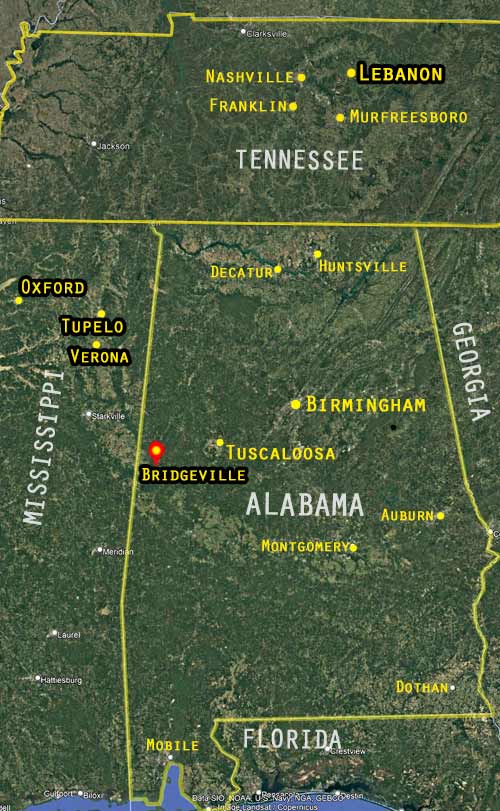
Milton Mabry received his literary education at
the University of Mississippi "Ole Miss" at Oxford, Miss. which is
about 30 miles NNW of Tupelo. Graduating after two years, in 1869, he
entered
the law college at Cumberland
University in Lebanon, Tenn. where he received his Bachelor of Laws in 1872. He was
admitted to the bar in Mississippi that year and commenced his law practice at his
home in Tupelo.
In 1876 Milton married Ella Dale
Bramlett in Lee County, Miss.
She was a daughter of John Woodson Bramlett and Eliza G. Turner
Bramlett).
MILTON MABRY MISSISSIPPI DELEGATE AND TUPELO
MAYOR
He was soon selected as a
delegate to the state convention to revise the laws of Mississippi and
subsequently was the mayor of Tupelo for two years from 1877 to 1879.
MOVE TO FLORIDA
On the persuasion of a friend and
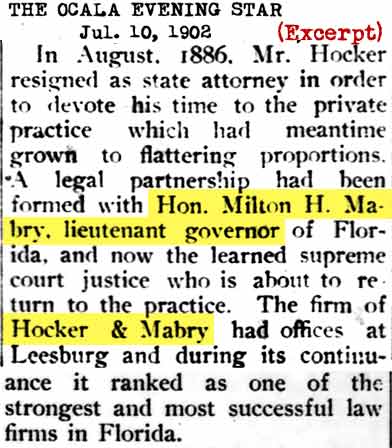
future law partner William A. Hocker of Sumter County, Fla., who had moved to Florida in 1874,
Mabry moved with his family
to Leesburg in Sumter County, Fla. in 1879, partly due to his ill health. Mabry
partnered with Hocker, who lived nearby, from 1880 to 1889 when Mabry
moved to Pasco County.
(William
Adam Hocker served on the Supreme Court from 1905 to 1915.)
STATE REPRESENTATIVE FROM SUMTER COUNTY
In
Nov. 1882, Mabry was elected as Sumter
County's State Representative to the Florida Assembly for a term of 2
years from 1883 to 1885.
LIEUTENANT GOVERNOR 1885 - 1889
Quickly earning a
name for himself, he was nominated as Edward A. Perry’s Democrat
running-mate for lieutenant governor in Florida’s gubernatorial election
of 1884. Upon winning the majority vote, Mabry served as lieutenant
governor of Florida from 1885 until Jan. 6, 1889, becoming Florida’s last
lieutenant governor for nearly 80 more years. As by virtue of the
position, he was also president of the Senate.
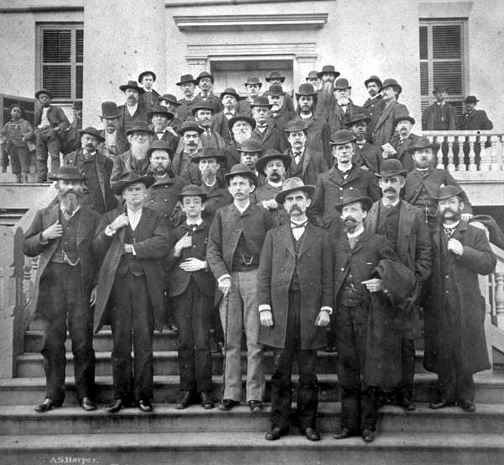
1885 Members of the
Florida Senate on the steps of the capitol building, Tallahassee.
Lt. Governor Milton H. Mabry on front step, left.

| |
|
The 1885 Constitutional
Convention of Florida which met and revised the laws of the state during
Governor Perry's administration eliminated the office of
Lieutenant Governor and prohibited the governor from
succeeding himself with a consecutive term.
In 1888, Mabry toured the state campaigning
for G.B. Sparkman and Circuit Judge Joseph Baisden Wall for the
Democrat ticket.
|

In 1890, Mabry began building a 10-room
residence on a hill in Pasco County, 2 miles north of Dade City
overlooking the the city.
FLORIDA SUPREME COURT JUSTICE FIRST
TERM
In August 1890, Mabry served as a delegate to
the Florida state Democratic convention in Ocala. Without solicitation
as to himself, his name was placed in nomination for justice of the
Supreme Court of Florida, and on the final ballot he received the
nomination over eminent but aged incumbent, Justice Maxwell. In Nov. 1890,
Mabry won the state election and served his first term on the Supreme Court from
Jan. 1891 to Jan. 1897, during which time he served as Chief Justice from 1895 to the
end of his term, serving under the governorship of Francis Philip
Fleming (1889-1892). and Henry
Laurens Mitchell (1893-1897.)
FLORIDA SUPREME COURT JUSTICE SECOND
TERM
In Oct. 1896, Mabry was the Democrat nominee
for Supreme Court Justice again. Winning election again, he served from
Jan. 1897 to Jan. 1903 for a total of two terms for 12 years.
|
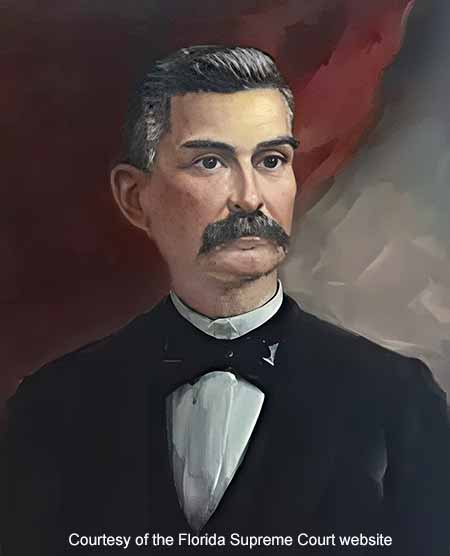
|

RETIREMENT
In Feb. 1902, Mabry announced he would
not run for a 3rd term on the Supreme Court.
Yearning
for retirement, he declined re-nomination for the Nov. 1902 election and retired in 1903, making way for his former law partner, William
A. Hocker, to join and serve in the Supreme Court from 1903 until 1915.
MOVE TO TAMPA, JOINS SON IN LAW
PRACTICE AS MABRY & MABRY
In Dec. 1902, Mabry announced his
desire to move to Tampa from Dade City. He arrived in Tampa on
Jan. 1, 1903 and began practicing
law with his eldest son, Giddings Eldon Mabry, as Mabry
& Mabry; Giddings having established his lone law practice in
Tampa in Oct. 1901.
Images courtesy of
Florida Memory, State Archives and Library of Florida
|
DEATH OF WIFE AND MOVE TO TALLAHASSEE
Milton's wife, Ella Dale
(Bramlett) Mabry, died in 1904 at their Bayshore Blvd. home in Tampa after suffering from some time with severe headaches.
Mention of Giddings' brother, Dr. Jesse Mabry, a physician
in Norfolk, Va.

| Justice
Mabry soon decided that the private practice of law was not for him and
persuasion from friends convinced Milton to return the
Supreme Court. He moved back to Tallahassee in 1904 and accepted
the position of Clerk of the Supreme Court from March 31, 1905 until 1915.
SECOND MARRIAGE
On Nov. 15, 1906, Milton Mabry married Kentucky-born Miss Irene
Washburne, one of six children of Louis Jermaine Washburne and Mary Ann
Rudy, at her home in Louisville, Kentucky. Due to the recent
passing of the bride's mother, the ceremony was private. The
couple made a southern tour before settling in Tallahassee. Their
son, Harton Washburne Mabry, was born in 1908 in Tallahassee
where they were living along with Milton's son, Dale.
SECOND RETIREMENT AND DEATH
Milton Mabry
retired from his position as
clerk of the supreme court in 1915,
relocating a final time to his home at 210
Fielding Ave. in Hyde Park, Tampa, before passing away
of tuberculosis on March 3, 1919 at the age of 68.
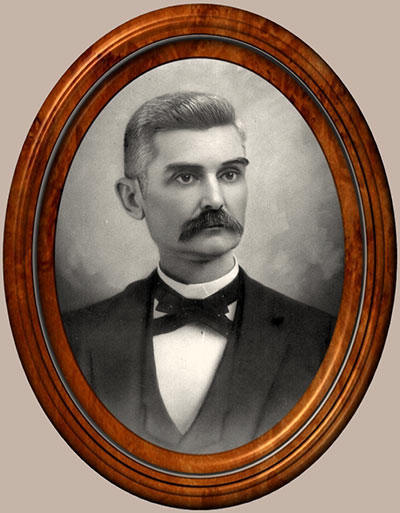
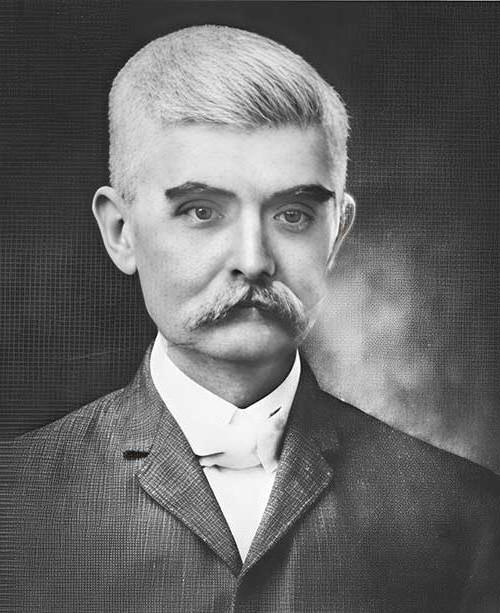
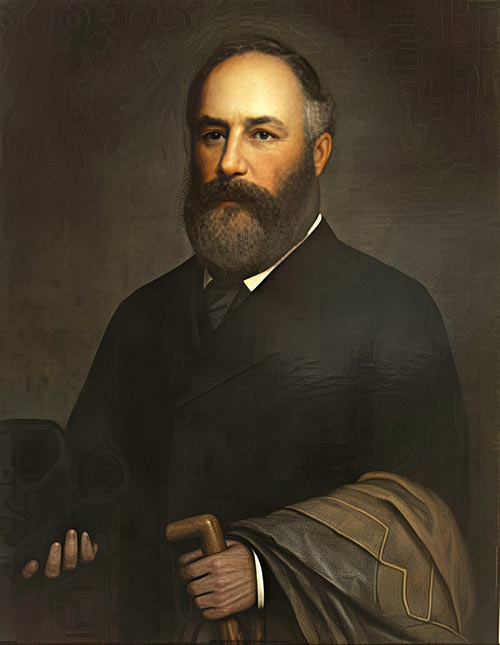
In stature Judge
Mabry was a tall man, six feet tall and of medium build. He wore a
mustache and his coal black hair did not have a streak of grey in it
until well past his 50th year. While not an orator
of the old school, his speech was pleasing and he was forceful,
entertaining and logical. In the months that preceded the general
elections he invariably received invitations to canvass the state with
other party leaders in behalf of the Democrat ticket.
After the death of her husband, Irene Washburne
Mabry moved by 1920 to Sanford in Seminole County where she lived with
her son, Harton, age 11, and with her sister Nellie and brother-in-law G.F.
Smith. By 1940 Irene had moved to Daytona Beach in Volusia County
with her son, where she died on Jul. 5, 1943.
Some information obtained from:
Cumberland University Archives.
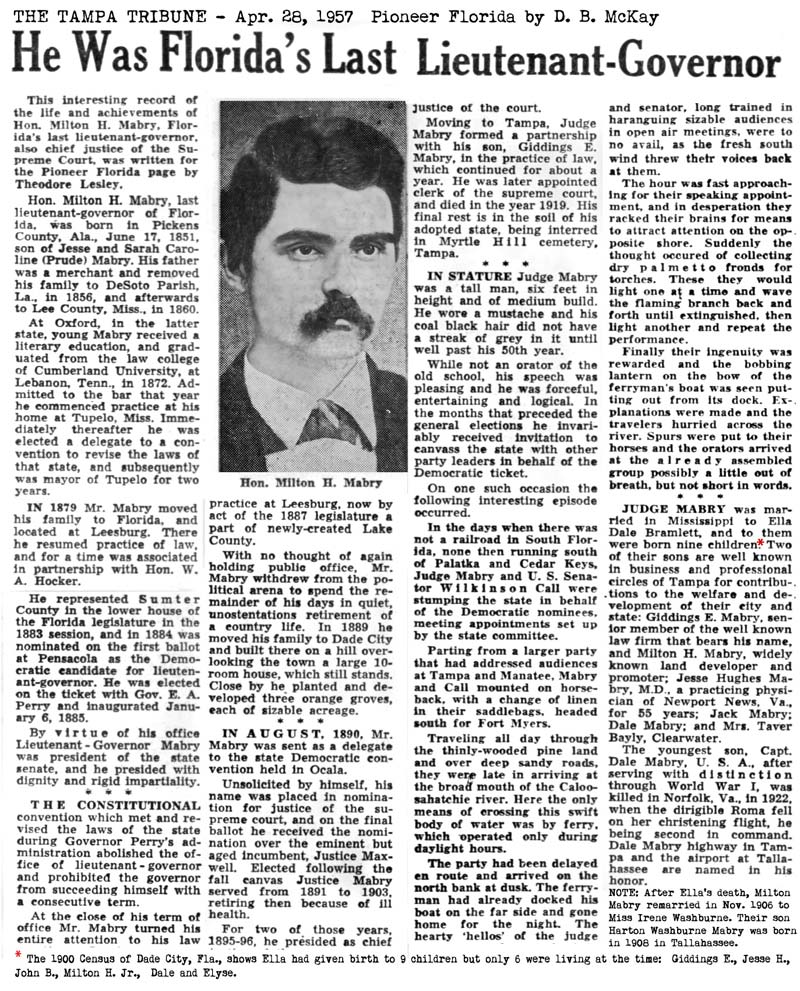
He Was Florida's Last Lieutenant Governor by Thomas Lesley
published Apr. 28, 1957 by D.B. McKay in "Pioneer Florida."
Various articles from newspapers in Mississippi and Florida.
U.S. Censuses of Alabama, Mississippi and Florida
State Census of Florida
Florida Supreme Court
|
| |
SUPPORTING SOURCES
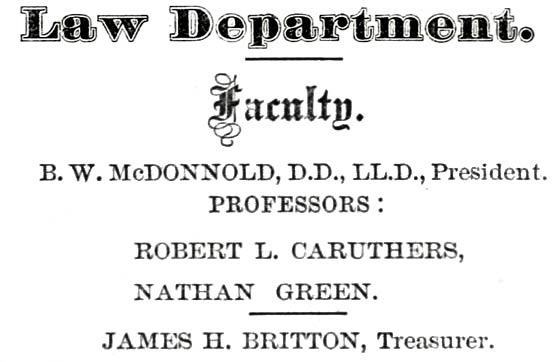
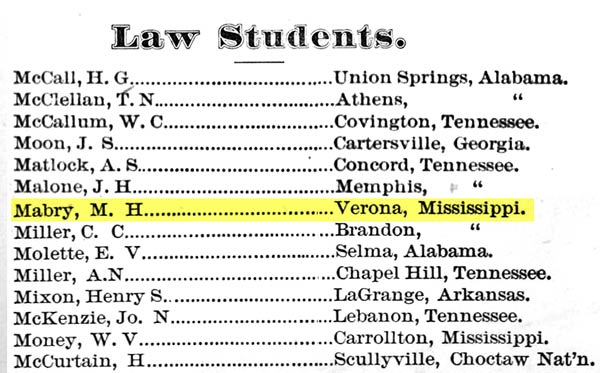
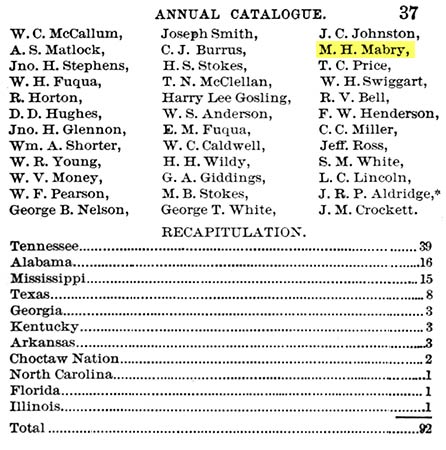
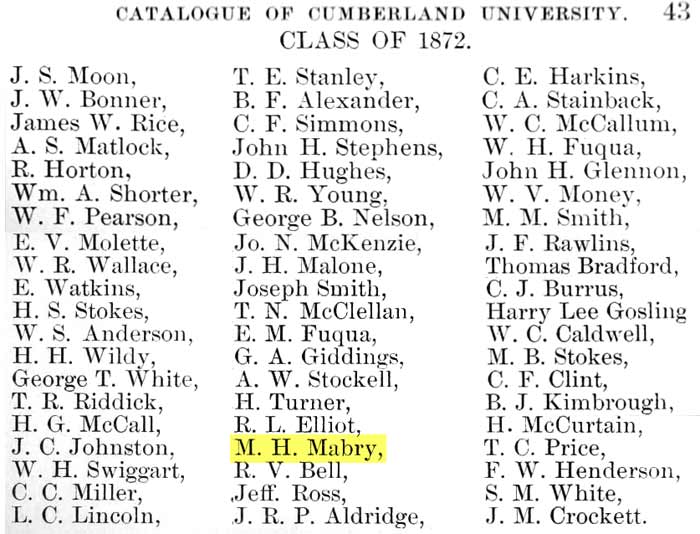
Cumberland University Annual Catalog, 1871-1872
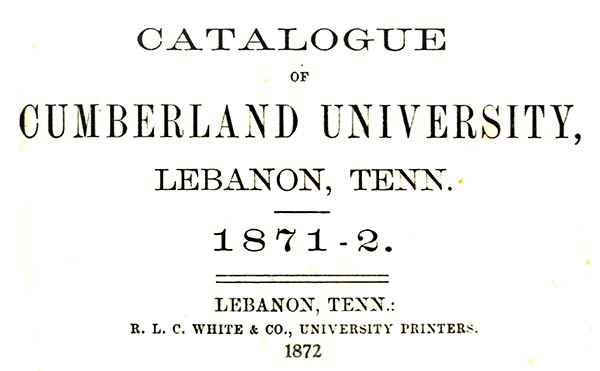
Milton Mabry was also on the Annual
Catalogue staff.


See all Faculty
1875-01-07 The Lee County (Miss.) Clarion
- MILTON MABRY SECRETARY OF TAXPAYERS COMMITTEE The tax-payers of Lee county met in Tupelo on the 28th of December and
proceeded to the permanent organization of a tax-payers convention by
the selection of Capt. R.M. Leavell as chairman and M. H. Mabry,
and S. Billingsley as Secretaries.
1876-12-21 MARRIAGE
Milton Harvey Mabry married Ella Dale Bramlett on Dec. 21, 1876 in Lee
County, Miss. (Ella was b.ca.1856, in Pontotoc,
Miss., a daughter of John Woodson Bramlett and Eliza G. Turner Bramlett).
.jpg)
1879-01-03 DEMOCRAT STAR, Pascagoula, MS
- MILTON MABRY LOOKING FOR NEW HOME Milton Mabry, mayor of Tupelo and promising lawyer, is on the coast
looking out for a place with the view of locating in our beautiful land.
We hope he may find a place to suit him, and that he will settle here.
THE MABRYS MOVE TO LEESBURG, FLA.
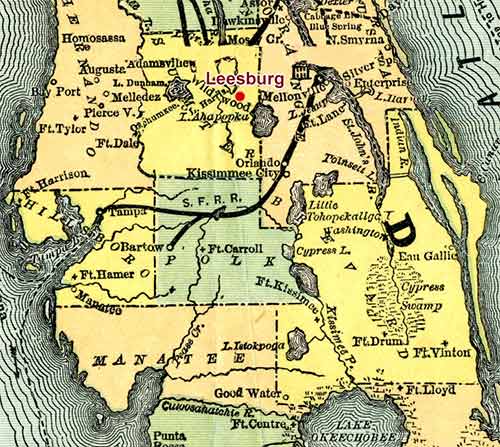
1880 CENSUS, SUMTER COUNTY, FLA.
In 1879
Milton, Ella, and their sons Giddings Eldon Mabry and Jesse Hughes Mabry moved to
Leesburg in Sumter Co, FL where Milton was in the practice of law and in the citrus
industry. Milton was 28, his wife Ella Bramlett Mabry was 24.
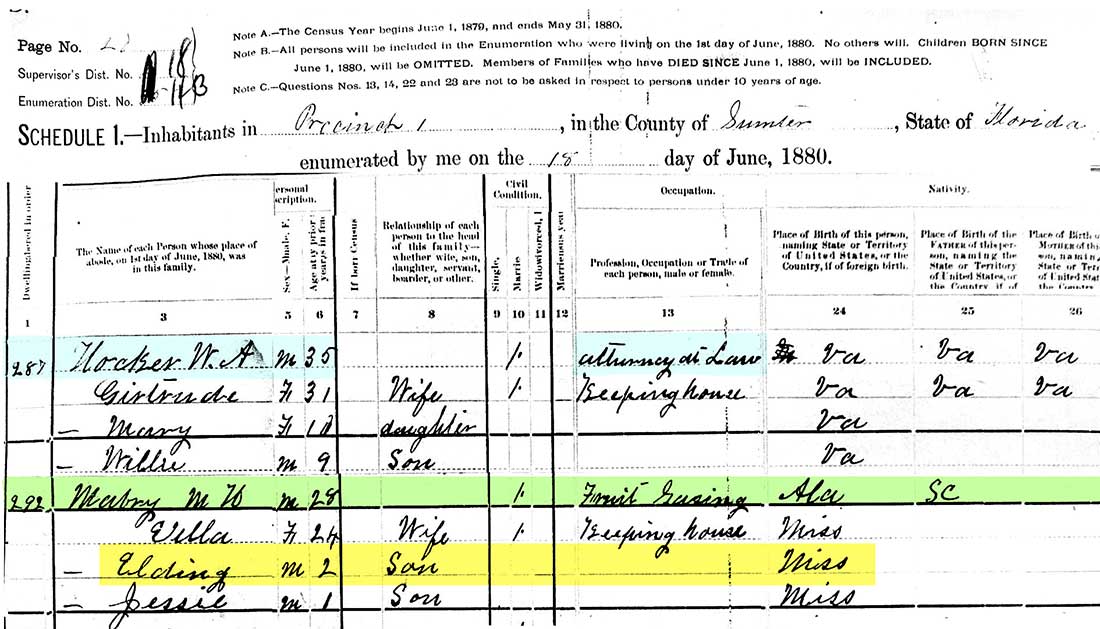
At the top of the page, five dwellings
before the Mabry family, the Hocker family was enumerated. W. A.
Hocker was 35, an attorney from Virginia. (The households in between
have been removed.) Mabry would soon form a law partnership with W. A. Hocker.

|
| |
Children of Milton H. and Ella Mabry |
Born |
In |
|
1 |
Giddings Eldon Mabry |
1877, Oct.9 |
Tupelo,Mississippi |
|
2 |
Jesse Hughes Mabry |
1879, July 30 |
Tupelo,Mississippi |
|
3 |
John Bramlett Mabry |
1883 |
Fla. |
|
4 |
Milton Harvey Mabry, Jr. |
1888, June |
Fla. |
|
5 |
Dale Mabry |
1891 |
Fla. |
|
6 |
Elyse (Eloise) Mabry |
1895, June |
Fla. |
|
They also had 3 other children who died
young, before 1900. |
1880-09-24
Weekly Floridian The Leesburg Advance of the 18th gives a graphic account of the Radical
meeting at that place on the 14th. Conover and U.S. District Attorney
Stickney were the speakers. Democratic speakers, W. A. Hocker and
M. H. Mabry tendered a joint discussion, which the others dared not
refuse, and the result was as might have been expected.
MILTON MABRY ELECTED TO THE
FLORIDA ASSEMBLY
1882-11-14 Weekly
Floridian Sumter Co. election results for the Florida Assembly (later called the
House of Representatives, or "the House.") SUMTER - Congress: Finley 713, Bisbee 312. Assembly: Mabry (Dem.)
709; Cassady (Dem.) 706; Brown 68, Hays 80. (These are the vote counts of the winners, not the winners and losers.)
1882-11-21
Weekly Floridian Mabry, member of the Assembly-elect from Sumter Co., is stopping at the
St. James (hotel.)
1882-11-28
Weekly Floridian Legals section, J. H. Goss, Taylor & Sanchez, for Relators, Hocker & Mabry,
Cockrell & Walker for respondents.
1882-12-12
Weekly Floridian County by county list of members of the Fla. Assembly, Sumter Co: M.H.
Mabry & Wilson W. Cassady
1882-12-19
Weekly Floridian Mabry & Cassady duly elected member of Assembly from Sumter Co.
MABRY'S TWO-YEAR TERM AS
FLORIDA ASSEMBLY MEMBER BEGINS
1883-01-02
Weekly Floridian List of members of the Florida Senate and Florida Assembly. Milton Mabry was one
of two Sumter County representatives in the Florida legislature starting
with the 1883 session.
1883-03-02
Pensacola Commercial Mabry vilified, accused of being "undemocratic" and described as "black
belt deserter from Sumter County" because he "left the large majority of
his party and voted with the negroes and the Radicals (Republicans.) "There
is no calumny or misrepresentation about it. These are the plain
facts. They are political not personal, Mr. Mabry, with his eight
associates are traitors to their party, have deserted to the enemy and
added that enemy to defeat their own party.
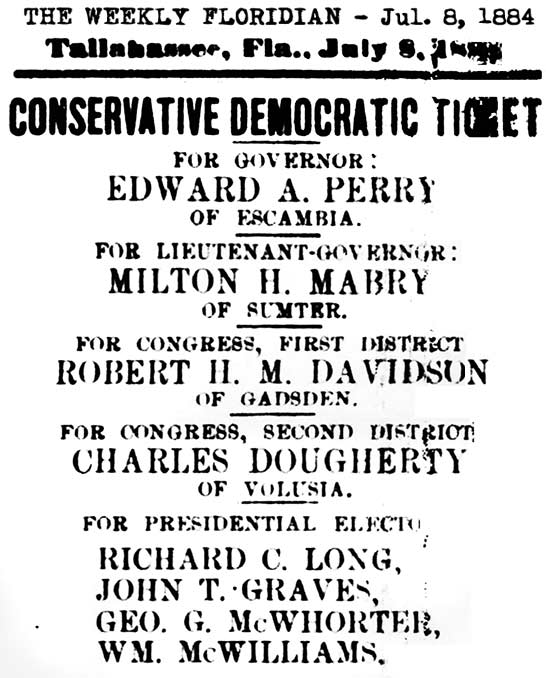
In 1884 Milton Mabry
was nominated on the first ballot at the Democrat convention in
Pensacola as their candidate for lieutenant-governor. On the
ticket for governor was Edward A. Perry.
1884-06-26
Semi Weekly Times Union Milton Mabry nominated at the Democrat Convention for Lt. Governor,
Edward A. Perry nominated for Governor.
1884-06-27
Palatka Daily News Ad by Palatka News promoting Perry for Governor, Mabry for Lt. Governor.
1884-06-27
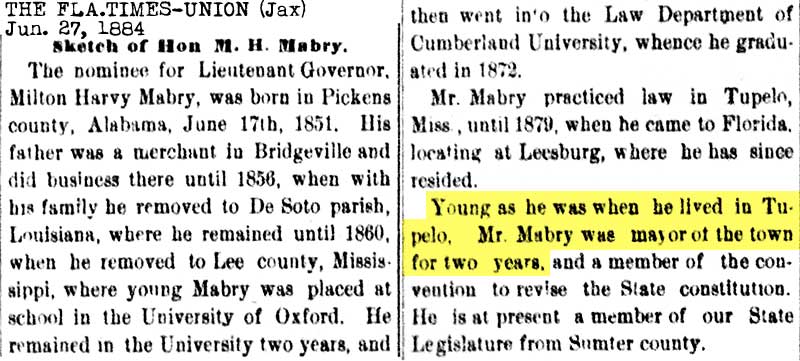
Florida Times Union Sketch of Hon. M H Mabry, nominee for Lt. Gov. He
was mayor of Tupelo when he came to Leesburg, Fla. in 1879.

1884-07-01
The Weekly Floridian - REBUTTAL TO CRITICISM OF MILTON MABRY The candidate for Lieut. Gov has already been assailed abusively because
he, like a a majority of the members of the Assembly, conceived it to be
his duty to oppose the summary method suggested by Senate bill 19,
session of 1883, calling for a Constitutional Convention and known as
the "Short Cut." It is proper now that he should be heard again as
he was on the 25th of January, 1883, when he participated in the debate
and gave his reasons for opposing the short cut bill. Mr. Mabry
had previously had occasion to study constitutional law, having been a
member of a Constitutional Convention in Mississippi. We may
remark that as Mr. Mabry was not from a "black belt" county he could not
have the direct personal interest in opposing the bill which might be
felt by those apprehending the consequences of a sudden change of manner
of constituting local officials. He obviously acted from his clear
convictions of duty under knowledge of law and usage. He was in
favor of a Constitutional Convention, to be called as he provided.
1884-07-08 Weekly Floridian Democrat ticket for governor, lt. gov, Congress, US President.
1884-07-11
Florida Times Union Description of Mabry, candidate for Lt. Gov and presiding officer of the
Senate. Mr. Mabry, the candidate for Lt. Governor, is a young man, and one of
the best men in Florida. Thoroughly honest and conscientious, it
is impossible to impugn his motives even when one differs from him.
He is a gentleman of ability also, and as presiding officer of the
Senate will reflect credit upon himself and upon his State.
1884-12-11
Weekly Times Union FLORIDA'S OFFICIAL VOTE - Perry elected Governor, Milton Mabry
elected Lt. Governor. vote counts Governor: Perry (Dem) 52,087;
Frank Pope, (Ind. Rep.) 27,845. Majority for Perry 4,242.
Lt. Gove: M.H. Mabry (Dem) 31,865; J.C.Greeley (Rep) 28,147.
Majority for Mabry, 3,718.
Mabry was inaugurated with
Governor Perry on Jan. 7, 1885 for a four-year term. By virtue of his office, Mabry was
president of the state senate presiding with dignity and rigid
impartiality.
The 14th governor of Florida, Edward Aylesworth Perry (March 15, 1831 – October 15, 1889) was a
Confederate general who was primarily known for serving under Robert E.
Lee during the American Civil War.
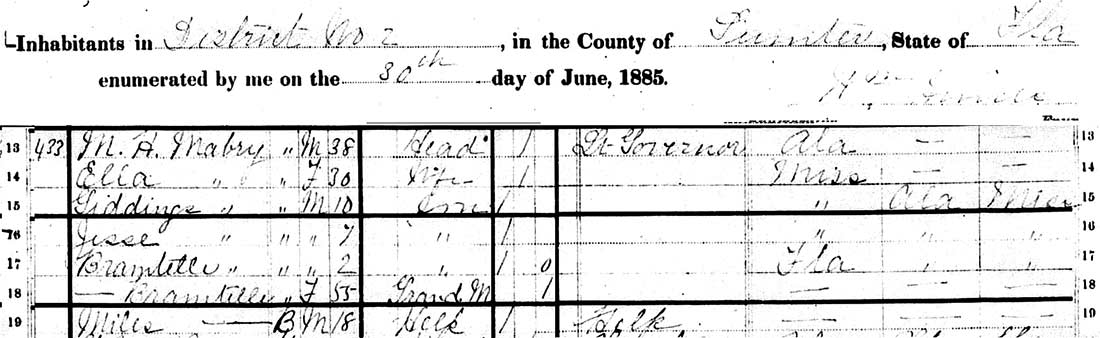
1885 CENSUS, SUMTER COUNTY
Florida took a state census
in 1885, 1925 and 1935. Milton
H. Mabry, Sr. and Ella are on the 1885 Florida State Census in Sumter County
with their three sons Giddings (10) and Jesse (7), and Bramlette (male, this
is John Bramlett
Mabry) (2). Under him is listed as grandmother "Bramtelle"
(55). Relationships were supposed to be to the head of house but she
can't possibly be Milton's or even Ella's grandmother. The
enumerator must have been thinking in relation to two year old "Bramlette" and so she
would be Ella's mother, Elizabeth (Turner) Bramlett. The line
before her name indicates that her first name was not recorded, so this
is the enumerator's error of crossing the L instead of the two T's in
Bramlett and adding an E at the end.)

This is the only census to record Milton as Lt. Governor.
1
The 1885 Constitutional Convention of
Florida which met and revised the laws of the state during Governor
Perry's administration did not provide for the office of Lieutenant Governor
to continue and
prohibited the governor from succeeding himself with a consecutive term.
1887-04-05 The Palatka Daily News The constitution does contain this provision and it is therefore true
that Mr. Mabry, the present Liet. Governor, is the "last of his line."
Nothing contained in this Constitution shall operate to vacate the
office of Lt. Governor until the expiration of his present term."
1887-04-07 The Semi Weekly Times Union The right of Lt. Gov. Mabry to preside over the Senate under the new
Constitution will not be questioned since he was elected by the people
themselves. MABRY ENDORSES DEMOCRAT CANDIDATES ON THE
CAMPAIGN TRAIL 1888-10-25 The Tampa Weekly Journal ABOUT THE CAMPAIGNERS - Cordially Received in Every Precinct Visited
Capt. Walton and Lt.-Gov Mabry Working For the Faith on the West Side.
Last Wednesday morning (17th) several carriages and buggies loaded down
with Democratic orators left the city for Peru (original name for
Riverview) where the first gun of the campaign was fired...In the party
were Dem. Exec. Committee chairman G.B. Sparkman Esq., Candidate
for State Senate Joseph B. Wall; S.M Sparkman, Lucius Finley,
C.W.Stevens, Lamont Bailey, G.M. Mathes and W. A. Givens.
1889 At the close of his term
(as Lt.
Governor), Mabry turned
his entire attention to his law practice in Leesburg which by an act of
the 1887 legislature had become part of newly-created Lake County. With
no thought of again holding public office, Mabry withdrew from the
political arena to spend the remainder of his days in quiet,
unostentatious retirement of a country life. (1957-04-28 The Tampa Tribune - "Pioneer Florida" by D.
B. McKay, provided by Tampa historian Theodore Lesley.)
1890-05-29 The Semi Weekly Times Union DADE CITY ITEMS
Lt. Gov. Mabry is building a residence two miles north of Dade City
in Pasco Co. The last reference found referring to Mabry as Lt.
Governor, but his term ended on Jan. 8, 1889.
1890-06-22 The Florida Times Union First reference to Mabry as Ex-Lt. Governor..
A party of six or seven families from Leesburg are negotiating for
summer quarters at Clear Water.
Ex Lt Gov Mabry and family will be in the party. (This indicates Mabry was still living in Leesburg at this time.)
THE MABRYS MOVE TO DADE CITY, PASCO COUNTY
In 1890** Milton Mabry relocated with his family to
Dade City and [soon] built there on a hill overseeing the town a large 10-room
house. Close by he planted and developed three orange groves each
of sizeable acreage. (**This date is originally 1889 in the 1957-04-28
article in the Tampa Tribune - "Pioneer
Florida" by D. B. McKay, provided by Tampa historian Theodore Lesley.
TampaPix has changed it to 1890 according to information found in
several articles indicating Mabry returned to his home in LEE county at
the close of his term.)
1890-07-01 Florida Times Union Call for a State Democratic Convention at Ocala, Fla., on Wed. Aug. 13,
1890. Democrat convention announced for Ocala on Wed., Aug 13 at 12
noon for the purpose of nominating a candidate for the office of justice
of the supreme court and for the office of comptroller, to fill the
vacancy cause by the resignation of Hon. W.D. Barnes, and to conduct
other business. MABRY NOMINATED FOR SUPREME COURT JUSTICE
1890-08-13 Milton Mabry was sent as a
delegate to the state Democratic convention in Ocala. Without
solicitation as to himself, his name was placed in nomination for
justice of the Supreme Court of Florida, and on the final ballot he
received the nomination over eminent but aged incumbent, Justice
Maxwell. (1957-04-28 The Tampa Tribune - "Pioneer Florida" by D. B.
McKay, provided by Tampa historian Theodore Lesley.In August 1890 Mabry)
1890-08-14
Pensacola News Bloxam nominated for comptroller by a rising vote. Triangular Contest
for the Supreme Judgeship - Judge Maxwell's Name Withdrawn After Several
Ineffectual Ballots, and Milton H. Mabry Nominated by Acclamation.
Judge Maxwell withdrawn, Milton Mabry is nominated for Supreme
Court Justice
1890-08-17 Pensacola News THE MAJORITIES -
Ocala - Democrats nominate ex-Gov Bloxam for Comptroller, Mabry for
supreme court justice.
MABRY ELECTED TO SUPREME COURT
1890-11-22 Pensacola News Florida election results: Mabry elected Supreme Court Justice 23,644 votes,
Ex-Gov. Bloxam elected State
Comptroller 24,530.
1890-11-27
The Semi Weekly Times Union County by County totals for Supreme Court Justice: M.H. Mabry vs.
J.R. Challen, State Comptroller: Bloxam
1891-01-04
Pensacola News M.H. Mabry, justice-elect, arrives in Tallahassee with his family.
MABRY'S FIRST SIX-YEAR TERM AS SUPREME COURT JUSTICE
1891-01-09
Polk County News Mabry to begin when Supreme Court meets in January.
1895-01-09 Pensacola News The Supreme Court began its January term today...by choosing a new
presiding officer. The state constitution provides that the chief
justice shall be designated by lot (random selection) by said justices,
and shall be such during his term of office...and the lot fell upon Mr.
Justice Milton H. Mabry, who will be chief justice during the remainder
of his official term.
1895 January term Reorganization of court, Milton H. Mabry chosen chief
justice, B.S. Liddon and R.F. Taylor associate justices. (1897-01-15 The Florida Times-Union - A history
of the supreme court of Fla.)
MABRY CAMPAIGNS FOR A
SECOND TERM AS SUPREME COURT JUSTICE
1896-06-18 WeeklyTribune STATE CANDIDATES - ...for supreme justice, Milton H. Mabry, of Pasco
(the present incumbent), and T. M. Shackleford, of Hillsborough, have
been suggested.
1896-10-01 The Pensacola
News Democrat ticket nominees: For Governor - William D. Bloxam, for Supreme
Court Justice - Milton H. Mabry
MABRY ELECTED FOR SUPREME COURT JUSTICE, 2ND TERM
Milton H. Mabry, justice, elected for six more years in Oct. 1896 [starting
Jan. 1897 term.] (1897-01-15 The Florida
Times-Union - A history of the supreme court of Fla.)
1896-10-15 The Weekly
Press Lee County results: The entire Democrat ticket for the state was
elected and the constitutional amendments all carried. Gov: W.D.
Bloxham, Supreme Court Justice: Milton Mabry.
Milton Mabry
served on the Supreme Court for 12 years from 1891 to 1903, as justice from 1891 to
1897, as chief justice from 1895-1897 as Chief Justice, and 1897-1903 as justice.
Florida Supreme Court - Justice Milton Harvey Mabry
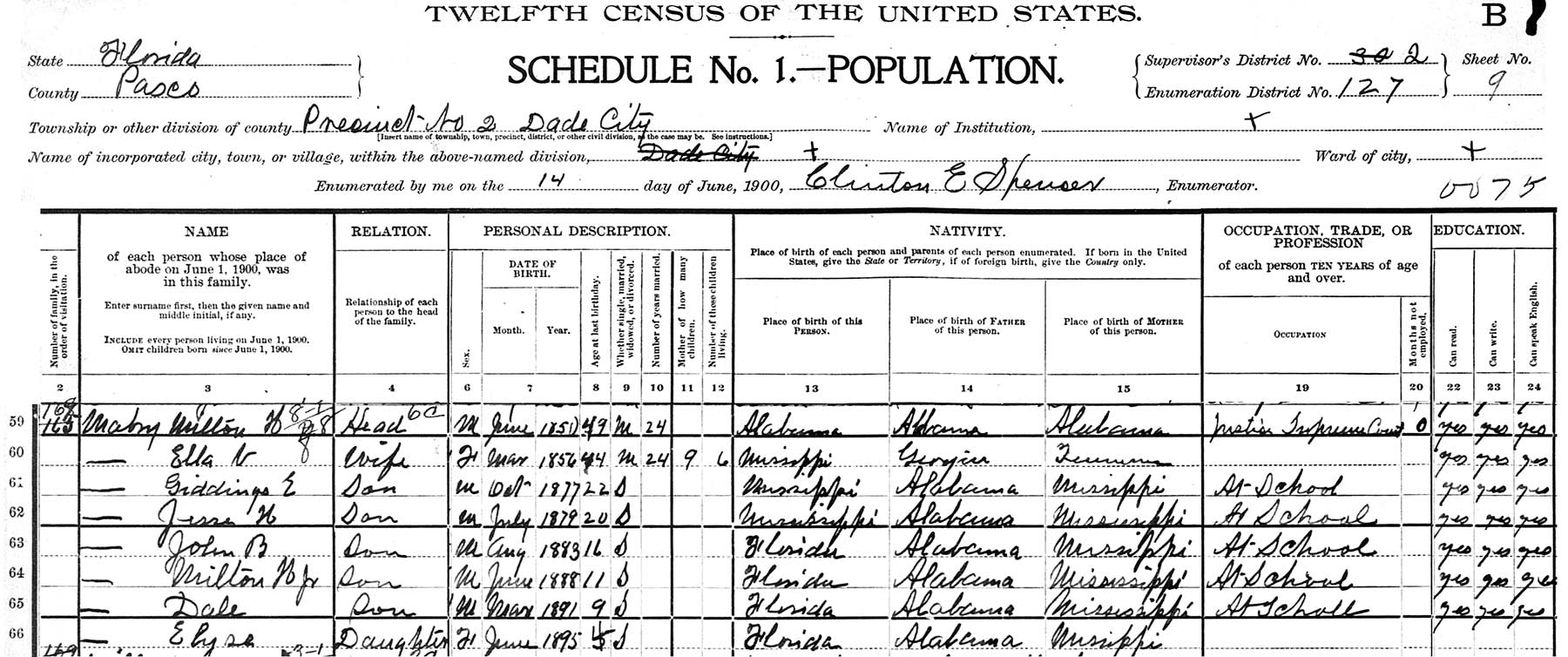
1900 CENSUS, DADE CITY,
PASCO CO. FLA.
Click the image to see it
larger.

| This is the only census to ask each
person their birth month and year, as well as their age.
Here Milton is listed as being born Jun 1851 and 49 years
old with occupation Justice Supreme Court. It
wasn't uncommon for the age to be calculated from the birth
year by the enumerator, or vice-versa. As earliest
censuses are usually the most accurate, Milton would not
have been 20 on the 1870 census if he was born in 1851.
Ella Mabry was the mother of 9 children, with
6 still living at this time, so the Mabry children in the
home are all of the Mabry children still living. Notice
Barmlette who was 2 on the 1885 census is missing--she would
have been around 17 on this census. Children born after the
1885 Census were Milton Jr.1888, Dale 1891, and Elyse 1895.
Dale was no doubt named for his mother's middle name. |
1901-08-07 Tampa Tribune Judge Milton Mabry of the supreme bench, and his estimable wife, are
guests of the hospitable Trice residence in Hyde Park. Judge Mabry
and Mrs. Trice were children together and attended the same college.
Judge Mabry enjoys the enviable reputation of being one of purist
jurists in the South, and is a gentleman universally admired and
esteemed by all who know him.
1901-08-08 Tampa Tribune Judge Mabry and wife, who have been guests of the hospitable Trice
residence in Hyde Park, leave today for Dade City where Judge Mabry owns
one of the finest homes in Florida.
1902-02-19 Tampa Tribune JUSTICE MABRY WILL RETIRE - Hon. W.A. Hocker will seek to succeed him on
the Supreme Bench Tallahassee, Fla. Feb. 18 - It was given out authoritatively this
afternoon that Hon. M.H. Mabry for the past twelve years Supreme Court
justice, will not be a candidate for re-election, and that Hon. W. A.
Hocker, formerly judge of the Fifth Judicial Circuit, and now Supreme
Court commissioner, will offer for the position made vacant by the
retirement of Judge Mabry.
1902-02-25 Tampa Tribune Judge Jos. B. Wall for Supreme Court - Circuit Court Jurist yesterday
announced his candidacy to succeed Justice Mabry who resigned. Sure
Winner. The other candidate is Judge W. A. Hocker of Ocala. (Further
endorsements and praise for Wall.)
1902-12-12 Tampa Tribune Judge Mabry of Tallahassee will come to Tampa later in the season and
will make this city their home. They will be welcome new-comers.
1903-01-01 Tampa Tribune
MILTON MABRY COMING TO TAMPA - Giddings.E. Mabry has returned to Tampa from Tallahassee,
his father Judge M H Mabry will arrive in a few days to locate here for the
practice of his profession.
1903-01-01 The Tampa Tribune
A
Distinguished Acquisition Judge Mabry who retired from the Supreme Court today has already arrived
in Tampa where he will make his future home. Judge Mabry will practice
law in this city and the acquisition of himself and his estimable family
is greatly appreciated by Tampa. He is considered on of the
shrewdest and most successfl lawyers in this State, and the Tribune is
confident that his most sanguine anticipations will be more than
realized in his new home.
1903-01-04 The Florida Times
Union Judge Mabry has moved his family to Tampa. His term as a Supreme
Court Justice having expired, he locates at Tampa for the practice of
law. Judge Mabry and his family made many friends in Tallahassee
during their stay here who regret to see them leave the capital.
1903-01-07 The Florida Times
Union The Supreme Court met on Monday with Judge Mabry as member. Today
the court organized with Judge Hocker in the place of Justice Mabry,
whose term expired yesterday.
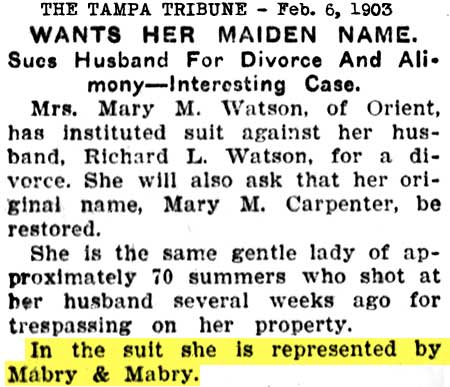
1903-02-06 TRIB - The
only reference to Mabry & Mabry in Florida newspapers Wants
Her Maiden Name Mary M. Watson files suit against husband Richard L.
Watson, for divorce. She will also ask that her original name,
Mary M. Carpenter, be restored. She is represented by Mabry & Mabry.
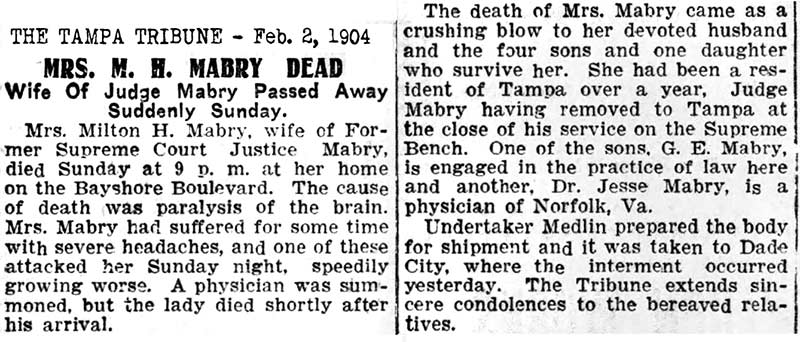
1904-02-02 Tampa Tribune Death
of Ella D. Mabry on Jan. 31, 1904, wife of Milton H. Mabry.

MABRY LEAVES TAMPA,
RETURNS TO TALLAHASSEE AS CLERK OF SUPREME COURT.
1905-03-31 The Weekly True
Democrat (Tallahassee) Mr. B. B. Wilson today retires from the office of clerk of the Supreme
Court and turns over that office to Judge M. H. Mabry....of Tampa, an
ex-Judge of the Supreme Court and is of course thoroughly conversant
with the duties upon which he is entering, as well as a gentleman very
highly esteemed, especially among the legal fraternity of the State.
1906-02-08 Pensacola News
Journal Dear sir, The court has today directed the entry of judgment in the
case of L.B. Croom, plaintiff in error, vs. C. Fred Schad, marshale,
defendant in error from Escambia county, affirming judgment in the case.
The decision of the court was en banc and the opinion prepared by Mr.
Justice Taylor. Very truly yours, M.H. Mabry, Clerk Supreme Court.
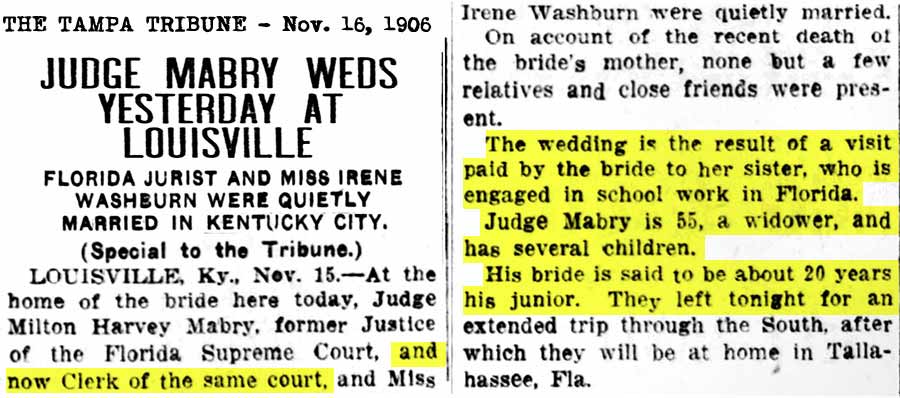
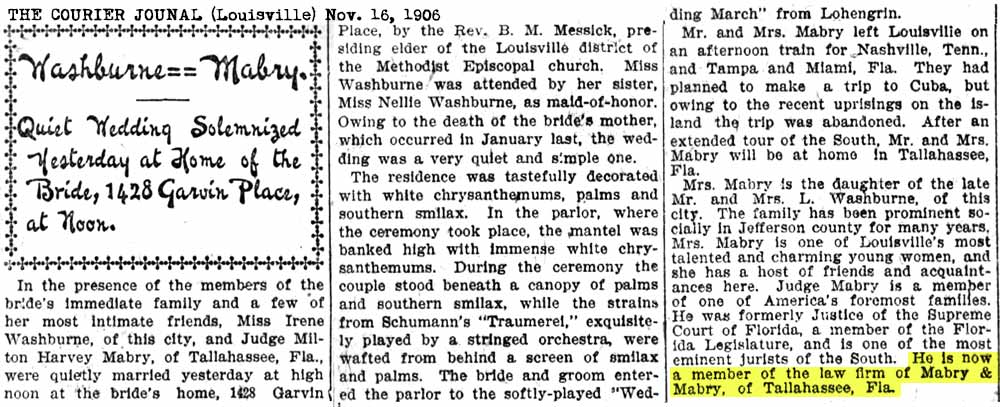
MILTON MABRY REMARRIES
1906-11-16 The Louisville Courier Journal Quiet Wedding Solemnized Yesterday at the Home of the Bride... This article is incorrect concerning Milton being a member of Mabry &
Mabry. He had already moved back to Tallahassee in 1905.
After the wedding, the Mabrys honeymooned in Miami, with expectations of
going to Cuba, but political unrest there made them decide not to go.

1906-12-2 Florida Times
Union Judge Milton H. Mabry and Mrs. Mabry returned Saturday from their
wedding tip and are making their home with Mr. and Mrs. F. C. Gilmore.
Mrs. Mabry has a host of friends here who remember her as a charming
visitor of last season, and who are delighted that she has returned to
make her home in Florida as the wife of one of the state's mos
distinguished men.
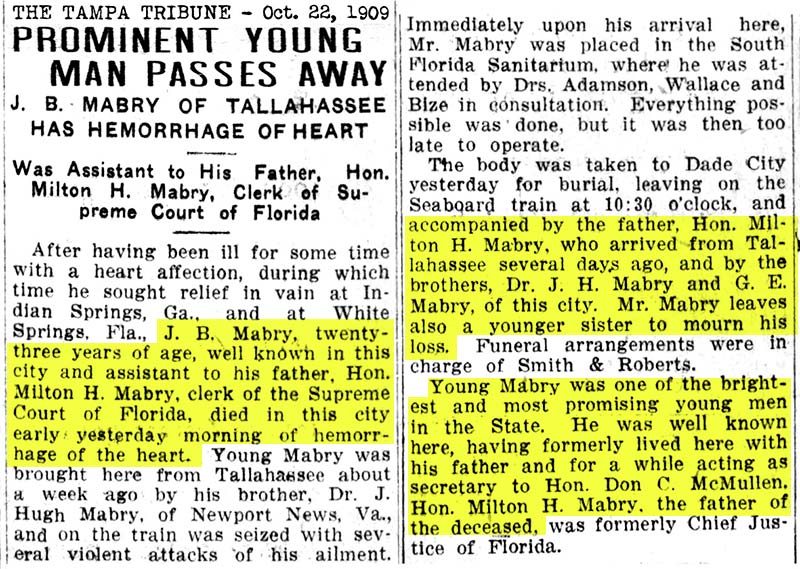
1909-10-22 TRIB Death of
John Bramlett Mabry
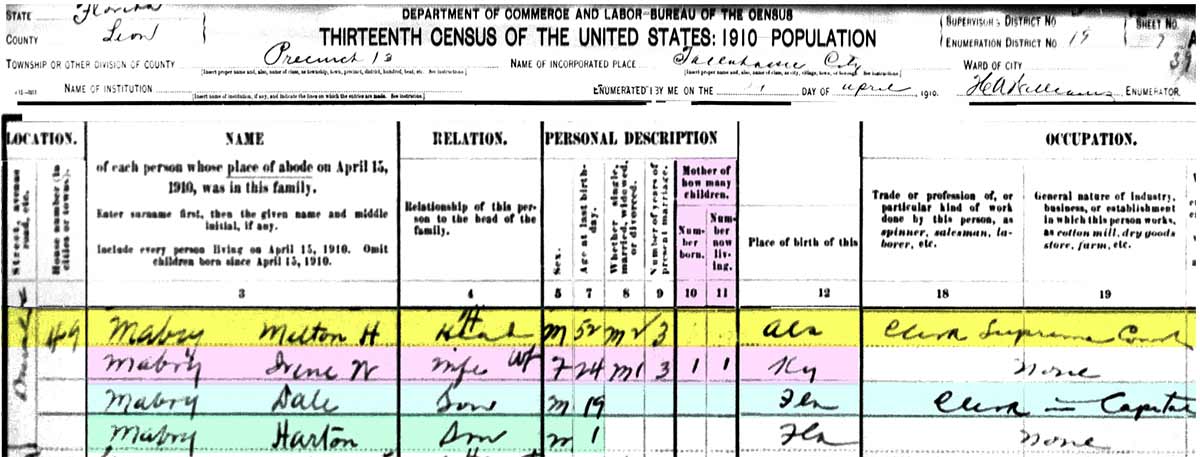
1910 Census, Leon County,
Tallahassee, 49 Duval St. The Mabrys were living about 3 blocks north of the State Capitol.
Milton was recorded as being 52, but he was actually 59 to turn 60 next
month. This was his 2nd marriage, indicated by the "M2," and was
working as Clerk, Supreme Court. Irene was recorded as 24, but she was
actually 38.
Her tombstone shows she was born March 28, 1872. This was her
first marriage, mother of 1 child, 1 living. Dale was 19 (b. Mar. 22,
1891) and working as a clerk at the capitol. Milton & Irene's son was 1
year old.

SECOND RETIREMENT
1915-06-06 Tampa Tribune MABRY QUITS AS CLERK OF THE SUPREME COURT - Is succeeded by Talbot
Whitfield, Governor's secretary. Judge Mabry's health is reason
for change. TALLAHASSEE, JUNE 5 - Hon. Milton H. Mabry has resigned as
clerk of the Supreme Court. The statement is made that the
probable reason for the resignation is the Judge's health. Hon. Talbot
Whitfield, private secretary to the Governor, has been named as Judge
Mabry's successor. The retirement of Judge Mabry marks the ending of a
long and enviable record in the service of Florida, and those who have
known and learned to love him express for him the wishes for peace and
prosperity as a reward for his fidelity.
1915-06-10 Tampa Times Judge Mabry and family of Tallahassee have located in Clearwater for the
summer, and probably will make this their permanent home.
1915-07-04 The Florida Tmes-Union
(Tallahassee) Judge Milton H. Mabry...turned over the jurisdiction of his office,
clerk of the supreme court, to Hon. G. T. Whitfield. Judge Mabry
will remain in the city for a week or two winding up his business and
then will enjoy a much deserved vacation, a part of which he will
possibly spend at Clearwater. His son, Dale Mabry, has been here
for a few days assisting his father in the conclusion of his affairs.
He returned to his home in Tampa Thursday.
1917-01-31 Tampa Tribune Mrs. Milton H. Mabry, Sr., is the wife of Judge Mabry and has recently
moved from Tallahassee to Tampa. She is a charming woman and will
be an asset to Tampa's society.
Death of Milton Harvey
Mabry, Sr.
1919-03-03 Milton H. Mabry,
Sr. death certificate Milton Harvey Mabry died at his residence at 310 Fielding in Tampa from
pulmonary tuberculosis on March 3, 1919, at age 68. His length of time
in this location was 18 years. His date of birth was June 17,
1850 in Alabama, occupation Lawyer. Parents Jesse H. Mabry of SC and
Sarah Prude (no birthplace given). The informant was his widow,
Mrs. Milton H. Mabry, of 310 Fielding. The place of burial was Dade City
Cemetery.
MILTON H. MABRY
OBITUARIES
Be aware that obituaries are rarely 100% accurate as they depend on the
information of relatives and/or friends. For example, the press
constantly refers to him as "Milton Harze Mabry" or Milton Harse Mabry.
1919-03-04 Florida Times
Union
See whole article.
Tampa, March 2 - MILTON H. MABRY DIES AT HIS TAMPA HOME -
One-Time Lt. Governor of Fla., justice of the State Supreme Court and
later Clerk of That Court. Errors: "Milton Harze Mabry".
...became Lt. Gov. a position he filled until 1888. Mabry held this position to the end of his term in 1890.
Survivors: wife, five sons, and a daughter. The sons are "C.E.
Mabry, Jr." (Should be G. E. Mabry and not a junior) and
Narton Mabry of Tampa" (should be HARTON Mabry), J. M.
Mabry of Newport News, Va. (Should be Dr. J. H. Mabry - Jesse
Hughes Mabry, "and Lt. Dale H. Mabry" (NO source ever
attributes a middle name or middle initial for Dale. Not even his
Jan. 28, 1921 application for a passport which bears his own signature.)
OMITS MILTON HARVEY MABRY JR.
1919-03-04 Tampa Times
See whole article MABRY FUNERAL OCCURRED TODAY - Former Justice of Supreme Court Died at
Home Here. Errors: Judge Mabry was born Jun 17, 1851...(b. 1850).
In 1883 he was elected as a member of the house of representatives from
Lake County. Mabry was a representative from SUMTER COUNTY.
Survivors are correct. G.E. Mabry, M. H. Mabry Jr, Harton Mabry, all
of Tampa, Dr. J. H. Mabry of Newport News VA, Lt. Dale Mabry with
expeditionary forces in France, and daughter Mrs. Taver Bayler
(Bailey) of Clearwater.
1919-03-04 Tampa Tribune
See whole article JUDGE M. H. MABRY DIES FOLLOWING LONG ILLNESS,
Spent several
years at Tallahassee, Former Justice Supreme Court, Lt. Gov. and
Representative Lake County (NO, Sumter County.) Judge Milton HARZE Mabry...born Pickens Co., Alabama June 17, 1851
(no, HARVEY, 1850). 67 years old (no, 68)
He was
elected in 1883 as a member of the state house of representatives from
Lake County..(NO, elected 1882, started 1883, represented SUMTER
Co.) This obit is almost word-for-word from the Times obit.
1919-03-05 Tallahassee
Democrat
See whole article
JUDGE M. H. MABRY DIES IN TAMPA - Same errors as above: -
Milton HARZE Mabry. Born 1851, Elected 1883...was Lt. Gov. until
1888 when office was done away with. NO, was Lt. Gov until Jan.
8, 1889.
1919-03-05 Tampa Tribune
- All correct, has no dates.
See whole article
1919-03-06 Tampa Times -
All correct Judge Mabry's Funeral Was in Dade City - Dade City, March 6 - Several
prominent attorneys of Tampa, besides all the attorneys of the Dade City
bar and old-time friends of Judge Milton H. Mabry, attended his funeral
here Tuesday. The services, which were conducted by Rev. C. W.
Duke of Tampa, were simple but impressive. Interment was made in
the Dade City cemetery.
1919-03-06 Tampa Tribune
- All correct MANY MEMBERS OF BAR ATTEND MABRY FUNERAL, Late Judge Interred at
Dade City Dade City, March 5 - The remains of Judge Milton H. Mabry were laid to
rest in the municipal cemetery here yesterday. The funeral
services, conducted by Rev. C. W. Duke of Tampa, were extremely simple.
All the attorneys of the Dade City bar, several prominent attorneys from
tampa and many of the old time friends of the judge, who once lived
here, were present.
1919-03-11 Tampa Times
DRAW RESOLUTIONS RESPECT TO MABRY - Circuit Judge F. M. Robles
(Francis Marion Robles, son of Tampa pioneer Joseph Robles)
today
named a committee of seven old lawyers who during the time Judge M. H.
Mabry practiced were members of the Tampa bar with him, to draw up
suitable resolutions and present to the court Saturday morning at 11
o'clock. Lawyers asked to serve on the committee are Judges James
F. Glen, S. M. Sparkman, Tom Palmer, H. C. Macfarlane, C. C. Whitaker,
H. P. Bailey and Wm. Hunter. Judge Robles said this morning that
he thinks it fitting that the local bar association and courts remember
the distinguished judge and local lawyer.
1919-03-14 Florida Times
Union - same errors as before Same errors as before:
Milton Harze Mabry, born 1851 (1850), elected 1883 to state house,
served as Lt. Gov until 1888 (1890) when office was
abolished (no) survived by sons C.E. Mabry Jr (NO,
G.E. Mabry)., Narton (HARTON) Mabry, Lt. Dale H.(no)
Mabry. Missing Dr. Jesse Hughes Mabry.
1919-03-15 Tampa Tribune
from the Gainesville Sun Judge Milton H. Mabry - When this distinguished Floridian passed
off the state of action a day or two ago, he practiced law with William
A. Hocker at Leesburg. Both these gentlemen represented Lake
county in the state legislature. (NO, both represented
Sumter County). and both became judges of the supreme court of
Florida. Judge Mabry (like his friend and co-partner, Judge
Hocker) was a lawyer in whom there was neither guile nor deception.
He was a profound lawyer; a gentleman of the old school. Courteous
always and a scrupulous disciple of the code of honor. His whole life
was one that those coming after him may emulate with profit to
themselves and to their country.
1919-03-17 Tampa Tribune
See whole article. SPLENDID TRIBUTE IS PAID TO JUDGE MABRY - RESOLUTIONS PASSED BY BAR
ASSOCIATION - Many Accomplishments of This Noble Citizen Reviewed in
Memorial. Accurate birth date. Mention of becoming mayor of Tupelo but says
"twice." Mentions partnership with William A. Hocker for more than ten
years. Accurate year of beginning as member of the Fla. House of Reps,
1883. Nominated and elected Lt. Gov. in 1884, (Nominated in 1884)
Although a newcomer and stranger to the people and politics of
Florida, so impressed his worth upon the thinking people of this state,
that he was, without effort on his part (NO, he campaigned for
this position, they are confused with his Supreme Court nomination)
nominated and elected Lt. Gov. of this state in 1884. (NO,
elected 1884, served starting 1885. ) This office he filled
acceptably to the people until 1884. (NO, served to 1890.)
1919-03-18 Tampa
Times
See whole article RESOLUTIONS ARE ADOPTED, Committee Meets in the Circuit Court Room
to Honor Judge Mabry. Resolutions: Accurate birth date, accurate name, Milton Harvey Mabry,
again says "twice honored with election to the mayoralty of said
town (Tupelo)" This may be accurate if mayors served 1-year
terms. nominated and elected Lt. Gov. of this state in 1884.
(elected 1884, served starting 1885. ) This office he filled
acceptably to the people until 1884. (NO, served to 1890.)
Tribute to character follows.
CLICK TO SEE LARGER

|
| |
|
|
|
| |
|
|
|
|
GIDDINGS ELDON MABRY, SON OF MILTON H.
MABRY, SR. & ELLA DALE BRAMLETT
Born on Oct 8, 1877 in Tupelo, Miss., Giddings
E. Mabry was influenced in his choice of a career by his father,
Milton Harvey Mabry, who had a distinguished career as a lawyer and
public servant.
Giddings was
educated in West Florida Seminary (1894-96) and Richmond
College, VA. (1896-98). He received his law degree from
Cumberland University Law School in Lebanon, TN, in 1901. In the
same year he was admitted to practice in Florida, commencing his
practice of law in Tampa in 1901. In 1904 he was joined by his
father, Milton Harvey Mabry.
Milton had
practiced law in Tupelo from 1872 to 1878.
In 1879, Milton H. Mabry was
persuaded to come Florida for his health by his friend and
future law partner, William A. Hocker, At two years old,
Giddings and his younger brother Jesse were brought by their
parents to Leesburg in Sumter Co., Florida.
From 1883 to 1884,
Milton was a member of the Florida House of Representatives. In
1884, he was elected Lt. Governor of Florida, but upon
adoption of a new Florida Constitution in 1885, that office was
eliminated; Mabry served out his term. Milton H. Mabry was elected to the Supreme
Court of Florida in 1891. He later became Chief Justice, serving
two terms on the Court until 1903. Declining then to seek reelection, he
moved from Tallahassee to Tampa to join his son in the practice
of law.
Justice Mabry
practiced law with his son for about two years in Tampa from
1903 to 1904. He then
returned to Tallahassee. According to David E. Ward, Justice
Mabry said he “didn’t care for the private practice of law.”
Upon his return to Tallahassee, Milton became Clerk of the
Florida Supreme Court where he served until 1915.
On Nov. 1,
1906, Giddings Mabry married Mabel Robey, daughter of Rev.
George C. and Rebecca J. (Kelly) Robey. Giddings and Mabel had
one daughter around 1910, Mabel Mabry. Daughter Mabel was a
pleasant, friendly woman, always supportive of the firm. She
married happily late in life and moved with her husband to New
York.
Giddings Mabry
served as City Attorney from 1910 to 1913, during which time
some of his accomplishments were securing for the city the land
needed for the estuary development and the property on Zack St.
where the new Fire Station #1 was built. He served as
County Attorney from 1917 to 1923.
Giddings'
brother, Milton H. Mabry, Jr. became a prominent realtor in
Tampa for many years. In 1953 he was still active in that work
and did business under the name of Mabry, Rice & Boring.
Giddings’ brother Dale Mabry was a WW1 veteran and Captain in
the U.S. Army Air Corps. He was well known for his pioneer work
in lighter-than-air aircraft. He was at the controls of the
airship Roma when the dirigible collapsed and struck a 2,200
volt network of power lines at Langley Field, near Norfolk, VA.
in Feb. of 1922. (Tallahassee’s airport was for many years named
for him. In the 1940’s, when a road was built to connect MacDill
Airfield with Drew Airfield in Tampa, the road was named in his
honor.)
The late D.
Wallace Fields (of Carlton Fields) noted that Mr. Mabry was a
thoughtful and generous man. He cared about those who worked
with him. This was his legacy. He was a fine citizen, an able
lawyer and a quiet, but effective influence upon partners more
publicly prominent than he. He left the active practice with his
firm in the mid-1960’s and died in Sept. 1968 at age 90. He was
a solid rock on which to build. Throughout these times, the
Firm’s founders were leaders in public, religious and civic
activities. Their partnership soon began to take the forefront
in the building and shaping of Tampa’s legal and real estate
development.
Some of the
information above is from “A History of Our Firm” compiled by
Wm. Reece Smith, Jr. in 1990. It is a collection of information
gathered from many sources, including interviews with then
senior members of the firm and firm history by Peter
J. Winders.
MILTON MABRY AND FAMILY, 1880 Census, Leesburg, Sumter Co.,
Fla.

Giddings was enumerated as "Elding;" an
attempt by the enumerator to spell "Eldon."
The Hockers were living 5 dwellings away, the dwellings in between them
have been removed here.
Milton's occupation here is a mystery. The first word is
"Fruit." By looking at this enumerator's handwriting
on many pages, the 2nd word appears to be "Susing."
It doesn't start with a "G" because all G's are consistent as it
appears in Hocker's wife "Girtrude." Considering the
enumerator has misspelled Gertrude, Eldon and Jesse, "susing"
may be a misspelling as well.

GIDDINGS MABRY'S EDUCATION
Giddings Mabry was educated in the Leesburg public grade
schools and Leon County High School in Tallahassee. In 1894 he entered the West Florida
Seminary in Tallahassee until 1896.
 |
THE WEST FLORIDA SEMINARY
In 1851 the Florida legislature commissioned two state
“seminaries” of higher learning—one east and one west of the
Suwannee River. So these date their origin from that act.
However the West Florida Seminary did not actually begin
classes until 1856. During the 1882-85 period, it was called
the Literary College of Florida University, and after 1885
it was the Academic Department. It offered three
degrees—Bachelor of Arts emphasizing Greek and Latin;
Bachelor of Science emphasizing natural science and modern
languages; and Bachelor of Letters, emphasizing English,
German and Romance Languages. In 1901 the school advertized
three branches: the academy, the normal school, and the
college. After a name change to Florida State College in
1902, it added a fourth branch—the school of music. The 1901
Argo shows a student body of 171—35 in the college, 77 in
the academy, and 59 in the normal program. There were also
seven “special students.” The two rival student groups were
the Anaxagorean Literary Society and the Platonic Debating
Society—each with more than 20 members. The highlight of
their year was commencement week, when each society had a
day to display its talents. The school also had a Dramatic
Club and an Oratorical Association. The 1905 Buckman plan
reorganized higher education in Florida, segregating
state-supported schools by race and gender. At that point
Florida State College became Florida Female College. It was
not until the aftermath of World War II that the school once
again accepted male students, becoming the school we know
today as Florida State University. Information
above from West Florida Seminary, 1851-1905 at
lostcolleges.com |
|
Photo
courtesy of Florida Memory, State Library and Archives of
Florida |
|
|
Giddings Mabry then attended Richmond
College at Richmond, Va. from 1896-1898, where he studied Latin, Greek,
English and philosophy, obtaining his
undergraduate degree in English and Latin.
Detailed history of Richmond College
RICHMOND
COLLEGE, RICHMOND VA. 1898
Images courtesy of
Richmond College Catalogue, 1897-1898
|
|

|
On March 4th, 1840, the Virginia Legislature
granted a charter for “a Seminary of learning
for the instruction of youth in the various
branches of science and literature, the useful
arts and the learned and foreign languages,
which shall be called and known by the name of
Richmond College.” Richmond College is not
defined by bricks and mortar, but as a community
of students who strive to respect others,
discover their best selves, and pursue lives of
purpose.
This
“Seminary of learning” grew out of an actual
seminary; The Virginia Baptist Seminary was
founded in 1832, and the Virginia Baptist
Education Society had been formed two years
earlier. The seminary began admitting students
who had not had a calling to the ministry, and
in due time it made sense to expand the mission
of the institution. The first campus was located
on the grounds of an old mansion once owned by
the Haxall family, who at the time owned the
largest milling operation in Virginia. The
mansion was named “Columbia” and stands to this
day at the corner of Grace and Lombardy Streets.
In the early days, Columbia was Richmond
College. Sixty-eight students were
enrolled in the early years, and the first
bachelor’s degrees were conferred in 1849 to
Poindexter Smith Henson and Josiah Ryland.
The College increased its student body and
endowment in its first twenty years. 161
students were enrolled in 1861, and there were
68 alumni. The College ceased operations during
the Civil War as most of the students and
faculty went to fight for the Confederacy. When
the war was over, one fifth of the alumni and
many members of the student body had died, the
campus was a camp for the Union Army, the
endowment was worthless, and the equipment and
books of the College were lost. Through the
generosity of alumni and the Virginia Baptist
Society, funds were raised to reopen the College
in the fall of 1866. Over the next 50 years a
beautiful campus thrived within the borders of
Ryland, Broad, Lombardy, and Franklin Streets.
In
1895 Frederic Boatwright was appointed president
of Richmond College. During this time, Richmond
College had 200 students and 11 faculty members.
Although there were no entrance requirements for
the College, the courses were of such quality
that students without preparation could not make
passing grades. Roughly two-thirds of the
matriculates failed to earn a degree. Although
women had been enrolled in Richmond College
toward the end of the 19th century, the
prevailing wisdom at the time was that higher
education was the dominion of men. In the early
1900’s, President Boatwright and the Board of
Trustees set in motion the series of events that
ultimately moved the campus to its current
location in the West End in 1914 and established
Westhampton College as a “coordinate” college,
“of equal grade, and having similar courses of
instruction.” Westhampton College existed on one
side of the lake, and Richmond College on the
other. To this day, we refer to the Westhampton
and Richmond “sides” of the campus. In 1920, the
name of the institution was changed to the
University of Richmond, but the Colleges
remained as separate entities well into the
later part of the 20th century.
Read more at the school's website, where the
above history was obtained. |


Giddings' brother, Jesse Hughes
Mabry (named for his paternal grandfather), also attended
Richmond College. Jesse went on to a medical doctor
career and practiced in Newport News, Va.
|
|
PATRIOTIC ASPIRATIONS
It was in mid-1898 when the Spanish-American war broke
out that young Giddings was fired up with patriotic enthusiasm to help
Col. Roosevelt free Cuba from Spanish rule and oppression.. He was
ready to join when his family convinced him into completing his
education.
(1963-03-14 Tampa Tribune - Giddings Mabry,
Faith that works.)
LAW DEGREE AT CUMBERLAND UNIVERSITY
Upon graduating from Richmond College,
Giddings entered Cumberland University at Lebanon, Tennessee, in 1898
and obtained his Bachelor of Law degree in Dec. 1900. This was the
same institution where his father, Milton, obtained his law degree in 1872.
1900-06-10 FLORIDA TIMES UNION
Giddings E. Mabry, a student at Cumberland University, Tenn., attended
the West Florida Seminary exercises.
https://archive.org/details/internationaldir0153unse/mode/2up
Cumberland University
Established as Cumberland College at Lebanon in 1842 under the
patronage of the Cumberland Presbyterian Church, Cumberland
University received a charter as a university in 1843. Except
for the period from 1962 to 1982, when the name was officially
Cumberland College of Tennessee, the institution has operated
continuously as Cumberland University and is the oldest
institution of higher education in the central South operating
under its original chartered name. Shortly after its founding,
Cumberland University occupied a large new Greek Revival-style
building. Robert L. Caruthers, lawyer, soldier, jurist, and
congressman, took a leading role in the subscription drive that
produced ten thousand dollars for the new college; he became the
first president of the board of trustees. In 1847 trustees at
Cumberland University established a school of law. It opened a
theological school and a school of engineering in 1853. By 1859
the law school was among the largest in the United States.
Catalogue of Cumberland University, 1900
|
|

Memorial Hall, University building, front

Memorial Hall, University building, rear

|
Divinity Hall |
Caruthers Hall |
 |
 |
|
GIDDINGS MABRY RETURNS TO FLORIDA After obtaining his law degree, Giddings
came back to Florida to join his parents and siblings at the
fine 10-room home his father had built in Dade City. Giddings came to Tampa
briefly in late Jan.1901 and immediately left for Ocala to study
Florida law in the law
office of his father's former law partner and friend, Judge William A. Hocker.
1900 CENSUS, PASCO CO.,
DADE CITY

1901-01-29 The Florida Times Union
(Tallahassee) Giddings Mabry, son of Justice Mabry of the Supreme Court, has returned
home from Lebanon Law School, where he graduated.

1901-01-29 The Tampa Tribune Giddings Mabry arrived in Tampa in late January, 1901, and left for Ocala to join Judge Hocker.
| JUDGE WILLIAM ADAM HOCKER
Service: January 6, 1903-January
5, 1915.
Born December 5, 1844 in
Buckingham County, Virginia. Educated at Hampden-Sidney
College of the University of Virginia. Admitted to bar,
1869. Moved to Florida, 1874. Member of Florida Legislature
in 1877 representing Sumter County and in 1891 representing
Lake County. Member of 1885 Constitutional Convention. Judge
of the Fifth Judicial Circuit 1893-1901. Died in
Jacksonville, July 16, 1918.
Portrait courtesy of Florida Memory Archives & State Library
About Judge Hocker |
 |
| |
|

GIDDINGS MABRY AT OCALA
1901-02-01 The Ocala Evening Star
See the whole article. Mr. Giddens [sic] Mabry, the polished and gifted son of Judge M.H. Mabry
of the state supreme court, has just returned from Lebanon, Tenn. where
he graduated with honors from the law school at that place. He now fills
a position in Judge Hocker's office in Ocala, where he hopes to acquire
as expeditiously as possible a full knowledge of Florida law. He
is certainly a promising young man and will no doubt make his mark as a
lawyer.
According to the revised Florida statutes of 1892, revised in 1899,
anyone desiring to practice law in Florida was required to pass an exam
given by the Circuit Judge and at least two members of the Bar.
Upon passing the exam, the lawyer was entitled to practice in the
several circuit and inferior court of Florida.
GIDDINGS MABRY EXAMINED IN OCALA
1901-03-20 The Ocala Evening Star William Hocker presented to the court the name of G. E. Mabry, who
desired to be admitted to the practice of law at this bar, whereupon
Judge Hocker appointed Messrs. R.L. Anderson and R. McConathy to assist
the court in the examination of the young applicant, which examination
will take place Wednesday morning in open court.

GIDDINGS PASSES EXAM
1901-03-21 Ocala Evening Star CIRCUIT COURT -
Wednesday's proceedings: The committee, Messrs. R.L. Anderson, W.S.
Bullock and R. McConathy, appointed by the court Tuesday to examine into
the qualifications of Mr. Mabry, with the court, proceeded to examine
the applicant for admission to the bar. Mr. Mabry passed a most
creditable examination and demonstrated the fact that he has a quick and
retentive mind. He is a son of Judge Mabry and has been reading
law for some time in Judge Hocker's office.
GIDDINGS MABRY RETURNS TO
TAMPA TO START HIS ONE-MAN LAW OFFICE
Upon arriving in Tampa at age
24, Giddings Mabry established his residence in a rooming house
at 409 East Street in Ft. Brooke. There he shared a room
with Herbert S. Phillips, who was admitted to practice in Tampa
in Feb.1901 and would soon serve as U.S. District attorney for
25 years. in Oct.
1901, Giddings opened his private law practice in the Knight
Building at the southeast corner of Franklin & Lafayette St.,


Ft Brooke was an area separate from
the City of Tampa which had not yet been annexed. It
originally consisted of all the land south of Whiting St. extending
north to the area later that became Ybor City.
See The Final Battle of Fort
Brooke at TampaPix.
GIDDINGS OPENS AN OFFICE IN THE
KNIGHT BUILDING
1901-10-11 TRIB LAWYER MABRY Mr. Giddens [sic] Mabry, son of Judge Mabry of the Supreme
Court, has decided to cast his lot in Tampa and will practice law in
this city, occupying elegant quarters in the Knight building. Mr.
Mabry is an exceedingly bright young gentleman and will no doubt gain
fame and fortune in his chosen profession.
|
THE KNIGHT BUILDING
Located on
the southeast corner of Lafayette St. (now Kennedy Blvd.) &
Franklin St., articles mentioning it as "the new Knight
building" begin in April of 1893.
At the far left of the
photo can be seen the back side of the old City Hall built
in 1892 and demolished in 1915 to build the old City Hall
that still exists today at that same location.
 |
|
This photo was originally published in the
Jan. 1900 Tampa Tribune mid-winter edition. Some
years later, The Burgert Brothers obtained this issue from
Tribune archives and photographed most of the pages that
pertained to the development of Tampa, thus producing
glass-plate negatives. When the Burgert negatives were
discovered in a backyard shed of a Tampa home, the Library
organized to obtain funding to print the over 20,000
negatives, scan them
and put them online.
LOCATION OF THE KNIGHT BUILDING, 1903
The 1903 Sanborn map presented above
shows the location of the Knight building, which was next to saloons, a liquor store and a billiard hall,
places Giddings likely abhorred.

The first City
Hall seen looking southwest from Florida Avenue and
Lafayette St. in 1900
Photo from the Jan. 1900 Tampa Tribune mid-winter
edition, rephotographed by the Burgert Bros.
and available from the Tampa-Hillsborough Co. Public Library
System.

Below: The rear of
the Knight building can be seen at far right in the photo
below.
Notice that the City Hall rooftop structure has been removed.
Find out when and why.

The signage on
the building is an indication that the photo was taken after
Oct. 1911. When the Fire Department moved out and into its
new building on Zack Street in late 1911, the old City Hall
building was then repaired and renovated in Oct. of that
year. The remodeling was done to accommodate the Police
Headquarters almost entirely . (These
events are detailed in this feature.) When originally
built, the signage showed "Head Quarters Tampa Fire
Department." The Burgerts were commercial photographers and
a newly completed repair/ renovation would have been a good
reason to hire them to photograph the building at this time.
Today this site is the courtyard in front
of the City Hall annex.

|
Giddings Mabry soon found himself being
appointed frequently by Judge Graham to defend suspects in the criminal
courts.
1901-10-18 The Tampa Tribune MERRITT SENT UP - Grant Merritt, the negro who carried away a
considerable portion of the goods of L.D. Geiger...was convicted of
grand larceny and sentenced to 18 months in the penitentiary.
Giddens [sic] Mabry, who has just begun the practice of law here, was
appointed by Judge Graham to defend the negro, and made a creditable
showing in a clear case of guilt.
1901-11-12 The Tampa Tribune G MABRY DEFENDS WALKER Doc Walker, burglary, was successfully defended by Attorney G. E. Mabry.
GIDDINGS MABRY ADMITTED TO THE HILLSBOROUGH COUNTY
BAR ASSOCIATION
1902-02-09 The Tampa Tribune
GIDDINGS MABRY APPLIES FOR HCBA GUNBY IS CHOSEN as president of the Hillsborough Co. Bar Association.
The meeting was held in the office of Circuit Judge Joseph. B. Wall.
Applications for membership were received from G. E. Mabry
and G. E. Lucas of Tampa. E.R. Gunby
was elected as president, Thomas M.
Shackleford as vice-president.

1902-02-14 Tampa Tribune Four young attorneys have been admitted this term to practice in the
court. They are Victor H. Knight, G. E. Mabry, W. B. Dickenson and
C. A. Drumwright.
1902-08-06 The Tampa Tribune
LAWSON IS FREE - Jury Agreed At Late Hour Last Night Attorney Mabry cleared his client of assault with intent to rape after a
hard fight against trained lawyers. Lawson was defended by G. E. Mabry; Solicitor Simonton and Samuel Borchardt represented the State.
1902-09-11 The Florida Times-Union -
Former roommates travel to Tallahassee Giddings E. Mabry, a promising young lawyer of Tampa, and Hon. H. S.
Philips, nominee for State Attorney in the Fifth Circuit, are on a visit
to the capital.
THE START OF MABRY & MABRY
When Milton H. Mabry, Sr's service as a Florida Supreme Court justice
was over, he declined re-election and moved to Tampa to join his son in
the private practice of law. Giddings E. Mabry, attorney at law,
became "Mabry & Mabry."
1903-01-01 The Tampa Tribune
MILTON
MABRY (SR.) COMING TO TAMPA - Giddings E. Mabry has returned to Tampa from Tallahassee; his father, Judge M H Mabry, will arrive in a few days to locate here for the
practice of his profession.
1903-01-01 The Tampa Tribune A
Distinguished Acquisition
Judge Mabry who retired from the Supreme Court today has already arrived
in Tampa where he will make his future home. Judge Mabry will practice
law in this city and the acquisition of himself and his estimable family
is greatly appreciated by Tampa. He is considered on of the
shrewdest and most successful lawyers in this State, and the Tribune is
confident that his most sanguine anticipations will be more than
realized in his new home.
1903-01-06 The Tampa Tribune MILTON MABRY, SR. ARRIVES
IN TAMPA
1903-02-06 The Tampa Tribune - FIRST AND ONLY MENTION OF MABRY
& MABRY IN FLORIDA NEWSPAPERS WANTS HER MAIDEN NAME Mrs. Mary M. Watson is represented by Mabry & Mabry in a divorce lawsuit
against her husband, Richard L. Watson. She also asked that her
original name, Mary M. Carpenter, be restored. "She is the same
gentle lady of approximately 70 summers who shot at her husband several
weeks ago for trespassing on her property.
1904-02-02 Tampa Tribune Death
of Ella Dale Mabry on Jan. 31, 1904, mother of Giddings Mabry


1904-02-18 The Weekly Tampa Tribune
HILLSBOROUGH CO. BAR ASSOCIATION ELECTS OFFICERS
Giddens [sic] E. Mabry is elected treasurer.

THE END OF MABRY & MABRY -
GIDDINGS GOES SOLO AGAIN
1904-04-12 The Tampa Tribune
By mid-April 1904, Giddings Mabry had moved his practice into the Hampton
Building. Giddings
Mabry, a leader in the temperance movement, was giving out badges to
members of the WCTU (Women's
Christian Temperance Union). Over 800 women
had been pinned.
1904-05-15 The Tampa Tribune Mabry, G. E., Hampton Block. Pen (Peninsular) Phone 1123

|
The Hampton
building was located on the east side of the 700 block of
Franklin St. on the corner at Polk St.
The Hampton Building, 1921 |
|

Behind the far right lamp post can be seen one of the three
1-story businesses that were demolished to build the Tampa
Theater in 1926. Construction on the Hampton building began
in late Sept. 1900 after the wood frame structures on the
corner were
demolished (meat market, tailor shop, barber shop,
restaurant, and laundry) and was completed in late Feb.
1901.
1900-04-08 Tampa Tribune - "ANOTHER BRICK BLOCK -
Hampton to Erect Handsome Structure at Franklin and Polk.
By Oct. 1934
it was the home of Walgreen Drug Store. Notice the
Tampa Theater blade sign and removal of the top decorative
facade of the right end of the Hampton building.

On the 1903
Sanborn Fire Insurance map below can be seen outlined in
blue where the Tampa Theater office tower and auditorium
were built in 1926.

The bank at lower left was the Citizens Bank.
 |
WILLIAM WADE HAMPTON
The
Hampton block and
the building were named for William Wade
Hampton, Sr, a Gainesville attorney who
owned a large amount of valuable property in the
state including in
Tampa. Born in Albany, Georgia in 1856, he
came to Florida in 1876 at Gainesville where he
founded the town's first law firm, Hampton and
Hampton, with his brother Edwin, William was the
first president of the Florida Bar Association. He was the
first of three generations of Wade Hamptons who
practiced law in Gainesville from 1875 until
2006. In early April, 1900, he announced
plans to build a new brick business block on his
property at Franklin and Polk St.
|
 |
|
Courtesy of "Men of the South" 1922 |
|
Courtesy of Florida Memory, Archives & State
Library |
Hampton block in
1911 looking north from Franklin St. and Zack.
At far right is the Citizens Bank Building. Place
your mouse on the photo to see the Hampton Building
highlighted.
Burgert Bros photo courtesy of the Tampa Hillsborough County
Public Library System


|
MILTON H. MABRY SR. RETURNS TO TALLAHASSEE AS CLERK OF SUPREME COURT.
1905-03-31 The Weekly True
Democrat (Tallahassee) Mr. B. B. Wilson today retires from the office of clerk of the Supreme
Court and turns over that office to Judge M. H. Mabry....of Tampa, an
ex-Judge of the Supreme Court and is of course thoroughly conversant
with the duties upon which he is entering, as well as a gentleman very
highly esteemed, especially among the legal fraternity of the State.

GIDDINGS MABRY JOINS TAMPA BOARD OF
TRADE, 1905
1905-03-12 The Tampa Tribune
Is your name on this list? Official list of the member of Tampa's Board of Trade, Mabry, G.E.,
attorney-at-law, Hampton building. Other members have been omitted.
1905-06-13 The Tampa Tribune Giddings Mabry Camping Trip Giddens [sic] Mabry yesterday chaperoned a hunting and fishing party to
Green Springs, where the boys will spend about 10 days
1905-06-20 The Tampa Tribune -
Read the whole article.
MABRY WAS CHIEF COOK, demonstrated rare culinary ability in Green
Springs Camp. Seven boys, counting Mabry, returned from Green Springs where they
camped out for a week and enjoyed life to the fullest. Besides his
other duties, Mr. Mabry acted as chief cook and gained 10 pounds on the
menu he prepared. He was so successful that he was offered a
steady salary of $4 a week to surrender his legal career in Tampa and
devote himself exclusively to the culinary art at the Springs, an offer
which his natural modest and retiring disposition impelled him to
refuse. Two tents and a house were needed to accommodate
the Tampa youth. Mr. Mabry, who is an expert carpenter as well as a cook
and barrister, building a handsome and commodious one story residence,
designated "Giddings' Castle," on the bluff near the hotel, during
leisure moments when not cooking, cutting wood, bathing, fishing,
hunting, sleeping, or otherwise occupied.
MARRIAGE OF GIDDINGS MABRY & MABEL ROBEY
1906-10-07 The Tampa Tribune
MABRY - ROBEY A wedding that will be of general interest all over Tampa and especially
in Hyde Park, will be that of Miss Mabel Robey and Mr. Giddings E.
Mabry. This will take place the first part of November.
Both Miss Robey and Mr. Mabry have endeared themselves to a host of
friends in Tampa and their future happiness is the wish of all who know
them.
1906-10-16 The Tampa Tribune
MABRY-ROBEY The following invitations were issued yesterday: "Rev. and Mrs.
George W. Robey invite you to be present at the marriage of their
daughter, Mabel, to Mr. Giddings Eldon Mabry, on the evening of
Thursday, the first of November at 7:30 o'clock, First Baptist Church,
Tampa, Fla."
On Nov. 1, 1906, Giddings married
Iowa-born Miss Mabel Robey, a daughter of the Rev. George C. and
Rebecca J. (Kelly) Robey.

1906-11-02 Tampa Tribune
Read
a detailed article about the wedding.
1906-11-04 Tampa Tribune -
Read
another detailed account of the wedding.
FRAZIER & MABRY PARTNERSHIP
IN THE FIRST NATIONAL BANK BUILDING
 |
1907-01-08 The Tampa Tribune
In Jan. 1907, Giddings Mabry entered into a
partnership with Joseph Wheeler Frazier as Frazier & Mabry
in the
First National Bank building on the 400 block of Franklin St. (the
southwest corner of Franklin and
Madison street.)
Mabry had
previously opened his office in the Hampton Building; the
bank was
the location of J. W. Frazier's office before they formed
their partnership. |
 |
| |
|
|
|
 |
From "Men
of the South, A Work for the Newspaper Reference Library"
1922, Southern Biographical Association.
JOSEPH WHEELER FRAZIER
Joseph Wheeler Frazier, attorney-at-law, was born in Rhett
County, Tenn., Feb. 24, 1875. He was educated at the
University of Tennessee, graduating in 1900.
Mr.
Frazier came to Tampa in 1901 and was admitted to the bar
the same year. He has practiced law in Tampa ever
since. He has had a large practice, mainly in
commercial law, and is one of the most extensive owners of
real estate in the city.
Mr.
Frazier is an Elk, a Knight of Pythias, a Woodman of the
World, a member of the Tampa Yacht and Country Club and the
Golf Club.
He was
married June 8, 1904 to Miss Nellie Hendry of Fort Myers,
Fla. They have four children, to boys and two girls.
Mr.
Frazier has offices at 915-916 Citizens-American Bank
building. He has never aspired to public office but
has devoted himself strictly to the practice of his
profession and to his real estate interests. He is
specially versed in the law applying to business dealings
and has had remarkable success in special branches of law.
|
According to his 1910 Census
in Tampa, Joseph W. Frazier (38) was born circa 1871 in Tennessee. He had been married for
six years to wife Nellie (Lydia Cornelia Henry), who was 27, born in
Florida. their children were Joseph Jr., Katherine and Edward, all born
in Florida. According to a user-submitted tree of this family,
Lydia was a daughter of William Marion Hendry, of the prominent Hendry
family in Tampa, and Susan C. Wall, a daughter of Judge Perry Green
Wall. Susan's brothers included John P. Wall, physician and mayor
of Tampa.
| THE FIRST NATIONAL BANK OF TAMPA |
|
| The
First National Bank started life as "The Bank of Tampa" in
1883 in a
small wood frame structure on Washington St. just west of
Franklin St.

This photo from the Hampton Dunn
Collection was taken at least 11 years after the bank had
moved out and occupied its third location at Franklin &
Madison St. According to Hampton Dunn, the signage
was added on by a photo artist. Proof is that the bank
was not "The First National Bank" until 1895 when it
occupied its 3rd location. While in this shack, and at
its 1886 new brick building, it was "The Bank of Tampa."
This indicates that the artist altered the photo to add the
sign after the bank had changed its name--after 1895.
By this time this location was in bad shape. It did
NOT look like this when the bank occupied it.

|
On the
Sanborn Fire Insurance maps below, you can see there
was another wood frame structure to the right of the
bank. The wood planks protruding from the roof
in the photo indicate that this adjacent building
shared part of the roof, and when that building was
torn down, the planks were cut between them.

Seen
below, the old bank building was vacant and had
moved to the new brick building on the opposite side
of the street to the corner.
 |
SECOND LOCATION
In 1886 the first brick building
in Tampa was built for the bank at the southwest corner of
Franklin and Washington St.
This Burgert Bros.
photo from the University of South Florida digital
collection is described as "Bank of Tampa Building on
southwest corner of Franklin (100 block) and Washington (200
block) streets with employees" and is dated 1886.
In the photo, Franklin St. is on the left, Washington St. on the right.
|
 |
| |
Notice decorative woodwork on the sign and trees have been
added.. |
| The bank
remained here until it moved into its third location at Franklin
and Madison streets in 1895-1896.
|

|
|
|
|
THIRD LOCATION
In mid-1894 construction began
on the new First National Bank building at the southwest
corner of Franklin and Madison. Completed by January
1895, the marble front facade was the most prominent
architectural feature and was a example of
Richarsonian Romanesque influence. The building
architecture was so
unique it made the Register of Historic buildings in 1974,
even though the building had been taken down in 1925. Read
on later about how this took place.
This is the building that Joseph
Frazier occupied when Mabry joined him in 1907. |
 |

The Bank of Tampa moved from
Franklin & Washington St. to this building in early 1895,
becoming the First National Bank.
The First
National Bank bldg at at 414-416 Franklin St., the northwest
corner of Franklin St. and Madison. Photo from the Tampa
Tribune Midwinter edition, Jan. 1900.
The First
National
Bank building in 1920 |
The 1913 Burgert Bros. photo below shows an elevated
view of Franklin Street looking north. The First
National Bank building can be seen on the left side
of the street with flag on the roof. The building which appears
unfinished seen immediately to the left of the dome
was the new Hillsboro Hotel. The south face was
built practically without windows because the next
phase was to expand it even taller on this side.
The building under construction in the distance is
the Citizens Bank tower at Franklin and Zack Street.
At the time of this photo, the bank occupied the
building directly across Franklin St seen here with
the "witch hat" roof and flag on its corner tower.

1895 Sanford Fire Insurance map
Franklin St. between Madison and Lafayette.
Pink structures are brick, wood frame in yellow, stone in blue.


By mid-1895, the the first
brick building in Tampa, the 2nd home of the Bank of Tampa,
became a saloon and storage.
In the early 1910s the old
bank building became the home of the Tampa Times which was
owned by D. B. McKay. McKay soon installed radio
equipment and it also housed WDAE radio station with
towering antenna on the roof. The Times moved out when the
paper was bought by the Tampa Tribune in 1958 becoming the
Tampa Tribune-Times. The Tribune became the morning paper
and the Times the evening paper.
In November 1960, this
building became the home of Tampa Hardware Co. founded in
1884 as Clarke & Knight (predecessor to Knight & Wall
Hardware.) It was bought by the Tampa Merchants
Association in 1963 who used the two 9,500 sq. ft. floors
with their collections department on the 2nd floor. By this
time the building was a composite of two buildings which had
been consolidated years earlier. It was then
demolished in 1980 with other properties in the area to
build the One Tampa City Center complex.
 |
The Times Building in 1958
Photo courtesy of the Hampton Dunn Collection,
Sunland Tribune.
 |
| |
|
|
|
FRAZIER & MABRY IN THE
HAMPTON BUILDING
By 1910, Frazier & Mabry
occupied rooms 6, 7 & 8 in the Hampton building at Franklin & Polk,
where Mabry previously had his office. The bank
location may have lacked space for growth.
Nellie was Frazier's wife. |
 |
1910-02-13 The Tampa Tribune GIDDINGS MABRY CAMPAIGNS FOR D.B. McKAY FOR TAMPA MAYOR MCKAY RALLY TO BE HELD AT COURTHOUSE TONIGHT- G. E. Mabry will preside -
Municipal Band to be Present - Several speakers to be heard.
With G.E. Mabry presiding, the first rally at the Courthouse Square
since the first municipal primary in the interest of candidate D. B.
McKay, will be held tonight beginning at 8 o'clock. Judge Raney,
John P. Wall, M. B. Macfarlane, and Rev. Joe Sherouse are scheduled as
the speakers of the evening and the McKay forces are expecting a large
crowd present.
1910-04-22 The Tampa Tribune FRECKER CAUSE GETS HOT SHOT - McKay Forces Hold Enthusiastic Rally -
Speaking Continues Until 11:45 With Mabry, McKay, Raney, Sherouse and
Wall Holding the Floor The meeting was presided over by G. E. Mabry, who made the first
address. Mr. Mabry opened by stating that this is an important
period in the growth of the city and that at this time, important issues
confront the people...
Read all of Mabry's comments about why he supports McKay and not
Frecker, the incumbent.
|
Donald
Brenham McKay -
Tampa’s 38th & 42nd Mayor |
1st, 2nd, & 3rd terms: June 7, 1910 - June
10, 1920
(Elected
1910 for a two-year term; re-elected in 1912 for four years,
and 1916 for four years.)
4th term:
January 3, 1928 - October 27, 1931 (incomplete term,
resigned)
Mayor Donald Brenham McKay was
one of the giants in Tampa journalism and a legend in his
time. He was a native
Tampan, born in 1868, the son of John Angus McKay and Mary
Jane McCarthy, and grandson of Scotsman Capt. James McKay;
former mayor and pioneer, merchant , and cattleman who had a
skill for evading Navy blockades during the Civil War.
McKay was a
hard-hitting, outspoken editor who voiced his opinions on
the burning issues of the day. He slapped around his rival,
The Tampa Tribune, which returned in kind. Simultaneous
with being editor and publisher, McKay served a total
of nearly 14 years as Tampa Mayor. While he was serving as
Mayor, McKay didn't give much time to his paper, in fact in
the four (three consecutive) terms ending in 1931 he
averaged less than 10 minutes a day around The Times office.
|

Mayor D. B. McKay
Photo courtesy of Fla. Memory
State Library & Archives of Fla. |
Read
about this period in Tampa political history and the friction
between
Donald Brenham McKay & the controversial
Wm.
Frecker.
GIDDINGS MABRY AMD FAMILY ON THE
1910 CENSUS
The April 1, 1910 Census in Tampa finds Giddings
E. Mabry, living at 207 Cardy St. in Hyde Park, age 32, married for 3
years to 32 year old Mabel R. Mabry, Giddings's occupation was
"lawyer, general practice" In their home was their 7 month old
daughter, Mabel Mabry. Listed last is Bessie Brown, their cook, a
28 year old widow..

THE END OF FRAZIER & MABRY
1910-06-04 The Tampa Tribune The last listing for Frazier & Mabry appears in the June 4, 1910
Tribune, but the legal section of court case schedules shows Frazier &
Mabry representing clients until March 1, 1911. These listings
were called "cards" back then.
Frazier and Mabry
probably parted ways in mutual agreement due to Mabry's
appointment as City Attorney.
|
 |
| |
|
GIDDINGS MABRY, TAMPA CITY ATTORNEY
1910-06-22 The Tampa Tribune MAYOR MAKES APPOINTMENTS
On Jun. 21, 1910, Giddings Mabry was chosen
by newly-elected mayor Donald Brenham McKay to serve as
City Attorney, serving until 1913.
Among the first of his many accomplishments, Giddings secured land that enabled
development of the Ybor channel and estuary area.
Construction of Ybor
Channel, the key project in Tampa's harbor development
program, was made possible by a Federal appropriation of
$1,750,000 authorized June 25, 1910. The channel was dredged
in a marsh which had once been part of the Fort Brooke
military reservation and was then owned by four businessmen.
Another large tract was held in the name of Charles Ballit
had been deeded to him by his father-in-law, Stephen M.
Sparkman, before the latter became congressman: The
U.S. government insisted that the city must secure at least 700
feet on each side of the channel before dredging would be
started. Giddings Mabry, as city attorney, started
negotiations immediately with the property owners and the
necessary land was secured late in 1911, the arrangements
providing that the owners should be paid with certificates
which could be used to pay taxes on remaining lands for
eight years. Dredging was started February 19, 1912, and
proceeded rapidly thereafter. |

In 1911, Giddings Mabry
published a professional card in the Martindale legal directory. His
Martindale card (abbreviated version shown at right,) displayed in the
Heritage Conference Room at Carlton Fields, read: “Careful, personal
attention given to every item of business, large or small. I hold no
Claims. I either collect them within a reasonable time or return them.
No inquiries necessary on claims sent to me. I report frequently and
regularly with each claim. All commercial reports are thorough, reliable
and up-to-date and are made promptly.”
Martindale's Directory was first
published in 1868 by James B. Martindale, a lawyer and businessman. The
first edition of Hubbell's Legal Directory was published in 1870. By
1896, Martindale's Directory included basic information that still
appears in today's Martindale-Hubbell Directory. This edition introduced
law digests for all the states and provinces. The same year, the 26th
edition of the Hubbell's Legal Directory was published. By
combining the Martindale's Directory and Hubbell's Legal Directory, the
first edition of the Martindale-Hubbell Law Directory was published in
1931 as a two-volume set. (Wikipedia)

1911-03-01 The Tampa Tribune - LAST
MENTION OF FRAZIER & MABRY
This March 1911 court session was the last mention of Frazier & Mabry
representing clients together.
Other cases have been edited out.
GIDDINGS MABRY HANDLES LAND ISSUES FOR
NEW FIRE STATION
As
city attorney, in March 1911, Giddings was called to negotiate contracts
with property owners of land surrounding the site of the planned, new
Tampa Fire Station at Zack and Jefferson St. This location
would be only the 2nd site of Fire Station #1, after being housed in the
ramshackle City Hall built in 1892 at Lafayette between Florida Ave. and
Franklin St. Today this building on Zack Street is the
Tampa
Firefighters Museum,
and the old 1892 City Hall building was replaced in 1915 by the old historic
City Hall we have today.
See Burgert
Bros. page 4 for close ups of the men.

|
After about four months into D. B. McKay's first term, plans
were progressing to build a new Fire Department headquarters
at Zack and Jefferson streets. Architect Fred Curtis had the
plans nearly completed for the property which had been recently purchased
by the City from Adam Katz of Ybor City
|
|
The photo below is dated 1901 and the tower is
still on the rooftop. It was intended to house
the alarm system, but was too weak to support it. A separate
tower had to be built for the system instead, which can be
seen at the left rear corner of the building. Displayed on
the street are the truck, wagons, pumper and horses stored
in the old City Hall building. At far left can be seen the
old Dr. Sheldon Stringer house.
The new brick headquarters would
be two stories with concrete floor, measuring 100 feet along
Zack St. and 69 feet along Jefferson, with entrances at both
streets. The ground floor would be used for offices, one for
Fire Chief Mathews and one for public business. Also on the
ground floor was storage for hose racks, horse wagons,
automobiles, and stalls. The second floor would house dorms
for the firemen and lavatories, as well as three rooms for
the Chief, Asst. Chief and the Captain in charge of Station
1. Racks for drying the firemen's clothing would be located
on the gravel roof, but out of view the general public. The
new headquarters would result in more room at City Hall for
other branches of City government. |
Previous Fire Station #1 in City Hall, 1901
This photo shows the east-facing front of the building, Florida Avenue.
|
 |
|
These photos are courtesy of Bill Townsend's "Tampa's
Bravest".
 |
THE DEVELOPMENT OF
SEMINOLE HEIGHTS AND SUWANEE HEIGHTS
In
1911 the Seminole Development Company purchased and developed 40
acres three miles north of downtown Tampa and Seminole Heights was
born. Following their lead, in 1911, the Mutual Development Company surveyed and plotted land
adjacent to Seminole Heights. Named Suwanee Heights, it
too, was a restricted subdivision. Giddings Mabry was a
stockholder and served as a director. In 1913, when the
company amended its charter, Mabry was the secretary and one of five
directors.

See this ad larger.
|
 |
1912-04-26
THREE
THINGS TAMPA NEEDS
City
Attorney Giddings Mabry spoke at the first luncheon of
the Tampa Civic Club on the 3rd floor of the YMCA
building.
-
Playgrounds
-
Jobs
-
Municipal gardens
Read the whole article. |
|
 |
MAYOR
DONALD BRENHAM MCKAY RE-ELECTED.
In June
1912, Mayor D. B. McKay was re-elected for a 2nd consecutive
term; this time for 4 years. |
|
MABRY
RESIGNS AS CITY ATTORNEY
On
May 27, 1913, Giddings Mabry resigned from the
position of City Attorney to continue his private
law practice and business ventures. Mayor McKay chose Judge Charles B. Parkhill to replace him.
|
|
 |
|
Charles
Breckinridge Parkhill was the son of Captain
George W. and Elizabeth Bellamy Parkhill and was
born in the family farm in Leon County, Florida on
June 23, 1859.Parkhill obtained his degree at the
University of Virginia, and was admitted to the
Florida bar in 1882 after moving to Pensacola. For
several years he was a member of the Escambia
Rifles, then Captain of the First Regiment of the
Florida State Troops and finally Major of the Third
Battalion of the Florida State Troops. He was a
member and president of the Hillsborough County Bar
Association, a Florida State Bar Association member,
and also a member of the American Legion, The Elks,
Beta Theta Phi and a grand master of the Knights of
Pythias.
Parkhill was a State
Senator for Escambia County, Florida from 1888 till
1890. He then became a county solicitor, before
becoming a Judge of First Judicial Circuit from 1904
till 1905. A Democrat, he took an active part
serving on councils and making speeches. He was
appointed to the supreme court when Francis B.
Carter resigned in 1905, he then stood and was
elected for the next six year term in 1906. He was
known for his "careful application, fairness and
conscientious discharge of his duty". At the end of
Justice Parkhill's term, the supreme court was
reduced from six to five justices. Therefore when
Justice Parkhill resigned at the end of his term
there was no replacement. He retired from the court
intending to run for the third congressional
district of Florida in place of his cousin Dannite
H. Mays the current serving congressman. He had also
been encouraged to run in the previous congressional
elections[9] but declined to run citing that he was
not willing to seek another position at the start of
his current office. After his unsuccessful
attempt for congress he returned to his law practice
and in 1913, his legal career as Tampa city
attorney. At the onset of World War 1, he served
in Washington D.C. and abroad as a Major in the
department of judge advocate. In 1920 he returned to
Tampa and was elected state attorney for the 13th
Judicial Circuit and served until his death. |

Painted portrait of Florida's
34th Supreme Court Justice Charles B. Parkhill.
Courtesy of Florida Memory, State Library and
Archives of Florida |
|
Judge
Parkhill married Genevieve Perry in 1885, the
daughter of Governor Edward A. Perry. They had
one daughter together before Genevieve died just one
year later in 1886. Later in 1891 he married
Helen Wall, the daughter of Judge Joseph Baisden
Wall. In total he had five daughters and three
sons, one dying a year before he did. Parkhill died
in Houston, Texas on May 13, 1933 at the house of
one of his daughters, and was taken back to his
Tampa home 2 days later before being buried at
Woodlawn Cemetery. (Wikipedia) |
DOYLE ELAM CARLTON

Doyle
Elam Carlton (Jul 6, 1885* - Oct 25, 1972) Twenty-fifth governor of
Florida.
Doyle E. Carlton was
born on July 6, 1885* just west of present-day
Wauchula; he was one of at least seven sons and one daughter of Albert Carlton & Martha
Winfield McEwen Carlton.
At
right, Albert and Martha McEwen Carlton with their daughter and
eight sons.
Place your cursor on
the photo to see their names.
Photo courtesy of
Florida Memory, State Library & Archives of Florida.
*Many sources list Governor Carlton's birth date as 1887. However,
there is credible evidence that 1885 is the correct date.
Photo at left
courtesy of Rootsweb freepages
"Cracker Barrel - Albert & Martha Carlton Family"
Albert Carlton (1845-1925) & Martha McEwen
Carlton (1851-1944), Wauchula, Fla. |
 |
|
EDUCATION - STETSON
UNIVERSITY, DELAND, FLA.
Carlton received his education in the public schools of DeSoto
County, Florida, and attended Stetson University from 1903 to
1910 (in which he
maintained a lifelong interest).
The article at right
indicates Carlton was a student at Stetson in Feb. 1903;
his name appears as one of the many students who
supported the school's president by signing the
resolution.
JOHN B.
STETSON, FOUNDER, AND PRES. DR. JOHN F. FORBES
The resolution was prompted by prior accusations in 1902 by the
school's founder, John B. Stetson, attacking President
Dr. John F. Forbes' character and reputation.
Stetson
had previously made what Forbes and the university
trustees, and students, considered to be libelous and
slanderous statements about Forbes in area newspapers in
the previous six months of 1902. This included a
"blue book" that was being handed out to young boys at
the university and being sent all over the state by
his "hired man." for the purpose of prejudicing those
people against Forbes, killing the school, and thus
gaining his object--the downfall of Forbes. Forbes
was persuaded by many supporters and his lawyers to
bring a libel and slander lawsuit against Stetson which
he did in early Feb. 1903 for $250,000. Three more
lawsuits were filed against Stetson by other parties
claiming damages as well.
The
previous year, on Sep. 25, 1902, it was announced that
the Stetson University board of trustees heard testimony
from 21 persons, meeting in a session lasting 16 hours.
By unanimous vote, they declared charges against
Forbes as positively false and expressed confidence in
Dr. Forbes in every way.
"Persons who heard the proceedings say that Dr. Forbes
need not have made any defense against the evidence
presented against him, which when sifted down, could be
traced back directly to a discharged steward." "The
steward referred to was an ex-preacher, who was
discharged for good and sufficient reasons, and seemed
to have sought revenge by creating a sensation."
"Some
of the trustees were angry for having to come all this
way and listen to such 'rot' and some of them did not
hesitate in expressing their indignation."
As a
result of Dr. Forbes being cleared, John B. Stetson
announced in late Jan. 1903 he had cut the University
out of his will, depriving it of over half a million
dollars, believing the trustees did wrong in clearing
Dr. Forbes.
|

See all the names of the signers. |
| |
|
|
|

1904 |
STETSON UNIVERSITY GLEE CLUB |

1905 |
Photos courtesy of the Stetson University Archives

Doyle Carlton, middle row, far left, 1905

Doyle Carlton, front row, 2nd from left, 1907

1909 Senior Class graduates get together.
See
the whole, uncropped image.

Carlton graduated from Stetson in
June 1910.
CARLTON AT THE UNIVERSITY OF CHICAGO
Carlton then entered Chicago University in
1909, from which he received the degree of A.B.

1909-09-06 The (Chicago) Inter Ocean
Carlton was listed as one of next year's Florida candidates for
degrees. This article has been edited to show only the Florida
graduates.
While
at Chicago, he was captain of the University’s debate team and
gained national recognition as a budding orator.

Ultimately, he also received five honorary doctoral degrees from
various universities. Admitted to the Florida Bar in 1912, Carlton
joined in a partnership with Giddings E. Mabry on July 1, 1912.
1910 CENSUS, COOK COUNTY, CHICAGO,
ILL.
Doyle E. Carlton was living as a
lodger on the campus of the University of Chicago. The census was in
April and he was born in July, so he would turn 25 in July, putting
his birth year at 1885.
All the students had an occupation of "none."

CARLTON AT COLUMBIA UNIVERSITY, NY.
The "A.B.: degree next to his name was
his degree from Chicago University. "Wauchula" misspelled
every time.
The circled X means his location may be outdated.


1912-06-09 TAMPA TRIBUNE
- DOYLE CARLTON RETURNS FROM COLUMBIA UNIVERSITY
In order to take
the examination for admission to the Florida Bar at an
earlier time than Chicago curriculum permitted, he
transferred in his last year of law study to Columbia
University. He received his undergraduate degree and his law
degree from Columbia University in New York, receiving the
degree of L.L. B. there in 1912.
MABRY & CARLTON
PARTNERSHIP
The
Mabrys and the Carltons were prominent Florida families who were
closely associated. There is no record of the circumstances that
brought Giddings Mabry & Doyle Carlton together, but it was
probably a result of a family association between Milton Mabry, Sr.
and Albert Carlton.
In July 1912 Doyle Carlton joined Mabry in his
private practice, and once again, Mabry had a law partner.
|
Original
announcement in the Heritage Conference Room of Carlton
Fields, PA. |
1912-07-07
TAMPA TRIBUNE - Wauchula news Carlton
leaves for Tampa
Doyle E. Carlton left this morning for Tampa where he has formed a
partnership with G. E. Mabry for the practice of law. |
 |
 |
1912-07-15 TAMPA TIMES CARLTON - RAY
WEDDING ANNOUNCED
On
July 30, 1912, Doyle married Nell Beauchamp Ray whom he met at Stetson
University. She
was born in Meridian, MS on January 27, 1891, and died February 18,
1982 in Tampa. For years they lived in a stately two-story home on
the north corner of Bayshore Blvd. and Carolina St. The home was
demolished in the 1970s to make way for town houses which now
occupy the site and are identified as “Governor’s Place.”


1912-07-31 TIMES
Carlton-Ray wedding
Read
the whole article.
GIDDINGS MABRY & THE BAPTIST
CHURCH IN HYDE PARK
Giddings Mabry was a devout Baptist
and member of the old First Baptist Church in Hyde Park.
In March 1914, he went before City Council with a request to change
the paving on the SW corner of Plant Ave. and Lafayette St. for the
purpose of building a "handsome church edifice" on that corner. The
existing paving made a sharp corner on the SW of the intersection
and Mabry's proposal was to round off the corner and carry back the
sidewalk. Church members were willing to donate the additional property
of the street to the city if the city would pay
the expense of changing the paving. Plans were to build a church
and Sunday School building which would cost around $100,000. It
was to be built on the west side of the site occupied by the old
tabernacle which was being used as a Sunday School.

First Baptist Church building nearing
completion on corner of West Lafayette Street and Plant Avenue, Mar.
22, 1924.
Burgert Bros. photo courtesy of the Tampa-Hillsborough Co. Public
Library System.
MABRY & CARLTON
PROSPERS
Soon after Mr.
Carlton joined Mr. Mabry, the firm began to prosper. The
Hubbell Law Directory listed nine clients including Tampa Dairy
Company, which eventually became a part of the Borden Company.
Doyle Carlton was
a superb public speaker and handled the firm’s trial work during
this period, while Mr. Mabry specialized in title examinations. Mr.
Carlton had a distinguished political career. He was elected to the
State Senate from 1917-19 as the State Senator from the 11th
District, Hillsborough and Pinellas counties. He is credited with
leading the fight in Tallahassee for women’s suffrage, for free
school books and for creation of the first state road board. From
1926-28, he was City Attorney of Tampa. The Florida land boom
commenced in the early 20’s, and the following years brought the
firm prosperity through real estate development and litigation.
| |
|
1915-01-28
TAMPA TRIBUNE - MEMBERS OF BENCH & BAR, TAMPA
The image at right is a crop
and rotation of a full size page image showing other members
of the bench and bar. Judge F. M. Robles was Francis
Marion Robles, a son of Tampa pioneer Joe Robles.
It is not known why Peter O.
Knight was cut from the page.
Click to see it larger.
|
| July 30, 1915 - SERIOUS
AUTO ACCIDENT INJURY, but which Mabry was it??
The July 31, 1915 Tampa Times says it was Dale Mabry, the
July 31, 1915 Lakeland Ledger says it was G. E. Mabry.
The Times subtitle is "REAL
ESTATE MAN PINNED BETWEEN TWO CARS." It says
Dale Mabry of the Mabry Realty Co. drove a Henderson
automobile with Mr. & Mrs G.E Mabry and Mr. & Mrs
Trice to Lakeland to attend a meeting at the Lakeland
Baptist Church.
From this point on, only "Mr. Mabry" is referred
to. The car was parked in front of the church and when
the meeting was over, "Mr Mabry" came out to crank start
the car.
(Before cars had battery powered ignition, a turn-crank
was located in front of the car, usually in front of the
radiator or above the bumper.) Not realizing he had
left the car in gear, the car started forward, pinning
Mr. Mabry between it and the car parked in front of it.
The cars proceeded 75 to 100 feet down the street with Mabry
pinned between them, ultimately stopping when the front car
ran up on a sidewalk and smashed into a telephone pole. It
ends with Mr. Mabry not having any broken bones or internal
injuries, and except for a little soreness, feels no effects
of the experience.
The Lakeland Ledger says "COL.
G.E. MABRY OF TAMPA PAINFULLY INJURED.." it claims
it was G.E. Mabry who had cranked the car and was pinned and
makes no mention of his brother Dale having driven the car
to Lakeland. However, it is made credible by the the use of
"Col." Mabry and the conclusion of the article.
When describing the damage to the front car, a new Ford
owned by D. H. Sloan, it says "Col. Mabry told Mr.
Sloan to have his car repaired and send him the bill, but
the latter feels that Col. Mabry did the Baptists a favor by
coming to Lakeland to speak, and with his customary desire
to give every man a fair deal, he does not entertain any
desire to allow Mr. Mabry to repair his car..."
Dale would not have been referred to as "Col." which is a
title of respect, age, esteem and honor in the South.
Dale was only around 24 yrs old and had not yet entered the
military. He & his brother Milton Mabry, Jr. were in the
real estate business in Tampa at this time. He was not a
Baptist speaker who anyone would invite to speak at their
church and consider it to be such an favor as to not
want him to pay for the damage. Only Giddings would have
been called "Col." |
DOYLE CARLTON RUNS FOR STATE
SENATOR FROM HILLSBOROUGH & PINELLAS COUNTIES IN 1916
 
THE TAMPA TRIBUNE - Nov. 5, 1916 The sample ballot at right shows Carlton ran unopposed.
1917-01-02 THE TAMPA TIMES Carlton
begins his term as state
senator, April 1917

See the caption larger.
1917-04-01 THE TAMPA TRIBUNE -
CARLTON, ANTI-SALOON SPEAKER
He was elected on his prohibition platform.

1917-05-02 THE TAMPA TRIBUNE - Carlton appreciated
by Floridians

GIDDINGS MABRY WW1 DRAFT
REGISTRATION
Gidding Mabry registered for the WW1 draft in late 1917 or early
1918, according to his age of 40. He was living at 207
Cardy St. His occupation was Attorney at Law with his
business located in the Hampton Building. He said his
nearest relative was his wife, Mrs. Mabel R. Mabry. His
description was "Tall, slender build, blue eyes, light hair."

1917-01-02
TAMPA TIMES
GIDDINGS MABRY BEGINS POSITION AS COUNTY ATTORNEY
The new board of commissioners went into into business session and on a motion by T.
P. Lightfoot, J.G. Yeats of Port Tampa City was elected chairman.
County officers were appointed as follows: G. E. Mabry, county
attorney; Dr. Roscoe E. Glass, physician; W. P. Bispham of Plant
City, superintendent of the county farm; T. L. Hackney, captain of
the convict camp. The commissioners adjourned at noon to meet at 2
o'clock at which time they went to the county farm to inspect that
place and familiarize themselves with conditions there.
Giddings Mabry served as County attorney from
1917 to 1923 and as vice president of the Hillsborough Co. Bar association in
1917. He was elected president of the HCBA in 1918. Mabry was a member of
the bar associations of Tampa, Hillsborough County, Florida and the American
Bar Association, Phi Gamma Delta fraternity, Masonic Lodge, board
member of the YMCA, Old Peoples Home of Tampa, Baptist Children's Home of
Lakeland.
 
MABRY & CARLTON IN THE STOVALL BUILDING
On Jan. 2, 1921, Mabry & Carlton moved
to the 4th floor of the brand new 7-story Stovall building at the southwest corner of
Tampa St. and Madison, occupying 6 offices.
.jpg)
The opening of the building made front page news in
Section 2 of the Tribune--and why not, Stovall owned the Tribune.
|
WALLACE FISHER STOVALL |
|
|
 |
From
"Men of the South, A Work for the Newspaper Reference
Library" (Stovall was the Tampa editor.) WALLACE FISHER
STOVALL (1922) "W.F. Stovall, President and Manager of The
Tribune Publishing Co. of Tampa and editor of The Tampa
Tribune is not only a conspicuous example of success
achieved by patient and untiring effort, but by reason of
the well-directed work done through his paper for the
benefit of Tampa and the State of Florida, has become one of
the most valued and indispensable citizens of that great and
growing commonwealth. Thrown at an early age entirely at his
own resources, he has steadily climbed upward on the
toilsome ladder of public life, and while yet a young man,
has reached a position of great influence in the field to
which is labors have been consistently and exclusively
devoted." |

Born in Elizabethtown, Ky
on Jan. 4, 1869, the son of Jasper and Eliza (Duncan)
Stovall. Left an orphan at age five, he spent his early
years on a farm while attending public schools of his native
town. He moved to Florida in 1886 at 17 years old and
entered into the business life with a job at a country
newspaper at Lake Weir and later Ocala, Sumterville, then
Bartow. Starting at the "bottom" he learned the business
first in the laborious print shops. In 1890 at age 21, he
established The Polk County News at Bartow, at which he was
the owner, editor and general manager, and often the printer
and pressman. He saw an inviting opportunity in Tampa and so
his Polk County News was left behind in Bartow for a promise
of future commercial importance. In 1893 The Tampa Tribune
was born. The paper soon kept the pace of development and
advancement of Tampa and went from a "blanket sheet" with
out-of-date equipment and limited circulation to become in
27 years the leading journal south of Jacksonville, with
modern equipment, Associate Press service, and the largest,
most complete, it became the most prosperous and progressive
newspaper in South Florida. He recently completed the
construction of the W. F. Stovall building, a modern
seven-story office building. He is a member of the
Benevolent and Protective Order of Elks, and a Mason.
Wallace F. Stovall died on Apr 16, 1950 at age 81. Read his
lengthy obit in the Tampa Tribune. Read his obit in the
Tampa Times. Wallace
F. Stovall died on Apr 16, 1950 at age 81. Read
his lengthy obit in the Tampa Tribune. Read
his obit in the Tampa Times |
STOVALL BUILDING IN 1931
The new 13-story First National Bank Building was built in 1925 at the
same location where the 1895 bank was built.

|
The
Stovall Building occupied the southwest corner of Tampa & Madison
streets with four handsome stores on the ground floor and 120 modern
offices on the six floors above. Designed by architect B. C. Bonfoey, it
was constructed of reinforced concrete fireproof construction, faced
with attractive buff pressed brick, trimmed with cement window bases and
stucco cornice at the approximate cost of $300,000. Mosaic tile floors
were laid throughout the lobbies while the office floors were of maroon
colored hard finished cement An eight inch marble base set off
the tile effect wainscoting and on each floor were automatic ice water
fountains fed from an Isko refrigerating plant on the ground floor.
The woodwork was finished in mission and of green tint, while the wood
was long leaf yellow pine of selected grain. Each floor had two
toilets.
 |

April 15, 1930 |
|
Architect's sketch
|
|
|
Steam radiators were located in each office and in the
lobbies. Attractive rubbed brass electric fixtures, both wall and
chain-effect overhead, increase the effect and the utility of the
offices, where wee also piped for gas. Running water with
lavatories were located in each room, and with 360 windows in the
building, the average was three cheery open windows to the room.
There were f59 windows on each floor and every office had at least two,
some having as many as five. Every office had an exterior view.
Two high-power , speed Otis elevators served the six upper floors
insuring a maximum of service--one more rapid than in any other
structures in the city. The elevator shaft, located in the center of the
building, also served as a ventilating well. Around it wound
marble stairs from the bottom floor to the top.
The entrance lobby was finished as was the remainder of the
interior, with Mosaic tile in an attractive pattern, and mission
finished wood.
The store fronts were "things of beauty" offering a maximum
of plate glass display. The baser of the show windows was only 18
inches high and made of marble and finished wood The two inside
stores had glass fronts in the lobby giving the same effect as
obtainable on the corner.
The construction was of fireproof construction, designed by
B. C. Bonfoey and built by General Contractor C. F. Aulick and
superintendent of construction James McGucken.The tile was laid by the
G.A. Miller company.
The building replaced two unsightly old structures before
Stovall purchased the property. |
|
JUDGE O K REAVES JOINS
MABRY & CARLTON
In 1921,
Mabry and Carlton sought “the best lawyer in Florida” to
give assistance and recruited Judge O. K. Reaves of
Bradenton. Judge Reaves joined the firm in 1921.


Original announcement in the
Heritage Conference Room of Carlton Fields, PA.

|
MEMBERS OF THE 1911 FLORIDA HOUSE
OF REPRESENTATIVES
 |

OK Reaves at 34
Photos courtesy of Florida Memory,
State Library & Archives of Florida
|
| |
O.K. Reaves was born
on October 16, 1877 near
Sarasota, Florida. He was a son of farmer
Charles Lee Reaves and Martha Tatum Reaves.
Reaves was educated in the public schools of
Manatee County and Massey’s Business College in
Jacksonville. He prepared for his long career by
attending Stetson University Law School,
graduating with his L.L.B. degree in the
class of 1903, just 3 years after the institution was founded. Fifty
years later he was honored at Stetson (with other 50-year graduates)
by former Governor Carlton as the principal speaker for the
occasion.
The initials “O. K. “ didn’t stand for anything,
he wrote the initials without periods. When his
father saw his new baby in 1877, he said,
"This baby is OK”. His granddaughter Betty
Lou Reaves Turner confirmed this; it was his
actual name because of what his father had said.
It
is reported that the Reaves family was not a
well-to-do family. One story was that Judge
attributed his long life to the fact that at age
18 he had his teeth extracted by a blacksmith.
Long
before he joined the firm, O.K. Reaves married
Minnie Kay of Bradenton in 1908. Judge and Mrs. Reaves
had one child – Charles K. Reaves, who became a
friend of Wally Fields at Stetson. Charles K.
Reaves married Virginia Morris, sister of the
two brothers (from Houston) who owned and ran
Stewart Title.
Reaves began his law practice in Bradenton (Bradentown
back then) in
1903, establishing himself in a highly competent
fashion for the next 12 years, until 1915 (at
least part of the time with a Mr. Singletary.)
They sat across from one another at their
“partnership desk” which Reaves later used
during his judgeship. Several years before his
death, he gave this desk to Wm. Reece Smith,
Jr., who used it in his office until his death
in 2013. Reece regarded it as his
highest compliment as a lawyer.

Reaves
represented Manatee County in the Florida House
of Representatives from 1911 to 1913, but did
not seek reelection. It may be Governor Carlton
who once said that Reaves made such an
impression in those two years that soon he would
surely have been Speaker of the House.
In
1914, the Governor of Florida offered to appoint
him as Attorney General of Florida, but later
withdrew the offer without explanation. Reaves
was appointed Judge of the Sixth Judicial
Circuit in 1915 and held that office until 1921.
In 1921 the salary of a Circuit Judge was $5,000
a year.
At the time Judge Reaves was a Circuit Court
Judge his circuit ran all the way from Manatee
County to Key West and he traveled by steamboat
from county to county trying cases. Carlton had
tried many cases before Judge Reaves and on one
of those occasions asked him if he’d be
interested in joining the Mabry & Carlton firm
to practice law. Later Judge Reaves accepted the
invitation.
Reaves resigned from the bench in 1921 and moved
his family to Tampa, practicing with Mabry and
Carlton the rest of his life. The firm name of
Mabry, Reaves & Carlton was used from 1921 to
1929. His resignation from the bench
created
considerable concern in the Sixth Judicial
District. Its citizens petitioned him to
reconsider.
In response, Judge Reaves wrote a
powerful letter to the editor of the Bradenton
Herald providing not only an explanation for his
resignation but also an admonition in which he
deplored the lynchings that were not infrequent
back then. Referring to the guarantees of the
U.S. Constitution, he noted that they were
“violated in every lynching” and added: “Let
no man assume to be wiser than the law…to keep
within the law will deter crime; to get without
the law is crime and will produce crime…this
circuit must be altogether free from the mob
spirit.”
READ HIS WHOLE LETTER
In
1923, two years after he joined Mabry & Carlton,
Reaves was offered but declined a seat on the
Florida Supreme Court which at the time referred
to him as “one of the two best lawyers in
Florida.” Reaves was considered to be the best
chancery lawyer in Florida.
Judge Reaves' son, Charles Lee Reaves, and wife
Virginia, had 3 daughters: Virginia, known to
all as Ginger, Betty Lou (Turner), and Kay the
youngest.
| |
|
 |
 |
Judge O. K. Reaves, West Central Florida Leviathan,
by Judge Morison Buck, 1998
Courtesy of USF Scholar Commons
| |
|
|
|
The year was 1877. It had been
a scant twelve years since the last shots were fired in the
nation's long nightmare - the calamitous Civil War. In the
spring of that year, Rutherford B. Hayes was elected
President and in late April the last federal troops withdrew
from the South by leaving New Orleans. Meanwhile in Florida,
George F. Drew, a Democrat, was sworn in as Governor, ending
the era of so-called "carpetbag" government.
It was also the year
in which two later closely-connected lawyers were born. One
was Giddings E. Mabry, a Mississippian, who ventured into
Florida and ultimately settled in Tampa where he formed an
association with Doyle Carlton for the practice of law in
1912. The other, centerpiece of this article, was O.K.
Reaves, native Floridian.
Biographical references and his own notes reflect his birth
in Sarasota. At least one record, however, reflects he was
born in Fruitville, which is more likely correct in that the
founding of Sarasota reportedly did not take place until
about 1884.
That O.K. Reaves lived,
practiced law, became a judge, then resumed the practice,
and was a pillar of his church and community leader are
facts. That his professional reputation and stature made him
a man apart from most of his contemporaries is the stuff
that gives birth to legends. He was of the common clay no
doubt but clay of a unique mold. Famed film director, John
Ford, is the origin of a remark attributed to a character in
one of his classic Westerns, "If a legend becomes fact, then
print the legend."
Judge Reaves, as he
was forever known following his judicial service, was
appointed Judge of the Sixth Judicial Circuit in 1915 and
held that office until 1921.
That Circuit is presently comprised of Pasco and Pinellas
Counties; during Reaves' tenure it also encompassed Manatee. When the 6th Circuit was restructured in 1915 by Ch.
6975, Laws of Florida the 13th Circuit was created
exclusively for Hillsborough County. Preparing for his
long career which lay ahead, Reaves attended Stetson
University Law School graduating in the Class of 1903, just
three years after that institution was founded. |
A half century later, Reaves was honored with other 50-year
graduates by Stetson. Judge Reaves' law partner, former
Governor Doyle Carlton, was principal speaker for the
occasion. Reaves launched his law practice in Bradenton in
1903 and established himself in what must have been a highly
competent fashion for the next 12 years. Attesting to that
conclusion is the fact that he became judge after that
relatively brief time in the profession. In 1921 the salary
of Circuit Judges was $5,000 a year.
A
Tampa Tribune story in the 40s featured Judge Reaves
calling him one of the "Builders of Tampa" and quoted
him as saying that he left the bench with a ten year old
son, was prompted to resign his judgeship and resume private
law practice. Perhaps it was the lure of big city life that
brought him to Tampa, at that time a metropolis of 51,628
souls. However it came about, he came and was made a
partner in the firm known as Mabry, Reaves and Carlton.
Governor Carlton took third position in the firm name
perhaps out of deference to Reaves who was older and a
former judge. Some years ago, Reece Smith, who joined
the firm early in his career in 1953, composed a splendid,
in-depth profile of firm members and associates. The firm
name has undergone a number of changes of the years,
ultimately dropping the familiar Mabry, Reaves signature,
and is presently titled Carlton, Fields, Ward, Emmanuel,
Smith and Cutler. As further evidence of his stature, Reaves
was once offered but declined a seat on the Florida Supreme
Court, which at one time is said to have referred to him as,
"One of the two best lawyers in Florida."
He served a term in the State Legislature, and later was a
charter member and President of the Florida Bar Association,
forerunner of The Florida Bar, in 1920.
In addition to his career in the law, Reaves had extensive
business and financial interests, reportedly being a
shareholder in Bradenton Bank and Trust, National Bank of
Commerce, Commercial State Bank, Merchant's Mechanics Bank,
Guaranty Mortgage Co., Seminole Furniture Co., Beach Park
Company and others. In 1949, O.K. Reaves attracted public
attention when he took a strong stand against strikes by
organized labor, calling for federal legislation outlawing
strikes or requiring all labor disputes to be resolved by a
three-judge panel in federal courts. |
Described by Reece Smith as a "lawyer's lawyer" who never
ceased to be a model of legal excellence for his firm's
junior members and associates and indeed, for all who dealt
with him, Judge Reaves was, perhaps surprisingly, a man with
self-deprecating humor. Reece tells the story, "When he was
over 90 years, Judge told Broaddus (Livingston) of the firm
that he was worried about the hereafter. Broaddus said he
couldn't see why since Judge had been a devout Christian all
his life. Judge replied, "Yes, but I voted for Franklin
Roosevelt in 1932."
While Reaves was not a man of the cloth, he was an
individual made of rock-ribbed, moral fabric. A stalwart
Baptist, he was chosen while still in Manatee County to lead
the Florida Baptist Convention. In 1962, he was recognized
as a "Christian layman of unusual achievements" by Tribune
Church Editor Adiel J. Moncrief in his column.
The writer met O.K. Reaves only once. In 1953, a committee
to prepare a resolution honoring Judge L.L. Parks on the
30th anniversary to his 13th Circuit Judgeship was appointed
by Bar Association President, William H. Gillen. It
consisted of Judge Reaves, T .M. Shackleford, Jr., Esq. and
a thirty-year-old fledgling lawyer out of his league.
My recollection of Judge Reaves from that distant and brief
association is that he was a man of commanding presence and
sincerity, and possessed of a wondrous speaking voice.
Lawyer/writer Louis Auchincloss once remarked of his
boarding school headmaster, Endicott Peabody, "Hearing him
talk was a little like listening to God." That was a feeling
experienced by me after meeting and hearing Judge Reaves 45
years ago.
His long and productive life came to an end in 1970 at age
93. Survivors included his son, the late Charles K. Reaves,
and three granddaughters, one of whom, Betty Lou Turner,
still lives in Tampa. Son, Charles, was trained as a lawyer,
associated for a time with the Mabry, Reaves firm, then
served with the F.B.I. Later, he engaged in business in
Tampa. Mrs. Charles K. Reaves still lives actively in Tampa.
To paraphrase Sydney Smith's** praise of a particular food,
doubtless God could have made a better man than O.K. Reaves,
but doubtless He never did. - Morison Buck |
**Judge Buck has
mistakenly attributed this paraphrased quotation to
Sydney Smith, but the actual source is attributed to
English physician Dr. William Butler (1535–1618).
"Doubtless God could have made a better berry, but
doubtless God never did (of the the strawberry.)
Isaac Walton, an English angler, attributes the
phrase to “Dr. Boteler,” who is generally believed
to be the English physician, Dr. William Butler.
(Variant spellings of names and words were common back
then.) Walton’s best known work is The Compleat
Angler, first published on October 10, 1653, one of the
earliest and most celebrated books ever written about
recreational fishing. In it, Walton states:
“No life, my honest
scholar, no life so happy and so pleasant as the
life of a well-governed angler; for when the lawyer
is swallowed up with business, and the statesman is
preventing or contriving plots, then we sit on
cowslip-banks, hear the birds sing, and possess
ourselves in as much quietness as these silent
silver streams, which we now see glide so quietly by
us. Indeed, my good scholar,
we may say of angling, as Dr. Boteler said of
strawberries, ‘Doubtless God could have made a
better berry, but doubtless God never did’;
and so, if I might be judge, God never did make a
more calm, quiet, innocent recreation than angling.”
This Day in Quotes, Oct.
10, 2015
1923-01-05 Tampa Tribune - T. J.
SHACKLEFORD MAY SUCCEED JUDGE MABRY
THE TRIBUNE published an entire article
mentioning the wrong Mabry;
JUDGE MILTON MABRY passed away in Tampa in 1919.

1923-01-06 TAMPA TRIBUNE
SHACKLEFORD SUCCEEDS G. E. MABRY
The Tribune did not call attention to the error the
next day.

BUILDERS OF TAMPA -
GIDDINGS E. MABRY
The Tribune has
forgotten Mabry's public office service as County attorney.
|

The
Development of Davis Islands
The
City of Tampa had purchased the 16 acres of Little Grassy Island
from Mrs. Mary Brown for $25,000. Big Grassy Island or Depot Key
which included 104 acres was owned by the estates of three
Southwestern Florida pioneers: Micajay C. Brown, William B.
Henderson and William Whitaker.

The grassy islands looking north
before dredging, Feb. 4, 1925, with
Hyde Park, the Hillsborough River
and downtown Tampa in the background
and Seddon Island at far right.
Courtesy of the Tampa-Hillsborough
County Public Library System Burgert
Bros. Collection.
|
|
The Tampa firm of Mabry, Reaves &
Carlton, retained by D. P. Davis and Hamner, made an offer to
purchase Little Grassy Island and the adjacent submerged lands.
The Mabry firm was an excellent choice for Mabry had practiced law in
Tampa since 1901 and had been City Attorney when the land had been
secured for estuary development.
 |
In order to be absolutely
sure that the City had the right to sell the land to
Davis, a friendly appeal was filed to Judge Robles'
decision. The Circuit Court upheld the decision
which was then friendly-appealed to the Florida Supreme
Court, which upheld the lower court decision in Sept.
1924. Judge Reaves knew the
law inside out and carried much clout in the Supreme
Court appeal. Finally after many conferences were
held between the firm and City Attorney H. S. Hampton on March 4, 1924,
the City of Tampa accepted Davis’ offer to purchase Little Grassy
Island and adjacent submerged land for $200,000. |
 |
|
The first acquisition by D.
P. Davis was of the Brown and Henderson lands for which
he paid $100,000 to the City on a time payment basis.
Next, $50,000 was paid for the Whitaker portion of land.
BY WALLY FIELDS:
DAVIS ISLANDS “Judge Reaves was employed by a man by the
name of Davis (D.P.Davis) who bought up three unoccupied
islands in Hillsborough Bay near the downtown section as
it is today. Judge Reaves did all of the legal work in
getting the permits from the State and from the local
authorities, and a deed to the islands from the Trustees
of the Internal Improvement Fund of Florida. Davis
built sea walls around the islands and filled in behind
them to create additional land, making what is known
today as Davis Islands. “The work that Judge Reaves did
was remarkable. It probably couldn’t have been done
today, because of the many agencies that have
jurisdiction over navigable waters."
READ MORE ABOUT
THE DEVELOPMENT OF DAVIS ISLANDS, D.P. DAVIS, AND HIS
MYSTERIOUS DISAPPEARANCE,
here at TampaPix. |

This letterhead shows why Mabry, Reaves &
Carlton occupied several offices in the Stovall building.
Four
associates were onboard. J.C. Stuckey was a brother of Judge
Reaves' secretary.
In 1928 the law firm moved its offices into the new
13-story First
National Bank Building at the corner of Franklin and Twiggs Streets,
with the firm’s offices occupying the 12th floor of the building.
FOURTH HOME OF THE FIRST NATIONAL BANK
1925-02-20 TIMES Tentative plans for
10-story Bank building
Stockholders of the First National Bank approved tentative plans of
President T.C. Taliaferro to build a 10-story bank and office building
on the site of the present 4-story structure at Franklin and Madison
streets. Holmes & Winslow of New York are the architects and final
plans are expected to be completed soon.
1925-04-03 Plans and specifications on
file.
The bank, Holmes & Winslow of NY, and Franklin O. Adams, resident
architect, are calling for a 10-story building at the present bank site.
Bids to be closed April 13. About 15 contractors from Atlanta,
Baltimore, Cleveland, Newark, Philadelphia, Toledo, Sarasota, and five
from Tampa were expected to bid on the construction.

Read the whole article
|
1895 BANK BUILDING BOUGHT,
DISASSEMBLED AND MOVED
Here is the first step in
this old building's second life which lead to it's historic
building status in 1974. Constant Street is today's Laurel
St.
|
 |
| Established in 1904
at 1502 - 1508 Tampa St., Joughin Plumbing was in business
into the mid-1950s, operated in the latter years by H. R.
Mitchell.
Read the
fabled history of the DeSoto Hotel here at TampaPix.
He also owned Joughin's
Corner in 1920 at Lafayette & Tampa streets.
In 1929,
Linius Monroe Hatton would be terminated as
sheriff of Hillsborough County by Governor Carlton
over accusations of corruption, and
was replaced by Robert Joughin. |


Robert T.
Joughin from
Men of the South, 1922
|
|

 |
Construction on the new 13-story First National Bank building began in
1924 with the removal of the 1895 marble-faced building. The
bank moved into temporary offices in the next to the Knight & Wall Hardware store before demolition began in 1925.
PA 2344 1926-05-12 near completion
PA 7758 1926-08-02 vault door
-08 SAFETY DEP BOX VAULT DOOR
PA 1180 1925-09-08 CONSTRUCTION
Photo courtesy of the Tampa Hillsborough Co. Public
Library System Burgert Bros Collection.
|
CLICK TO SEE THIS PHOTO LARGER

Foundation Construction by
Spencer, White & Prentis, New York
Sep. 8, 1925 |
 |
|
1926-02-25 PA 36 CONSTRUCTION

See the entire photo above before cropping.
Read
about the Greeson Theater building seen at the bottom right corner
NEARING COMPLETION
May 12, 1926
Photo courtesy of the
Tampa Hillsborough Co.
Public Library System Burgert Bros
Collection
PA 2344
Oct. 25, 1926 PA
201
Click to read the signage in the top two floors windows.

|

The steelwork was completed in late Dec. 1925.


|
|
Sep. 8, 1926 - First National Bank safely deposit
box vault
PA 8011 |
Aug. 2, 1926 - First National Bank assets vault
door
 |
|
 |
|

Sep. 8,
1926 LOBBY
MABRY,
REAVES & CARLTON MOVES INTO THE NEW FIRST NATIONAL BANK
BUILDING
 |

This late 1950s photo shows the
rarely-photographed south face of the building. The parking lot
seen in the foreground was built in the place where the
1891
county courthouse was demolished in 1953.
Except for the Floridan Hotel, this building
was the tallest of the 1920s structures still standing in the 1990s. It
was in many respects like the Chicago-style skyscrapers of the 1880s and
90s in its straightforward base-shaft-capitol treatment of the facade,
with ground floor mezzanine banking area and arched top windows, with its brick and terra-cotta cladding of the steel frame. But the base
especially is a concession to the Renaissance Revival style.
The south
and west sides are, alas, not as nice, but even the Chicago's Louis Sullivan usually gave only two sides of a building his extensive
detailing.
Color by TampaPix.
These photos from the
USF
Digital Commons, Sape Zylstra collection show the building from the
corner of Franklin and Madison streets circa late 1980s
when
Wolf Brothers clothing store occupied the first
floor.
Carlton and Reaves tried
cases as a team, with Reaves presenting the law and interrogating
witnesses and Carlton using his exceptional oratorical abilities in
closing arguments and in presenting appeals. Once, while defending a
client sued by a small loan company, Carlton allegedly referred to the
plaintiff in closing argument as a “buzzard.” He went on to say he
“didn’t have anything against the buzzard," but he "just didn’t like the
business he was in.”
|
DOYLE
CARLTON ELECTED GOVERNOR
Inauguration day photo
courtesy of the Stetson University Archives |
Carlton ran for governor in
1928 against Fons Hathaway. Apparently as a state official, Hathaway had submitted and
received payment for a number of repair bills on an old car. The bills
were exorbitant and the car could not be found. Often literally speaking
from a stump, Carlton waved the repair bills before his audience and
asked the crowd, “Where is this fine car?” Carlton won the election and
later he observed that “Hathaway rode to Tallahassee in a flivver."**
**The earliest use of the
word “flivver” meant a small, cheap, or old run-down car, and in the
early days referred especially to a run down Ford Model A or Model T.
This sense is first found in 1910. Nowadays this use is typically
historical or jocular; it's rarely found when discussing current cars.
Upon election as governor, Carlton resigned from the firm
and Morris E.
White was brought into the firm in the Governor’s place; for the next
few years the firm's name was Mabry, Reaves & White.

|
|
 |
Carlton assumed the office
of governor on January 8, 1929. He was the youngest ever (41) to assume
this office at the time. Florida Supreme Court Justice Whitfield
described Carlton’s four years of service as “the most progressive
administration in memory.” Carlton was immensely popular and that popularity
followed him throughout his career. He was widely acclaimed for his
integrity and his commitment to fiscal responsibility. He voluntarily
reduced his salary from $7,500 per year to $5,000 per year in his effort
to balance the State’s budget. He was offered a bribe of $100,000 “to put his
name to the bill.” His reply was “if my name is worth that much, I think
I’ll just keep it.”
Carlton served as governor
during one of the most critical peacetime periods in Florida's history.
During his term, he faced several difficult problems, helping the state
through them all. The collapse of the state's land boom, a violent
hurricane hit the state, a Mediterranean fruit fly infestation, and the
Great Depression began during his term. He cut many state jobs in an
attempt to reduce the state's budget. Leland Hawes, historical writer
for The Tampa Tribune, commented that Governor Carlton came out of his
four-year term with a reputation for integrity in the face of great
pressure.
BRIBE ATTEMPT
During his term, the
Legislature passed the first pari-mutuel betting bill, but it
could not become law without the Governor’s signature. A visitor
to his office offered him a box of cigars to not veto the bill.
Governor told the proposed giver of the cigars that he didn’t
smoke and thanked him very much, but the proposed giver said ‘Rake
those top cigars back and see what’s in the bottom of that cigar
box.’ Governor did and found a check for $100,000. He pulled
the cigars back over the check and handed the box back to the
man and said "I still don’t smoke" and “if my name is
worth that much, I think I’ll just keep it.” He did
veto the bill. Carlton had a reputation for being eminently
honest and this is one way of proving it. (by D. Wallace Fields)
|
Governor Doyle Carlton (center) and Florida State Troopers posing on
the
steps of the Tampa Bay Hotel. USF Burgert Bros Collection
|

Gov. Carlton circa 1929 |
|
 |

Gov. Carlton and his cabinet.

Stetson President Lincoln
Hulley in a group shot of attorneys attending the 26th Annual
Convention of the Florida Bar Association at the Don CeSar, St. Petersburg,
Florida, 1933.
Gov. Carlton to the left of woman in white at center.
Courtesy of Stetson
University Archives

Close up from above photo.
During his term of service, the Legislature passed the first pari-mutual
betting bill, but it could not become law without Carlton's
signature. He was offered a bribe of $100,000 "to put his name on
the bill". His reply was "if my name is worth that much, I think
I'll just keep it."
After Governor served
his full term in Tallahassee on
January 3, 1933,
he returned to Tampa and was taken back
into the firm. At that time the firm name became Mabry, Reaves,
Carlton & White.
Carlton renewed his efforts in trial and appellate work and, whenever
possible, buying land in Hardee County even though the price ultimately
soared to $2 per acre. He became one of the State’s major landowners. In
1936 he was defeated in a bid for U.S. Senator in what was
considered to be a “major upset” by Orlando’s Charles O. Andrews.
White left the firm in 1943 and later joined
attorney Cody Fowler to form the firm of Fowler White. Associate Daniel
Wallace Fields was then made a partner and firm became Mabry, Reaves,
Carlton & Fields.

Associate C.K. Reaves was Judge Reaves' son, Charles
K. Reaves. D. W. Fields was
Dan Wallace Fields, who would soon be promoted to partner when White
left the firm.
Stetson University Board of Trustees members
pose in front of Elizabeth Hall with President J. Ollie Edmunds. 1948.
Place your cursor on the photo to see names.

https://archive.org/details/bwb_S0-BTN-632/page/368/mode/2up
GRISMER, History of Tampa
Men of the south
https://archive.org/details/bub_gb_NfA1AQAAMAAJ
GIDDINGS MABRY
Mr.
Mabry’s specialty was real estate law. Some of the largest Florida
developments of his lifetime were built under his legal direction.
In his post-1930 career, Mr. Mabry didn't go to court, although
he did handle a lot of cases that he’d have others in the firm go to
court (to try) for him. He was a fine-looking man, thin and tall and
good looking looked like a movie actor, even in his old age. (D.
Wallace Fields)
Giddings
was a member of the Masons and the Seminole Baptist church, and enjoyed
playing golf. His home still stands at 1503 Bayshore Blvd, between S.
Oregon Ave. and S. Dakota Ave. It is the big, red brick house with
a huge oak in the front yard. It was built for the Mabrys in 1925.
The old rose bush that Giddings would pluck a fresh rose from to wear on
his lapel to work every day, still exists. Giddings E. Mabry died
Sept. 24, 1968 in Tampa and is buried in Oaklawn Cemetery. His
wife Mabel died on Oct. 5, 1946 and is also buried in Oaklawn Cemetery.
MEMORIES OF GIDDINGS MABRY BY MICHEL G.
EMMANUEL
Giddings E. Mabry, who everyone except
Governor Carlton and Judge Reaves called “Mr. Mabry,” was a tall, erect,
kindly man who was quite easy to get along with so long as you met his
high standards of professionalism. Mr. Mabry was 72 years old when I
joined the firm in 1949 and not in the best of health. He was a widower
and lived in a lovely home on the Bayshore with his daughter Mabel. All,
of the firm’s closed files resided in the third floor attic of his
Bayshore home. Mr. Mabry worked at a leisurely and deliberate pace. He
kept five piles of work on his desk; the first pile being the current
day’s accumulation, the second pile first drafts of responses and
instruments, the third pile marked up drafts, the fourth pile the
finished or almost finished product, and the fifth pile finished work
awaiting his signature and sending to the client. In all difficult
matters Mr. Mabry liked to review his work with another lawyer and one
of his favorite sayings was, “Two heads are better than one, even if
they’re both cabbage heads.”
In 2005 I had the
opportunity to visit the Mabry house. I was cordially greeted by the
present owners who were kind enough to allow me to photograph their home
and to learn a little of the history. They, in turn, were very
interested in learning more about the previous owner of their home.
Their parents bought the home directly from Giddings Mabry in 1962.
See photos.
DOYLE CARLTON

Upon
his return to private practice, Doyle Carlton thereafter devoted his
attention to his law practice, business interests, and civic and church
activities, being a member of the First Baptist Church of Tampa. In 1947
he was special attorney for Florida in the settlement which brought to
the state ownership of the Ringling Museums at Sarasota. Carlton also
served on the first U.S. Commission on Civil Rights upon appointment by
President Eisenhower (a position he was most proud to serve), and was
appointed by President Kennedy to the National Agricultural Advisory
Commission. Doyle Carlton’s reputation as a statesman, trial and
appellate lawyer long attracted clients to the firm. In later years, he
left to those of us who were younger the actual trial and appellate work
but he supervised our efforts and gave wise counsel. Carlton was
responsible for attracting Humble Oil Company to the firm which provided
much of the work for us in the 1940’s and has since. Humble was acquired
by Exxon which we continue to represent today. Despite his distinction,
Doyle Carlton was a humble man. His oratorical prowess and great sense
of humor abided until his death. Older lawyers still remember him with
great admiration the day he and Fuller Warren debated before the
Hillsborough County Bar Association. Carlton died at age 87 on October
25, 1972. An editorial in the Tampa Tribune commented: “No Floridian
ever made greater contributions to his state, and in such varied areas
of vital interest as Doyle E. Carlton, Sr. He remained first in the
hearts of Floridians until his death.” (History of the Firm, Wm.
Reece Smith, Jr.)
Portrait in the Heritage
Room at Carlton Fields, PA.
BY D. WALLACE FIELDS
“Governor Carlton was the best speaker of anyone I ever knew
and he and
Judge Reaves were a team in court. Judge Reaves would try the case
before the jury and Governor Carlton would make the closing argument. He
was a master at this.” “Governor Canton was trying a lawsuit
in which he was defending a man who was being sued by a small loan
company. In his closing argument he referred to the plaintiff as a
‘buzzard.’ He went on to say that he didn’t have anything against the
buzzard, but he didn’t like the business he was in. Governor was a genius at getting to the facts of a case, the
equitable facts, leaving out those that weren’t, and he’d have Judge
Reaves get those things out, and occasionally he’d take over and
question a witness himself, but Judge Reaves was the one who did that
most of the time. “Governor was a marvelous, marvelous speaker and
he would make the oral arguments to the jury, and they appealed hundreds
of cases and Governor would always make the oral argument before the
Appellate Courts, all the way to the U.S. Supreme Court.”
GOVERNOR CARLTON'S MILLION-DOLLAR JOKE
|
 |
|
Mich
Emmanuel in 1979
Photo courtesy of Carlton Fields PA photo archives |
When Michel G. Emmanuel was a young lawyer in the
late forties, he had occasion to travel a great deal with Governor
Carlton. Travel in those days was almost invariably by automobile and
Governor and Mich had lengthy conversations. Mr. Emmanuel is a source of
many stories of the founders of the firm, and he was asked to relate the
story below.
During
the 1930s, the period of the Great Depression, our firm
represented the
Lake Istokpoga Drainage District, a quasi-governmental
entity with the power to levy taxes and float tax exempt bonds.
Of course, levying taxes during the Depression was an exercise
in futility since most people were in default on their basic
city, county and school district taxes.
Accordingly, Governor Carlton was directed by the board of the
Lake Istokpoga Drainage District to apply to the Reconstruction
Finance Corporation (RFC), a federal agency, for a loan. After several
months, a loan of $2 million was negotiated and the date for
closing set.
As was
the custom on those days, the entire Istapoga board took the
train to Washington D.C. to meet with the chairman of the RFC, a
hard-bitten Texan by the name of Jesse Jones. The meeting began
at 10:00 a.m. in the RFC board room with Governor and his people
on one side of the table and the RFC people on the other. Jesse
Jones sat at the head of the table and the paperwork took up
several feet of space at the foot. Jones called the meeting to
order and announced that they were present to close a loan to
Istokpoga for $1 million, which would be forthcoming only after
$1 million was raised locally by the Istokpoga board.
There
was stunned silence since this was not the deal that Governor
had negotiated. Two or three minutes passed before Governor
leaned forward to address Mr. Jones.
“Mr. Chairman,” he
said. “This reminds me of the farmer who wrote to Sears &
Roebuck to order a gross of toilet paper. In due time, he
received a response: ‘When ordering from Sears & Roebuck,
please give catalog page and item number.’ To which the
farmer replied: ‘Dear Mr. Sears and Mr. Roebuck, if I had
your catalog, I wouldn’t need your d------ toilet paper.’”
Jesse Jones threw back his
head and laughed uproariously and called a recess to consult
with his staff. The papers were redrawn and that evening
Governor Carlton and the members of the
Istokpoga
board left Washington with
a check for $2 million. I have always referred to this as
Governor Carlton’s $1 million joke. (Michel G. Emmanuel)
Of all the honors and recognitions
he had received, Governor’s office had few decorations, one
being his appointment to chair the President's Commission on Civil
Rights by President Eisenhower.
See Gov.
Carlton's favorite recipe.

Governor Carlton in his law office at
Carlton Fields Ward Emmanuel Smith & Cutler, PA,
in the Exchange Bank Tower, 600 N. Fla. Ave.circa 1970.
Photo courtesy of the Carlton Fields history photo collection.

Judge and Mrs. Reaves
lived for many years at 3606 Waverly Court, South, their “back yard”
adjoined Bayshore Blvd.

| In 1964 Mabry and
Judge Reaves were both advanced in years. They
insisted that their names be removed from the firm name
so that the names of Mich Emmanuel, Reece Smith and Ed
Cutler could be popularized by adding their names to the
firm name. The firm became Carlton, Fields, Ward,
Emmanuel, Smith & Cutler. (By Wally Fields.) |
| |
1984 Carlton Fields Ward Emmanuel
Smith & Cutler, PA annual Christmas party, Hyatt Regency ballroom,
downtown.
Photo by D. Perez
Place your cursor on the photo to see names.

|
| |
Child of Giddings and Mabel Mabry |
Born |
In |
| |
Mabel Mabry |
1910 |
Tampa, FL |
| |
|
|
|
| |
|
|
|
|
2. Jesse Hughes
Mabry (b. July 30, 1879, Verona, Miss.) married Virginia-born Marie
Elizabeth Boatright around 1904. In 1910 they lived in Newport News,
VA. where Jesse was a physician. They apparently had no children and
Marie probably died by 1918 because in 1918, Jesse registered for the WW1
draft at age 39 and listed the "person who will always know your address"
as his father, M. H. Mabry in Tampa, FL. On his draft registration,
he listed that he was a physician and lived at 2414 Chestnut Avenue.
Jesse then married Ohio-born, 13 years his junior, Eleanor Cook,
in 1918. In 1920, Jesse and Eleanor lived on Chestnut Avenue at the
same address as a dentist named Howard Boatright and his family.
Jesse still lived and practiced medicine in Newport News, Virginia where
on April 26, 1942, he registered for the WW2 draft at age 62. He
gave his home address as 6400 Huntington Ave. and his medical practice
office as 2414 Chestnut Avenue. For "Person who will always know
your address," he listed his wife. |
| |
Children of Jesse and Eleanor Mabry |
Born |
In |
| |
Eleanor
C. Mabry |
1921 |
Virginia |
| |
Jesse H.
Mabry, Jr |
1923 |
Virginia |
| |
|
|
|
|
3. John Bramlett
Mabry (b. Aug. 1883, FL, d. Dec 1909, FL, age 26) More to be added. |
| |
|
|
|
|
4. Milton H. Mabry, Jr.
(b. June 26, 1888, FL) married Wisconsin-born Gertrude Emma Dean in 1907,
possibly in Tennessee. By 1920,
Milton and Gertrude and their 3 daughters lived in Seminole Heights, on N.
Nebraska Ave. in Tampa, where Milton Jr. was a real estate agent and
developer. On
the 1930 census in Tampa, they were living at 4215 Sylvan Ramble in Palma Ceia. Milton Jr. was the president of a mortgage company. He
died in Hillsborough County in Nov. 1964. |
| |
Children of Milton Jr and Gertrude Mabry |
Born |
In |
| |
Dale
(female) |
1908
Mar. 26 |
Tenn. |
| |
married James R.
Boring, Jr in 1930 |
|
|
| |
Jane G. |
1912 |
Fla. |
| |
Alice
Dean |
1914 |
Fla. |
| |
married
Mr. Cochran |
|
|
| |
Barbara
Lucile Mabry |
1921
(d.2004) |
Fla. (d.
Valdosta, GA) |
| |
married
Wm. Drew Smith in 1943, one
daughter and two sons live in Valdosta, GA. |
|
|
| |
|
|
|
5. Dale Mabry, b.
March 22, 1891 in Tallahassee, FL. He fought for the United States
Army during World War I. After the war, the Army commanded Captain Mabry
and his crew to return the Italian semi-rigid airship Roma back to the
United States. On February 21, 1922, while flying the Roma in Norfolk,
Virginia, Captain Mabry and others in his crew crashed the airship and
died. The city of Tallahassee, Florida, commemorated the local hero and
named their first municipal airport after him, Dale Mabry Field.
Unmarried, no children.[Much
more to be added.] |
| |
|
|
|
|
6. Eloise Mabry (b.
June 10, 1894, Tallahasse Fla.).Milton Mabry's 1900 census records her as Elyse
Mabry is listed as his daughter, age 4, born June 1895. Her father appears on the 1900 Census in
Dade City with Elyse as his youngest child,
In 1910 in his second marriage (to Irene W.) the only children in his home are
son Dale Mabry, age 19, and son Harton Mabry, age 1. She would have
been around 16 at the time. She is named as "Mrs. Taver Bayler or
Bayley of Clearwater" as a surviving daughter of Milton Mabry in 1919.
He was Taver Bailey, born March 1890 in Florida, a son of Philip Bailey
of England and Emma Louisa Lowe of the Bahamas. Eloise and Taver
married in April 1916. She died in Clearwater, Fla. in Nov. 1977. |
| |
|
|
|
| |
|
|
|